
Making the familiar strange
The Valley of Walls, an exhibition curated by Farida Youssef and housed in the abandoned apartment of Egypt’s late Irrigation Minister Ahmed Ali Kamal, invites viewers to join a journey of guessing. Unguided and unlabeled, with neither a beginning nor an end, the exhibition, on view from October 12th to December 6th, intentionally unsettles its audience — the moment one experiences the comfort of knowing is the very moment s/he is perplexed.
Born in 1912 in Damanhour, Kamal joined the Public Works Ministry in 1962 until 1968, served as a member of several committees overseeing the High Dam’s construction in the 1960s, and was appointed Egypt’s minister of irrigation in 1974-1975. The exhibition and its different pieces hint at the content of Kamal’s archives from these years and beyond in unexpected ways. In it, we are invited to complicate our viewing of a high-level bureaucrat’s technical archives and the broader infrastructures erected by the state he serves, while also intersecting this viewing with details about his personal life and interests.
The exhibition brings together four artists: Kamal’s granddaughter, painter Nada Baraka, along with architect Mohamed al-Maghraby, visual artist Hany Rashed, and visual artist Malak Yacout. The artists have little in common in terms of artistic style and backgrounds but share an avid interest in giving Kamal’s archival material a second life, with his apartment as the main protagonist.
Stripped of any sign of renovation, the abandoned apartment is a place that may at first seem familiar. However, with the artists’ interventions, it becomes confusing, inviting viewers to re-interpret the space and its objects. Like a labyrinth separated by walls, these walls in turn separate rooms, which include riddles. The entire setup invites visitors to wonder how the artists and the curator engaged with the archives.
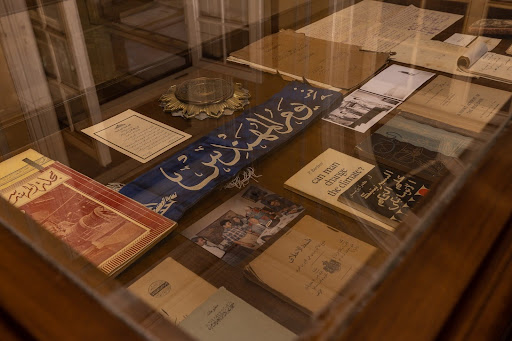
A room that I would call the main hall includes a cabinet placed at the center. It gives the illusion of an overview of the collection’s main themes, like a map legend that visually primes the audience for what will be tackled. The cabinet has a few of Kamal’s pictures, and showcases some of his drawings, personal letters, postcards and book collections. In this room, we learn that we will not only get exposed to Kamal’s political and technical archives but also to his personal interest in Africa, ethics and philosophy.
Yacout’s playful works invite the audience to experience the fragmented, fictional and speculative nature of the textual archive material. On a room floor, she carved sentences from a technical report on moveable tiles, which she changed every day, creating incomprehensible scripts. On a wall, she speculates answers to technical questions on sewage water in Fayoum. How is sewage water distributed? Who distributes it? What does it mean for the sewage water to be distributed slowly? A research-based artist, Yacout entices us to navigate the technical archive without prior expertise in the owner's chosen field — in this case, agriculture, water and irrigation. Everything is written in the obscure, cryptic text often attributed to bureaucrats, which researchers know can only ever mean one thing: you are not a technical expert, therefore you will never fully grasp the technical aspects of governance. As an anthropologist studying bureaucracy, experiencing the mystification of technical work feels relatable.

The High Dam is the elephant in the room — too significant to be left out and too substantial to be fully tackled in light of the exhibition's playful tone. Maghraby’s three pieces address this dilemma. The first is an augmented reality rendering of the dam titled Phantasmagoria, a term borrowed from Walter Benjamin’s Arcades Project, and defined as a series of images in a dream or an illusion. Perhaps the work captures the alienation of the artists from the dam, while tinkering with the possibility of bringing its phantom to life using technological intervention.
The second piece is a video installation that consists of three screens [with pictures of the dam's sections] constantly metamorphosing into unexpected shapes. And the third is a typical sketch of a dam drawing placed in a classic museum cabinet, equipped with a moving magnifying glass. Displayed separately, the pieces initiate a conversation about the dam and its different relations with its body.

But with this recent work, Maghraby hints at another personal detail in Kamal’s life. In his later years, Kamal used this cabinet as his vision deteriorated. The cabinet is a museum display furniture piece par excellence, but it is also a piece of furniture that was originally in the house. What Maghraby did is that he complimented it with new additions to serve its exhibitional purpose.
This methodological direction is manifested in several works. Baraka’s abstract paintings appear stacked in batches, illustrating the process of archiving and mimicking objects in Kamal’s vitrine. Original art pieces found in the apartment are put side-by-side in an installation, resembling a cabinet d’amateur. A damaged bathroom is filled with miniatures of workers, giving the feel of an under-construction, or perhaps a failed sewage project. A collection of the home’s jars is filled with specimens of various minerals labeled with morals and values, showing Kamal’s technical background and interest in philosophy. A recording is playing a technical report by Kamal, narrated by Yacout’s grandfather and featuring unidentified non-human sounds. A kitchen, one of the most intimate spaces in a home, is turned into a strange, unidentifiable place with unfinished drawings and sketches, along with typical utensils. A bed is turned upside down in a corner to reflect the archival experience of moving and cataloging objects and making space. A room is locked to remind the audience of the impossibility of knowing it all.


Youssef and the artists conceptualized the exhibition as site-specific, referring to an interest in creating an experience beyond galleries and museums. Here, art pieces are born out of the space’s material remains and have interrelationships with the specific location in which they are placed.
In the spirit of Kamal’s interest in ethics, the choice of site-specificity, in the curator’s view, is an ethical one. When prompted to reflect on this ethical dimension, Youssef explained that it is so in the sense of “befriending the space, collaborating with the apartment rather than using it simply as an exhibition space…That ethical consideration allowed the artworks to exist humbly in the space as the practice of this project was that of listening.”
Youssef notes that there is an epistemological gap between the artists’ performative approach to the archive as opposed to the factual method. This gap, according to Youssef, was replaced by an ontological one, “to create an ethical exhibition, one where aesthetics serve us in understanding our experience of being in the apartment.”
“More importantly, the ethical quality [of] this exhibition translates to respect for the unknown. If the myth of the archive and the museum is a factual production of truth, here, we foster an ethics of the unknown. Accepting it, with the same humility that the artworks brought with them into the space,” Youssef concludes.
Speaking of the unknown, a pigeon happened upon the site as the artists were working. They decided to keep it and now, there is a pigeon's nest in the bathroom sink. This unintended intrusion contributed to the fantastical feel of the exhibition, but also, its respect for the unknown.
The exhibition carved an afterlife through recorded tours, available on Apexart, which supported the exhibition.
تقارير ذات صلة
Lara Baladi’s Cosmovision
In Cosmovision, Lara Baladi breaks down photography’s cadre into a discursive unfurling of her becoming from 1996 to 2011, autobiographically performing the logic of the white cube. Shown at Tintera,…
In pursuit of filling art-historical cracks: Chafik Charobim and missed opportunities
Hana Elhaddad considers the effectiveness of the retrospective's curatorial framing

On the creative impulse under violence: What is the point of making art during genocide?
Multidisciplinary artist Ash Moniz has turned art-making into aid relief for Gaza
Your support is the only way to ensure independent, progressive journalism survives.
You have a right to access accurate information, be stimulated by innovative and nuanced reporting, and be moved by compelling storytelling. Subscribe now to become part of the growing community of members who help us maintain our editorial independence.
Join us