
On living, dreaming and dying in peace: Huda Lutfi and Bernard Guillot
Huda Lutfi (b. 1948) needs no introduction. A major figure in contemporary Egyptian and Arab art, her work is shown widely internationally. Contemporary art lovers in Cairo may have already seen elements of her mixed media series When Dreams Call for Silence at the American University in Cairo’s Tahrir Cultural Center in 2019. In Quiet Dwellings, an exhibition held at Tintera in Zamalek from April 9 to May 7, Lutfi’s surrealist compositions were brought in visual conversation with spectral images of Cairo by Bernard Guillot (1950–2021), a French photographer who began visiting Egypt regularly in the 1970s. The two artists’ long-standing friendship became the starting point for this rare encounter between their works, staged by curator Lamees Abdelaziz.
Quiet Dwellings was first and foremost an invitation to meditate on death and dreaming, rest and rebirth, in an atmosphere suffused with great peace and tenderness. The exhibition’s title links the notion of home to death, as both artists attempt in their works to imagine ideal places for eternal rest — quiet dwellings that feel familiar before we’ve ever been there. Guillot's passing in 2021 infuses the exhibition with melancholy, although the works on view invite us to contemplate death with serenity, as if we were going through a process of mourning, not only for loved ones, but also for bygone eras and places that persist through representations.

In Guillot's photographs, localities are very specific. The exhibition brings together a selection of black and white images from several of his series. One of them is a tribute to the Maffett Astoria Hotel in Cairo, where he lived from 1977 to 1998, and which he set out to document in anticipation of its imminent demise. The dilapidated building, with its decaying furniture and decrepit walls, appears like a ghostly space.
There are only a few human figures in the photographs: a man, slightly blurred, staggers through a doorway; in another, a woman wrapped in a white sheet sits in bed, her eyes closed. A sleepwalker or a reborn mummy, she too stands on a threshold, between waking and dreaming.
The sense of passage between two worlds, waking and dreaming, is also evoked by the image of a mirror reflecting a staircase, and most strikingly by the recurring motif of doors left open or ajar across several photographs. Doors appear in another series too, shot in the City of the Dead. Whether walled in or fenced off, they admit only architectural shadows, cast in geometric shapes by harsh sunlight.

Some photographs include hand-painted elements that heighten their narrative force by opening onto a fictional field. For example, a picture shows a room of the Sakakini Palace, an Italian-style palace built at the end of the 19th century in the Daher district of Cairo. On the wall, decorated with stucco motifs and floral paintings, overlapping strokes of white paint suggest gushing water. These abstract, nebulous dabs increase the setting’s baroque aspect, while veiling reality with an oneiric screen. Similarly, in an aerial view of the City of the Dead, Guillot paints an imagined watery landscape behind Salah Eddin’s Citadel, framed by a curtain — a playful and dramatic gesture of this mise en scène.
Taken over a very long period, between 1979 and 2012, the photographs exhibited in Quiet Dwellings synthesize visions of Cairo on the scale of two sites that share nothing except their oscillation between life and death. “For years, I would escape the small labyrinth which is the hotel to win the big labyrinth which is the City of the Dead, spread without limit at the junction of the city and the desert. Big cemetery, small cemetery, twenty years were spent in this research, in this aspiration, this ascendance of wall,” wrote Guillot in his book Hotel Maffet Astoria. Le Caire (Ides & Calendes, 1999).
While Cairo is one of Huda Lutfi's recurring themes, her works she presented in this exhibition were far more intimate, inhabiting the city only through their placement alongside Guillot's photographs. The exhibition's scenography paired or grouped the artists’ works in small constellations, often connected by the repetition of a shared motif. For example, the disemboweled armchairs in Maffett Astoria sit alongside Chair (2018), Lutfi’s depiction of a seat contorted to defy the rules of perspective, topped by a pair of high-heeled shoes.
At first glance, When Dreams Call for Silence, of which Chair is a part, departs from the earlier aesthetic of Lutfi's works. It is more introspective, oriented toward the domestic, and marked by a minimal palette in which shades of grey are impregnated with pink. Yet the same “game of bricolage,” as the artist puts it, just as it was in her more overtly political exhibitions Cut and Paste (2013) and Found in Cairo (2003), which helped establish her reputation. In When Dreams Call for Silence, Lutfi manipulates cut-out painted forms and combines visual elements that are a priori unrelated to create highly narrative compositions, sometimes tinged with humour. Carefully looking at these works, it is not always clear whether they evoke a dream or a nightmare. In Crows (2018), black birds perch on boots, encircling a grave suspended among the clouds. In Golden Bed (2018), a woman’s truncated bust strikes a lascivious pose on a wrought-iron bed, while her detached feet emerge from outside the frame.
Throughout the series, interiors and cemeteries blend into one another: “Death is home, and when we sleep at night, we also go home. Deep sleep is going home,” Lutfi says in an interview with Lamees Abdelaziz, referring to her painting Home (2018), in which a topless woman stands out from a tombstone, as if leaning against a headboard.

A certain strangeness pervades the paintings and collages from When Dreams Call for Silence. The artist has said she was reappropriating the formal vocabulary of Surrealism by titling her series after a line by Franco-Egyptian poet Joyce Mansour (1928–1986). By invoking Mansour, Lutfi situates herself within a genealogy of women artists and affirms their enduring presence.

Lutfi has often stated that she walks in the footsteps of figures such as Effat Naghi (1905–1994) with whom she shares a taste for assemblage, dolls and found objects, but also of the German Dadaist Hannah Höch (1889–1978), particularly in relation to collage.
When Dreams Call for Silence also reflects a major preoccupation in Lutfi's work from the outset: the issue of women’s representation. Unlike Guillot's empty spaces, bodies are omnipresent in Lutfi's paintings on show at Tintera. Before becoming an artist, Lutfi was a historian specialising in Arab culture and gender issues. In her teaching and academic work, she sought to foreground women’s role as historical agents, to counter their erasure from dominant narratives — an impulse that would later translate into women occupying a central role in her visual practice. Her very first solo exhibition, Women and Memory (1996, Ewart Gallery, AUC) bore witness to this, as did her early collage, Woman Cut in Half, produced in 1991.
Women’s bodies in Lutfi’s artworks are often fragmented, dismembered, or cut into pieces. In this respect, they are reminiscent of the tortured representations by the Egyptian surrealist group Art et Liberté (جماعة الفن والحرية), active from 1938 to 1948. While her compositions do not exude the same anguish found in the works of Ramses Younan (1913–1966), Amy Nimr (c. 1898–1974) or Fouad Kamel (1919–1973), for example, Lutfi's fragmented bodies are nonetheless shaped by a similar tormenting political moment. Surrealism itself emerged in reaction to the absurdity and violence of the world wars. Lutfi recalls the impact that the United States’ invasion of Iraq in March 2003 had on her exhibition Found in Cairo, which opened shortly afterward and featured installations of mannequins and dolls, some headless or armless. (No to War, 2003).
Incidentally, Lutfi's works often feature legs without bodies, whether as mannequin limbs or or their image reproductions. In Quiet Dwellings, an animated video shows the same pair of legs reproduced several times, moving slowly to the sound of a symphony by Vivaldi, like a symbolic procession. The multiplication of the same shape, combined with the movement’s repetition, lends a meditative quality to the video, resonating with Lutfi’s relationship to Sufism, and her abundant body of works inspired by spirituality. The legs in the animation are taken from a photograph by Guillot of his own body, who granted his friend permission to transform the image into her own. This is not the first time that Lutfi has re-used images, especially legs, produced by other artists. Back in 2003, in Her legs!, a series of hand-painted photographs, she amusingly multiplied dancer Fifi Abdou’s legs cut from a photograph by Youssef Nabil (b. 1972), well-known for his portraits of celebrities from film and show business hand-painted using the technicolour film colouring technique.
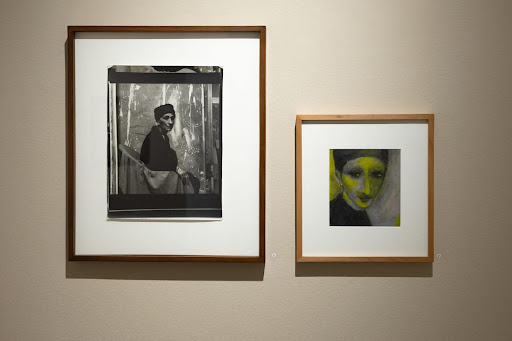
Among the female figures in the Quiet Dwellings exhibition, Guillot's portrait of Huda Lutfi (2017–2019) holds a special place, positioned on a central wall. The artist appears seated three-quarter, her face hollowed out by strong contrasts of light and shadow. “He captured something so bizarre. I can’t stand it,” she laments. Perhaps in an attempt to reconcile herself with the portrait, she reproduced it as a painting several years later. The result, A Younger Self-Image (2025), focuses on the face, rendering it androgynous and unreal, outside of time. It recalls her Dawn Portraits, a series she began in the early 2000s, in which she attempts to capture, through painting, her mood every morning upon waking. More than striving for likeness, Lutfi seeks to capture the fleeting manifestations of her inner life.
Several pieces from Dawn Portraits punctuated Quiet Dwellings, asserting the omnipresence of female subjectivities among the rooms and streets photographed by Guillot. These self-portraits also become a means for Lutfi to probe her own psychic state: the exhibition expresses not only her mourning of Guillot, but also that of her recently deceased mother, whose presence crystallizes from time to time in the exhibition. In Pink Boudoire (2018), we see a portrait of a mother as she sits atop a chair, watching over a group of female heads with her eyes closed. An image of collective rest, the heads seem to be sleeping on the floor, relieved from the weight of their absent bodies.
Lutfi also dedicated two artworks to her mother, highly unusual in their subject matter and medium. Florals (2023), produced during a monotype workshop (a technique then new to her), features organic forms emerging from white and black ink and paint. They suggest flowers that the artist symbolically offers to her departed mother. The stains, lines, and colours resemble Guillot’s painted photographs, so much so that without knowing, it is difficult to tell which of the two artists made these bouquets.
Ultimately, Quiet Dwellings staged a resonant dialogue between Lutfi and Guillot. It is a reunion of two friends and artists, a bricoleur and a photographer, who both combine images and painting in an attempt to capture the passing of time. The exhibition also contributed in raising the profile of the French photographer, whose works are held in museum collections such as the Centre Pompidou and the Bibliothèque Nationale de France (BnF). Tintera complemented the exhibition with the recent publication of the photo book La Cité des morts by Origini Edizioni (Livorno, 2024). Specifically for the exhibition, curator Lamees Abdelaziz has published booklets including extracts from Guillot's texts translated into English by Sarah Sarofim.
As for Lutfi, the infinite gentleness that emanates from the strange, sometimes unsettling representations in her When Dreams Call for Silence series resonates particularly strongly with the current times we find ourselves in. This was echoed in the reception of her exhibition Unraveling — held at almost the same time as Quiet Dwellings, between April 15-June 8 — at The Third Line gallery in Dubai, where she showed additional works from the same series. What lends these pieces their potency today is our urgent need for poetry and spirituality in a world shattered by war. Perhaps it is also the way in which they implicitly reaffirm, in the face of extreme violence, the right to live and die in peace, and the enduring right to dream. While firmly anchored in her own time and society, Lutfi’s work invites us to look inward and engage with her through the fundamentally human experience of mourning, gently prompting reflection on our own finitude.
For despite the palpable absence and underlying anxiety, it was with a profound sense of peace that one left this exhibition.
تقارير ذات صلة
Lara Baladi’s Cosmovision
In Cosmovision, Lara Baladi breaks down photography’s cadre into a discursive unfurling of her becoming from 1996 to 2011, autobiographically performing the logic of the white cube. Shown at Tintera,…
A visitor’s guide to Cairo Design Week after John Berger
For its third and largest edition, the self-proclaimed fastest-growing design week in the region set out to transform Cairo into an “open-air design playground.” Its ambition took physical form: oversized…

On the creative impulse under violence: What is the point of making art during genocide?
Multidisciplinary artist Ash Moniz has turned art-making into aid relief for Gaza
Your support is the only way to ensure independent, progressive journalism survives.
You have a right to access accurate information, be stimulated by innovative and nuanced reporting, and be moved by compelling storytelling. Subscribe now to become part of the growing community of members who help us maintain our editorial independence.
Join us