
Keeping Egypt above the breadline: How has the government strategized to supply wheat during a global shortage?
When Russia launched its offensive on Ukraine in February, the Egyptian government perceived an immediate danger to about two-thirds of its population.
Russian tanks rolled over Ukraine’s wheat fields and warships blockaded its Black Sea ports, in a conflict that looked set to suspend the crucial supply of wheat from two countries on which Egypt, the world’s largest wheat importer, depends for about 80 percent of its annual stocks.
The government supplies those stocks at a subsidized rate to mills, which grind out flour to stock local bakeries to provide cheap loaves of bread to the nearly 70 million people across the country that qualify for social support.
The government first turned to global markets. Days into the Russia-Ukraine conflict, the General Authority for Supply Commodities put out two tenders to global markets still reeling from the shock of Moscow’s assault and offering sky high prices.
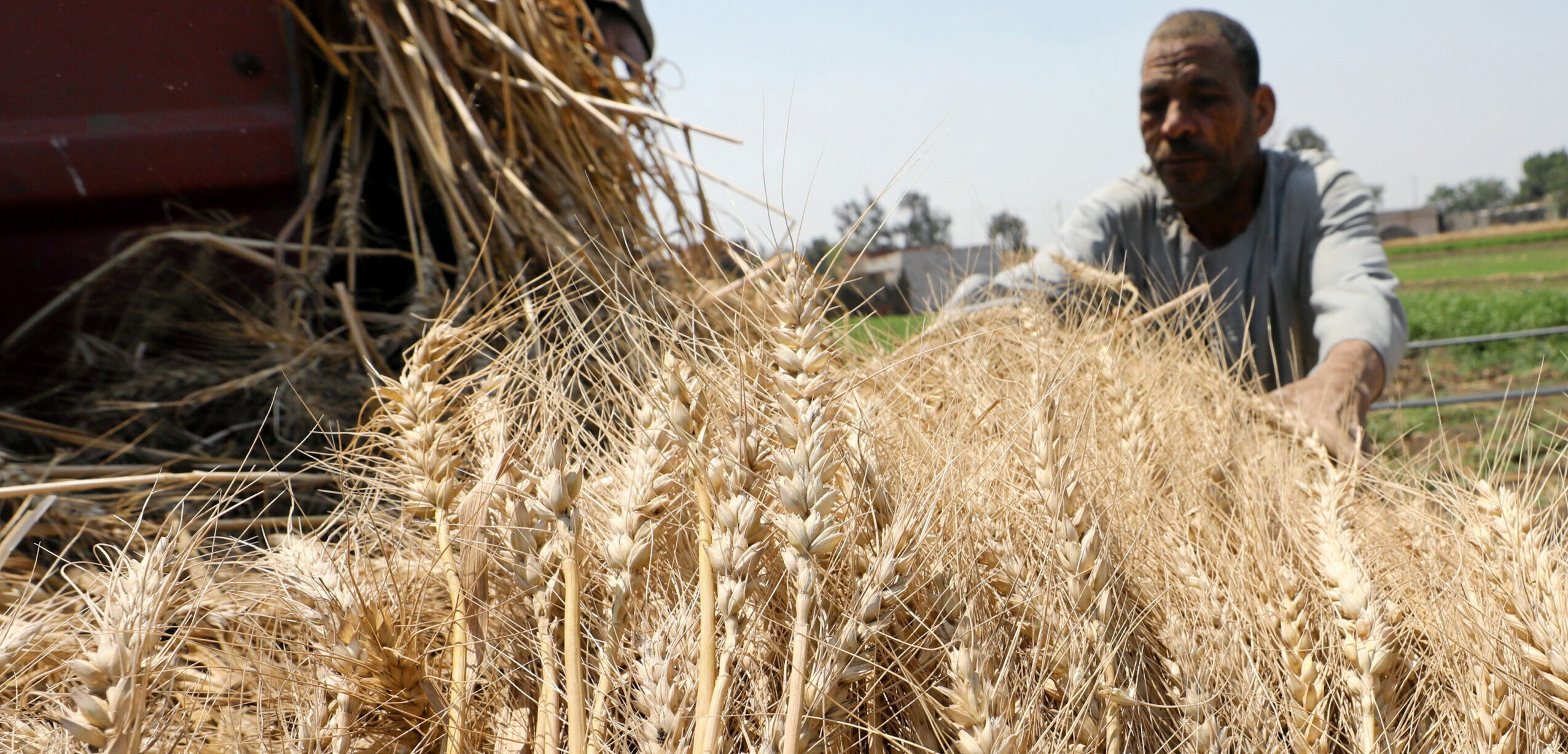
Shortly afterward, it became clear that Egypt would be placing its hopes in the local harvest to bolster stocks of the crop. Supply Minister Ali al-Meselhy told television viewers that the ministry would be procuring 6 million tons of wheat grown by domestic farmers, which the government would gather over the April-to-June harvest season: almost double what the ministry usually collects from the country’s wheat fields each year.
In order to secure such high quantities of wheat from the country’s farmers — who during the sowing season expected to supply only 3.5 million tons of their harvest to the state — the government has resorted to extraordinary measures, including heightened legal action against non-compliers.
Yet, with the crisis dragging on, the supply commodities authority once again issued tenders for further imports in May, in an apparent effort to make up for lower than hoped-for outcomes from the local market.
Why has it been so difficult to procure sufficient quantities at home? In a typical year, the government has first claim over local farmers’ wheat. To ensure it can secure local stocks in the interest of food security, the government normally buys wheat from farmers at a fixed price point, set before the harvest season commences and calibrated to be higher than the average global price in order to incentivize local production and supply. The private sector is, in theory, permitted only to purchase the remainder of local stocks.
Since incentivization makes local stocks costly, the government bought only 3.5 million tons from local farmers in 2021, less than half of the 9 million-ton total it procured to supply bakeries. The remainder was imported from global markets.
Yet, very shortly after Russia’s invasion, global wheat prices soared by as much as 48 percent. As a result of the surge, costs for importing wheat from abroad were all but prohibitively high. But on top of that, the price point the government had set for its procurement of local wheat was suddenly meager compared to what farmers could get if they sold to private buyers.
Dynamics in the domestic market were disrupted as a result. Last year, “there was no need for the private sector to enter the game and outbid the government [in the local market],” said a wheat import company source speaking to Mada Masr on condition of anonymity. “It was cheaper for them simply to buy imported wheat. This year, it’s different. Local wheat is cheaper than imported wheat, so naturally, the private sector wants to get in on the game.”
The Supply Ministry pushed up its procurement prices to incentivize harvest-time delivery, offering farmers LE5,800 per ton (currently around US$310). Yet, ongoing inflation saw prices leap to LE9,000 per ton (currently around $481) outside of Egypt. Domestic farmers also saw production costs rise, with agricultural inputs such as animal feed and yellow corn also subject to inflationary pressure.
Alongside the carrot, the ministry also proffered a stick. A raft of new regulations obliged farmers, for the first time in 12 years, to supply to the government around 60 percent of their crop: a minimum of 12 ardebs per feddan of land. Failure to comply would incur punishment: farmers would no longer receive government-subsidized fertilizers. And those caught selling wheat to the private sector without a pre-authorized license to do so would be subject to new penalties, including imprisonment.
Behind the scenes, security agencies also approached local wheat traders, who are usually in charge of collecting the harvest, urging them to gather as much wheat as they possibly could and reminding them that, this year, their work is a “patriotic duty,” according to two sources involved in the harvest who spoke with Mada Masr on condition of anonymity.
Since the start of the harvest, the government embarked upon a series of educational seminars to inform farmers of the imperative to supply their crops to the government.
“We don’t hear a word from this agricultural cooperative all year. We’ve been begging them to organize more educational seminars on improving farming practices to deal with climate change, which ruins crops for us every season. Now they’ve decided to show up and they’ve drowned us in seminars on handing over wheat,” said Salah Abdel Aty, a farmer from Kafr al-Sheikh.
Then, in early May, the government turned to threats. Using land ownership records kept at local agricultural associations, reports were filed under a police division tasked with investigating the subsidies sector, three association sources previously told Mada Masr.
At least 41 arrests were made on the grounds that the individuals in question had violated the government decree regulating wheat distribution and had supplied non-governmental entities with wheat. The Public Prosecution released all 41 pending trial for the charges, issued warrants for 30 others it could not locate and ordered that seized wheat in 80 documented incidents be transferred directly to silos run by the Egyptian Holding Company for Silos and Storage.
And most recently, a new June 4 ministerial directive, of which Mada Masr reviewed a copy, said the ministry would task committees in the governorates with surveying wheat farms in order to compare their total output to the quantity they supplied to the government since harvest began in April. They would then either order anyone found to have delivered less than 60 percent of their crop to pay compensation worth LE1,770 per ardeb of undelivered wheat, or would take legal action.
Regardless, a stream of news reports continues to document incidents of locally grown wheat being smuggled onto the black market, bound for privately owned mills. Experts in the sector told Mada Masr that the outlook for local procurement is unlikely to meet the government’s 6-million-ton target.
One month into the harvest, only 250,000 tons had been collected, down almost 77 percent on the amount gathered in the same period last year. By June 8, over 3.7 million tons were in the state’s silos, according to comments by Meselhy.
The import company source anticipated that, “taking into account the measures to force farmers to hand over wheat, coupled with a good harvest season, the government could acquire at least 4 million tons this year.”
Though Meselhy reassured journalists in mid-May that “abundance is at hand,” referring to the supply of locally sourced wheat and his assertion that Egypt would "not need to import wheat right now," his ministry nevertheless removed restrictions on the government mills that supply subsidized flour to bakeries, allowing them to use Egyptian wheat from the ongoing harvest to meet up to 40 percent of their demand. Normally, mills can only buy Egyptian wheat once the harvest is over.
“If they’ve resorted to this measure, it means strategic reserves have plummeted,” according to a source from the private mill sector who spoke to Mada Masr on condition of anonymity. Allowing mills to use Egyptian wheat while the harvest is ongoing makes it much easier to cheat the system, the source said. “Quantities are just written on paper, but the wheat will end up being sold on the black market.”
Accordingly, and just days after Meselhy’s reassurances, the supply commodities authority issued a tender for unlimited quantities of wheat from the global market, purchasing nearly 500,000 tons at around $480 per ton from Romania, Bulgaria and Russia.
And with domestic agriculture unable to provide a long-term solution, the government is also making contingency plans, attempting to diversify its certified countries of origin for wheat imports.
According to data released by the Central Administration of Plant Quarantine and reviewed by Mada Masr, Egypt currently accepts wheat imports from 22 countries, that include expensive, high-quality French wheat; expensive and distant American and Australian wheat with high transportation costs; cheaper wheat of lower quality from faraway destinations such as Brazil; or intermediate quality crops from nearby areas in Eastern Europe that are currently facing supply issues due to the Russia-Ukraine war.
To allow for additional countries to be added, the Trade and Industry Ministry raised the percentage of permissible moisture level for imported wheat on May 23 from 13.5 percent to 14 percent, according to a Supply Ministry document of which Mada Masr viewed a copy. Higher moisture content produces lower yields of flour, usually of inferior quality and more vulnerable to rot and spoilage.
With initial attempts to procure substantial quantities from India apparently dead in the water, the government is now working to add Mexico and Pakistan to its list of suppliers. But sources in the grains sector are skeptical of how much the approvals will help the situation. Wheat importer Hesham Suleiman tells Mada Masr, “Pakistani wheat is of inferior quality, even worse than Indian wheat, and Mexico is really far away, so transit costs would be very high, and its wheat is also of low quality.”

تقارير ذات صلة

Devaluation drama and hot money’s return: What happened with the pound’s historic plummet?
'As long as there is more demand than supply, the price of the pound will continue to decrease.'
Why is Egypt not on the IMF’s December public agenda?
Measures taken by Egypt in recent weeks have not been enough to push the deal across the finish line

What’s behind Egypt’s green hydrogen hype?
Many voices caution about the feasibility of establishing a national industry for the product
Your support is the only way to ensure independent, progressive journalism survives.
You have a right to access accurate information, be stimulated by innovative and nuanced reporting, and be moved by compelling storytelling. Subscribe now to become part of the growing community of members who help us maintain our editorial independence.
Join us