
January 25 lived by teenagers
We are Wizza and Inaam Hanim, two Egyptians who belong to a young generation that witnessed Egypt’s 2011 revolution from behind TV screens. The uprising is a movement that sprouted in our hearts, but whose promises, like dangling fruits, are yet to be reaped. Some would say we are just homesick. We would say whoever loves freedom must be constantly homesick.

Wizza: I was 13 when the revolution happened. I experienced big change, lived two years in moments of some sort of freedom. But in 2016, the mere existence of this freedom was denied. It was a moment when every good change in Egypt seemed unattainable. I held on to the fact that violence and suppression of freedom are insufferable. I was 18. I realized that I could not take it anymore. The decision to leave was a matter of life and death. I recall my body urging me to leave, and I left to Europe, shaken. I carried many questions, and lacked the energy to answer them. I was simply exhausted from all the violence. I came here and started trying to survive.
Inaam: I was preparing to leave Egypt at the revolution’s fourth anniversary. I left Egypt behind, full of hope that everything is possible. Tahrir said so, and so it would be.
European cities, as destinations, hold many promises. Amro Ali, professor of sociology, writes about arriving in Europe: “(...) where the newly-arrived Arab suddenly (but not always) recognizes that the frightful habit of glancing over the shoulder — painfully inherited from back home — gradually recedes.”
But what about glancing repeatedly at what one has left behind? That does not recede.
Wizza: Whenever I went back to Egypt, I would resume the life I left behind in 2015. I would feel baffled, unable to move on, as though time stopped.
“[The revolution] is vacuumed out of my head, I don’t think about it.”
Ibrahim, 25.
Inaam: I want to understand where memory resides; where to look when the whereabouts is either nowhere, or morphs into a make-believe place. But memory is faithful, it preserves itself beyond our own capacity to comprehend. I think memory is like bechamel too. Stirring the stuff of memory, on medium heat, often ends up thickening it. Not stirring enough will end up clogging it, rendering it clumpy, unmoored. We became aware, however, that memory could turn into a heavy laundry bag as well; too heavy a luggage to drag around, labeled nostalgia to despair.

Wizza: When I am in Egypt and would want to talk about the revolution, I would have to meet up with some friends in Cairo in the privacy of their homes, or I had to bring it up randomly with family members I trusted. Some would take it well, and look at it as a holy thing, and others would avoid it. There’s also a group that tends to believe that everything is a continuation of this past moment.
The urge to relive past glories quenches a human thirst within us, but the clock ticks on, and we are meant to tick along. Too often we’d be engulfed with sadness about Tahrir; the democratic breeze sweeping across the country. We tried to break the curse of ritualized nostalgia, we tried to break free from the ceremonial vivacity of the revolutionary moment; the triumph, the euphoria that rushed through our bodies as it was announced that President Hosni Mubarak was stepping down.
Wizza: Next to people glorifying the revolution, I noticed that, at the same time, my youngest sister Rana, who was five during that time, was developing severe anxiety. It must have been a result of growing up in the aftermath of a revolution that she did not know much about. I experienced her anxiety firsthand when we were a few years older. In 2021, we were taking a walk to downtown, near Tahrir Square. Naturally, around the area, I became careful with what we discussed and what we were doing in general. Rana, on the other hand, would scream her thoughts, unconcerned. She shouted, full of rage, with tears in her eyes: “aren’t we living in a free country; can’t we say what we want?” as if she were asking for help, or validation. I laughed a little anxiously because I could not justify my fear viscerally to her. Brushing it off, we said we can’t talk about this now. In my head I thought, where would we start? Do I have to sit her down and explain to her everything that has happened since 2011? And do I, the one who left Egypt, want to delude someone who has no other choice but to stay? At that instance, I understood the root of her anxiety.
What is the root of this anxiety and what might we, as teenagers of the 2011 revolution, still be carrying with us? Personal traits or failure, like lacking energy, perplexity or difficulty finding words, were symptoms of the big bang that erupted earlier in our lives.
“Sometimes when [the world] becomes so unbearable to the point where it’s hard to understand, you just stop trying.”
Ibrahim, 25.
It appears that some bewildering fog blinded many of us, as though a smoke machine was in play. Both the fogginess and scarcity of words drew us back to the revolution’s orbit.

Inaam: You called me one day: “let’s make our project happen, we can say whatever we wish to.” It seemed like a new possibility to have a conversation with a new generation, who, just like us, vividly remember something of that event. The event. Akin to the Chinese whisper game, where you whisper words swiftly in your neighbor’s ear and wait for the word to come back, I was curious what was left of the revolution. What does this younger generation know or remember? What have they heard of it amidst the mainstream’s loud cacophony? I was 14 and I remember a lot. What do those who were nine remember? Not only are prior places of assembly completely refurbished, but also many faces are behind bars, or behind borders. Where do we go to remember? Revolution is like a faint careless whisper from a past future. We wanted to listen in, what does she have to say after all? We wanted to explore the invisible remains of the revolution; how its impact lives on within and between us.
Wizza: When I went to Egypt in October 2023, amidst the news coming from Palestine, working on this project seemed out of place. And it was O. who awakened a sense of urgency within me. You must do it, he said. “All my generation — the generation of the revolution — is desperate thinking we are just a failure. You are touching on something important with this question of the invisible remains and impact of the revolution.”
With that momentum, I interviewed people in my vicinity. People were connecting me with others outside our circles. It was trust that kept us in a tight knitted network. I interviewed seven young people. My questions orbited around their memories, their affective associations with the revolution, whether they could find traces of the revolution today and how they see the future.
I spoke with Salma first, now 23. Salma and I met in my family’s house, a privilege since we’re both relatives and call the same village home. We locked the door, sat on the bed and made sure nobody could eavesdrop from the outside. I was flabbergasted to find out that Salma often went with a friend to the protests, and waited on the side until her friend was done chanting. In 2012, upon the death of a neighbor, she attended a protest in our village. I had frankly thought I was the person most attached to the revolution. I thought I was the bravest of the family. I migrated, broke a lot of rules, and, in a way, led a life completely different from the rest of my family. I guess I was wrong. The revolution inspires all of us in different ways.
Salma kept repeating: “the revolution is coming.” She said it assertively, and, simultaneously, in a relaxed way. I pictured all the images of what a revolution in our village would look like. The image burdened me. Her insistence reminded me of what Z. told me about Hannah Arendt’s theory of the sense of possibility; if people experience big change, they are more likely to believe it is going to happen again.
Inaam: As I listened through the interviews, I could feel a sense of familiarity in most of what was said: the fuss in the house people felt, their parents’ sense of anticipation, their confusion about who’s who. I remember being on the other end of the telephone line, with an uncle who mocked the protestors in Tahrir: “(..) the meals the protestors received from KFC must’ve been enough of a motivation to stay at the midan, no?” Kentucky Fried Chicken became a symbol for foreign meddling in Egypt, speaking English, and merely being youthful. The young were guilty until proven otherwise. My mum would storm my room and ask, in the plural form: “What do you all want? I want to understand.” I and we and you are now one and the same. I feel a pit in my stomach when I talk about this.
Wizza: I realized when I mention the revolution, people only think about 2011, which is usually a stalemate to our conversation. My interview with Ibrahim was especially painful. When I told him about the research, he was so happy. I was surprised, as he seems cynical to me. Thirty minutes in, the conversation turned bleak. His sadness and cynicism bore something of the current political and economic situation of Egypt. I have to explain that I mean the events that followed 2011, too. Only then, Ibrahim started to say more. He is an artist from a middle-class family, gifted with the ability to visualize things even in his words. I could see his pain in front of me.
“When people get killed, it is not like in movies, [the camera doesn’t] zoom on their faces. They just fall on the sideways.”
My head started buzzing. The sentence: “I don’t want to die this death” rushed through my head. I was scared, my body was hurting. Fear took over and it felt like with his words, the walls were dissolving and the memories and images of another uprising were visible in the background. I was in a flat alone in Cairo, and I thought: Oh my God, I might be attacked should it happen again. I felt a sense of insecurity, and although I despise the current situation in Egypt to the core, I was afraid of the damage it will take for it to change.”
Inaam: I had a similar realization as yours. We were nostalgic. In many ways we had romanticized this past moment. It was, though, not just a poetic adherence to a bygone moment that captivated us, there were also real, substantial, visceral concerns about our own security. A word heard on the streets of our exile city, ringing too familiar to the sound of home, and my heart would palpitate, racing to the nearest exit. We’d be a Mediterranean away, but trembling from news about disappearance, displacement, incarceration, threats to family and friends. All the scary stuff sifted down to a misunderstanding of a word, a deed, a photo taken in the wrong place, at the wrong time. Oh, how I wish I could reason with you, my love, my Egypt, even if you tread around me with suspicion.
Wizza: Sometimes, I would be paralyzed for days on end. One time I was editing the interview with Ibrahim next to my lover, and I had to stop working because I became too restless. “We have to talk,” I said. They often tell me that I’m holding back. In the past, I used to try to explain to them where I, an Egyptian living in exile, was coming from and what shaped me. The events since 2011 are a big part of that. Sometimes when I think about it, I imagine an explosion. Yet I was still clueless about its impact on me. I would hold my lover, urge them to listen to Ibrahim, to say: “Look, I am still speechless about it, but this person is saying something that would help you understand more of me.”
Sometimes, in the face of novel circumstances, we become wordless. The silence is especially mute after we had a mouthful of words before, once upon a revolution. Ibrahim encapsulates this, recalling a statement he heard from a friend: “all those mindless animals are speaking about politics now, even you!”
As though the Nile carrying silt from the south, blossoming into a lotus, pouring into the sea, the uprising’s stream rushed. Language flowed, we gathered like beasts to drink, our lisped tongues swayed with words, with swear words, with melodic chants. The revolution is a time when volcanoes of speech erupt. Everyone speaks to everyone, to themselves, to the city. Haytham al-Wardani, the Berlin-based writer, explores in his untranslated book Jackals and the lost letters, when animals speak in fables: “it was in Kalila Wa Dimna that animals first spoke fluently, in Arabic, and their conversations came against the background of the social and political conflicts of the 19th century, with the Arabic language constituting one of its crucial fronts.” We, too, discovered political discourse during the revolution, a time of social upheaval.

Inaam: When dark times loom, and we feel the urgency of finding a solution, we, Egyptians, say: “even lifeless bricks would speak.” I think that’s why my vocabulary grew at the time. I remember appropriating words such as: cartoonish, deep state, ancient regime, ultimatum, arbitrary, technocratic. I realized now that we, as different generations, are linked. Music, poetry, vivid memories connect us. Oral history and feelings reach out in synapses toward a layered present, we all share. We excavate, questions overrun us, but we never run out of questions.
Feelings truly leave trails behind them. By following and tracing feelings we yielded information about the future.
Wizza: Even strange feelings can be a vehicle to do brave things. When I met Ahmad at a bookstore, I overheard him speak about taking part in a demonstration. He insistently asked another person roaming around the bookshelves to update him on “what happened on the streets today?” Alarmed, the person denied involvement, but I was eager to hear more then. Later, after a couple more visits to his bookstore, I invited Ahmad home. We sat on the sofa by the balcony, looking over the Nile. It was a dusty day, and I was preparing to leave Egypt, thinking it was risky to interview someone I did not know so well.
Ahmad sees the generation of the revolution as hopeless. His pessimism is his impetus, however. Listening to someone speak poorly of the revolution was challenging. I managed to put myself in his shoes, though, and accepting his despair as a reaction to a revolution that did not last long, is also okay. “I’ll be full of regret if I missed another chance to be part of change,” he alluded to his fear of missing out, one igniting his curiosity around the current minimal political room available in Egypt’s constipated political climate.

Perhaps the thrust of revolutions obscures the slow but steady stream of all the branching creeks flowing toward the ocean. Still, water is destined to slow down at the estuary. At this backdrop other organisms are conspiring day and night to warrant themselves a place under the ebb of flow of clouds. Take Sylvia Plath’s mushrooms, how they erect, mushrooming out of the soil, out of the blue. Nobody predicts their rising before they pop out of the crevices and crannies.
“The mushrooms have started to grow, tomorrow we inherit the earth.”
Tayf, Mashrou’ Leila

Upon launching this project, we gathered our gadgets, collected our thoughts, asked here and there. We realized that by now, after eight years of migration, we have a treasure; a network of people empowering us with studios, microphones, art, theory, edits, words, they even lent us their voices. Truly, the I and the You and the We are sometimes one and the same.
تقارير ذات صلة
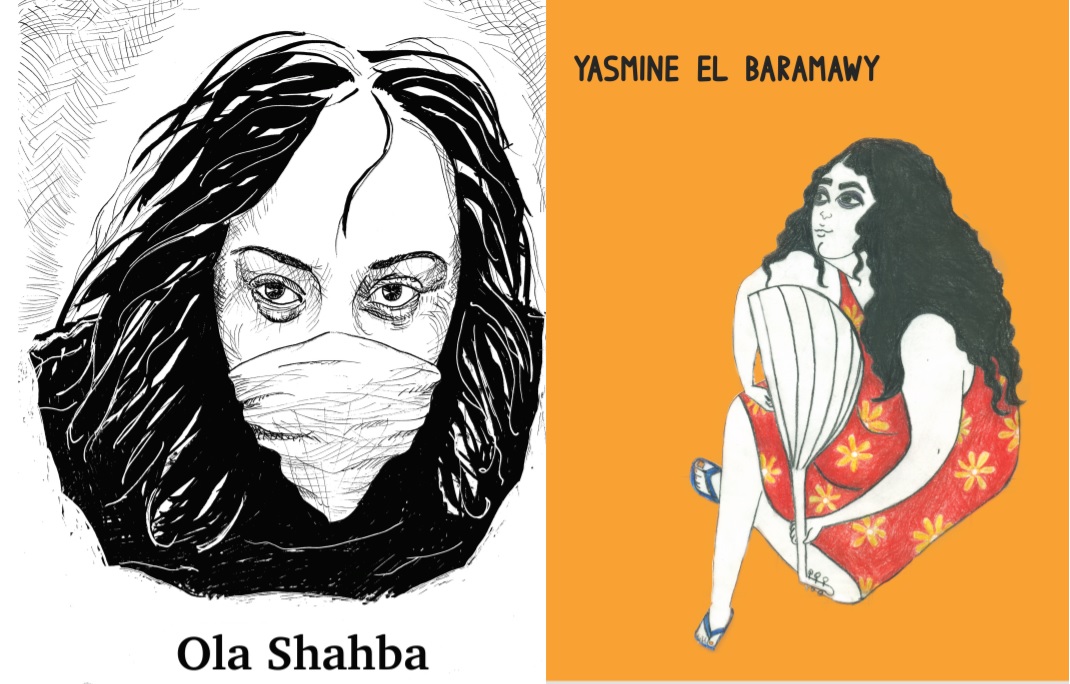
Stories from the Egyptian revolution: Ola Shahba and Yasmine El Baramawy
The comics express the anger and betrayal the women felt, especially toward revolutionary friends.
From NDP to PDN
The message needs to be “blatant and intense.”

Clubhouse: What’s the story?
The live and direct engagement on Clubhouse makes it fertile ground for the unexpected.
Your support is the only way to ensure independent, progressive journalism survives.
You have a right to access accurate information, be stimulated by innovative and nuanced reporting, and be moved by compelling storytelling. Subscribe now to become part of the growing community of members who help us maintain our editorial independence.
Join us