
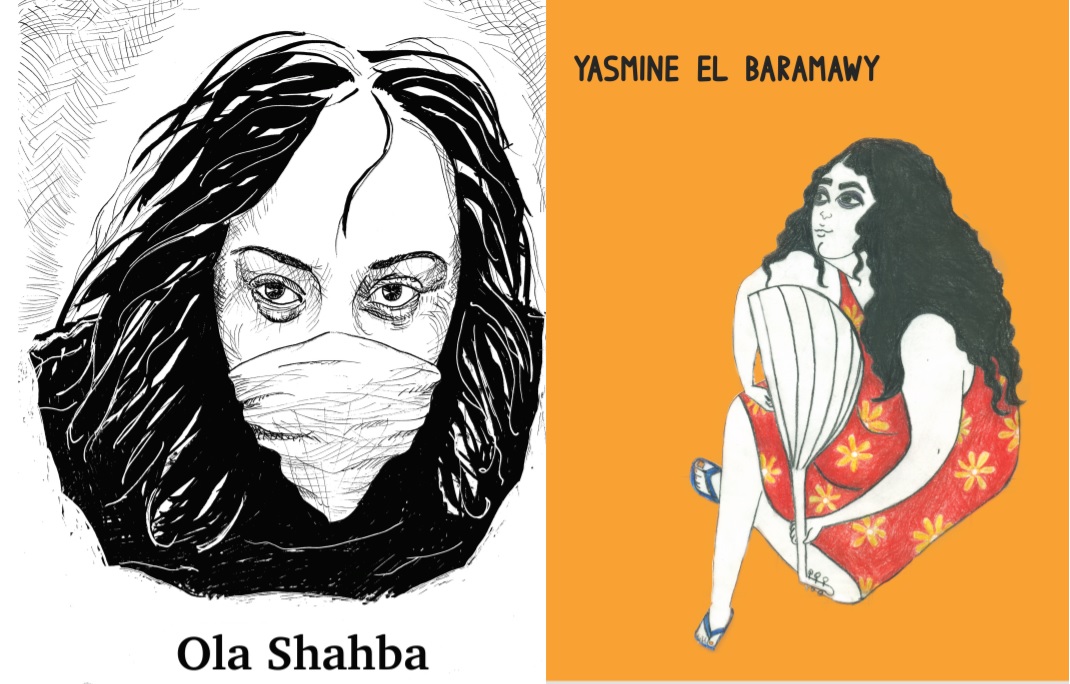
Stories from the Egyptian revolution: Ola Shahba and Yasmine El Baramawy
Editor’s Note
* The comics contain explicit depictions of sexual violence
With every anniversary of the January 25 revolution, we see articles and posts that include nostalgia and bitterness, and pose questions about what we can learn. Which parts of this history do we put forward for public discussion? And which are we still unable to reckon with?
This year, we publish comics based on the testimonies of two women who were sexually assaulted at protests in late 2012 and spoke out about it at the time, insisting that revolutionary movements confront a form of violence that many wanted to deny.
[pdf-embedder url="https://www.madamasr.com/wp-content/uploads/2022/01/18-06-26_1-copy.pdf" title="18 06 26_1 copy"]
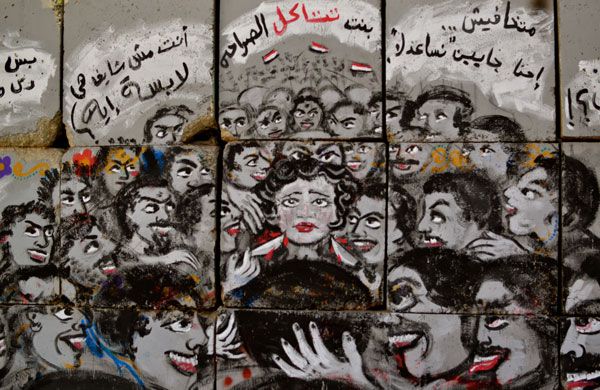
A large and violent mob beat and raped musician and activist Yasmine El Baramawy in late November 2012 in the vicinity of Tahrir Square. Just a few days later, long-time activist and anthropologist Ola Shahba was beaten, sexually assaulted and detained by Muslim Brotherhood supporters outside the presidential palace. Through testimonies and the work of journalists, rights organizations and civil resistance groups, we know that hundreds of other women were attacked in similar ways between November 2012 and July 2013. Women were encircled, beaten, stripped of their clothes, and raped, sometimes while surrounded by crowds of hundreds of people who were fighting, pickpocketing, filming on their phones, joining in the assault, or trying to save the woman or women being attacked.
The project, suggested by Baramawy, was coordinated by Manal Hamzeh, a gender and sexuality studies professor at New Mexico State University, who included Shahba and Baramawy’s testimonies in her book, Women Resisting Sexual Violence and the Egyptian Revolution: Arab Feminist Testimonies. She describes the larger project as building with Chicana epistemologies by centering testimonies, which, in moments of collective struggle, “are used not only to speak the truth, but rather to tell ‘an account from an individual point of view whose consciousness has led to an analysis of the experience as a shared component of oppression.’” In the context of the revolution, women’s testimonies of sexual assault, which Hamzeh places within the history of women's involvement in Egypt’s “continuous revolutions,” were a political tool used to raise consciousness and bring about change.
The women in this project see the mob sexual assaults as both a political tactic intended to deter women from protesting and one of many manifestations of socially endemic gender violence. “We hope to bring the reader face to face with what happened, and our expectations at the time. We didn’t expect this from men who were not in uniform,” Shahba said in a conversation Mada Masr moderated in late 2021.
Baramawy and Shahba’s testimonies were illustrated by Salma El Tarzi and Rim Naguib in 2017 and 2018, and the comics are published here for the first time. The women undertook a collaborative work process, speaking about their experiences for hours, and going over drafts of the drawings together. When violence against women is so often rendered and perceived as sexually exciting, one of their major concerns was how to avoid being titillating without censoring the details of Shahba and Baramawy’s experiences. “Of course, there’s only so much we can do there, and we can’t control what’s already in people’s heads,” Tarzi says. Tarzi, whose comics are a collage intended to show different textures and depth when printed, used color in the parts showing her and Baramawy talking about the attack. In the panels showing the attack itself, color is mostly absent. Naguib’s drawings of Shahba are in black and white. Like manga, the Arabic and English versions are read from right to left.
Shahba and Baramawy each saw themselves as political actors who were committed to the revolution and continued to be so after their attacks. The comics express the anger and betrayal the women said they felt especially toward revolutionary friends and comrades who asked them not to go public about their experiences of violence in order to preserve the image of Tahrir. “If the men attacking us were uniformed,” Baramawy says, “our [supposed allies] would have spoken out about it the next day. It’s very clear how this would have been politicized.”
Baramawy, Shahba and many other women who spoke out online and on television shows contributed to a wave of mobilization that included civilian groups like Operation Anti-Sexual Harassment/Assault (OpAntiSH) and Tahrir Bodyguards, which organized intervention squads to physically pull women out of attacks, help them get to a safe place and provide medical or legal services if needed.
[pdf-embedder url="https://www.madamasr.com/wp-content/uploads/2022/01/Ola_English_1.pdf"]
That moment of Egypt’s feminist history has much to share with more recent movements around sexual violence, especially about confronting the stacked costs of speaking out and then being disbelieved, and of shattering the stereotypes people look for in rape victims. “I went on television hours after my attack, and I remember one woman saying she didn’t believe me because I was speaking too calmly,” Shahba says.
“She didn’t believe you, even with bruises on your face?” Baramawy asks.
Among those who mark the memory of the revolution and its wounds and sacrifices, “there’s no memory of these attacks or the organization against them,” says Tarzi, who helped organize OpAntiSH and was herself assaulted by a mob while trying to save other women in Tahrir in 2013.
With the drawings, Hamzeh says, “We, as a collective, hope to offer their testimonies in a more lasting and accessible form and to elevate the revolutionary struggles of women in the January revolution. We also hope to sustain their experiences in the collective memories of Egyptians, Arabs, and those struggling for dignity, justice, and freedom. I also hope that soon, the drawings can be exhibited and discussed as stand-alone artworks as well as be published in several languages.”
To read the comics:
Yasmine El Baramawy, drawn by Salma El Tarzi
https://issuu.com/madamasr/docs/yasmine_english/16?fr=sZTAxZTQ2MDYzMjc
Ola Shahba, drawn by Rim Naguib
https://issuu.com/madamasr/docs/ola_english/16?fr=sMDNhNjQ2MDYzMjc
Graphic representation is published courtesy of Manal Hamzeh

تقارير ذات صلة
On sexual violence – Feminist testimonies from Egypt
Progress on sexual violence seems a beautiful success story, but reality was complicated and painful
Tahrir sexual assault survivors recount their ordeals
Sara’s* 11-year-old daughter still won’t wear the clothes or bag she had on that night, on June 8, when her and her mother were grabbed and assaulted by mobs of young…
Sexual assault and the state: A history of violence
This article contains strong language and graphic sexual content. Hend (not her real name), an outspoken political activist, is used to being watched and threatened. She rose to prominence during…
Your support is the only way to ensure independent, progressive journalism survives.
You have a right to access accurate information, be stimulated by innovative and nuanced reporting, and be moved by compelling storytelling. Subscribe now to become part of the growing community of members who help us maintain our editorial independence.
Join us