
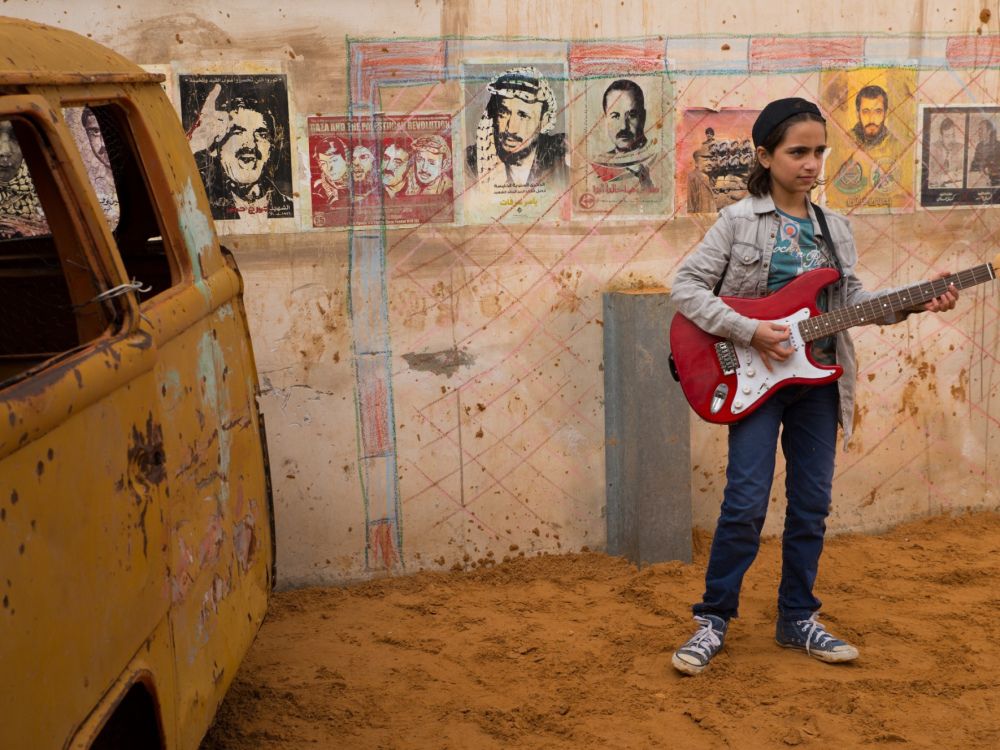
Hany Abu-Assad creates a fictional gem about the Palestinian Arab Idol winner
Children cycle around Gaza in a picturesque shot before sunset in 2005. Rundown — but not yet war-torn — buildings contrast with the Mediterranean blue and farmland greenery. Laughter and music fills the air, then the sound suddenly cuts to perfect silence when they're confronted by a long, barbed-wire fence.
This scene sets the tone for Palestinian director Hany Abu-Assad's latest feature film, Ya Teir al-Tayer (The Idol), which premiered at the Toronto Film Festival in September and showed in Palestine and Jordan last week. It won the audience award at Dubai and is the first runner-up for the audience award in Rotterdam, with an audience rating averaging 4.5 out of 5.
The film recounts a largely true story — some details have been altered for dramatic purposes — of how Gazan wedding singer Mohamed Assaf won the second season of the live competitive TV show Arab Idol in 2013, thus becoming a symbol of Palestinian cultural resistance and unity.
Abu-Assad is no stranger to the international cinema landscape, with two Oscar nominations under his belt for Paradise Now (2005) and Omar (2013), which also won the Cannes Un Certain Regard jury prize. But while his past works centered on suicide bombers and young people falling victim to the crimes of Israeli occupation, his new film is a story of hope coming out of siege.
While this could be a perfect recipe for a commercially successful artistic failure, Abu-Assad and his crew stay clear of most potential pitfalls — such as melodramatic dialogue or over-the-top acting — to create a thoughtful, inspiring story of overcoming fear and empowerment through art.
Reminiscent of the rags-to-riches tale of Danny Boyle's 2008 award-winning Slumdog Millionaire, The Idol is more complex, because the blockade on Gaza is a larger obstacle than Assaf's economic background. It also reminds me of several Abdel Halim Hafez films from the 1950s about a talented but poverty-stricken singer who makes it big despite incredible hurdles. Indeed, Assaf sang several Halim songs on Arab Idol (and in the film), so Abu-Assad clearly draws parallels with those films, paying homage to the late singer in the process.
But in its knowledge of the impact this season of Arab Idol, an essentially commercial show that arguably exploits young talent to make big money for television corporations, has had on Palestine and the Arab world (which eagerly followed Assaf's rise to the top), The Idol does not over-romanticize the potentially clichéd narrative.
The film rests on the compelling performances of its child actors, all of whom were cast from Gaza, as a large portion of the tale focuses on Assaf's childhood. It starts with Assaf (Qais Atallah) at age 10, when he, two friends and his tomboy sister (Heba Atallah, who really steals the show with her witty, knowing yet endearing acting) start a band, dreaming of performing at the Cairo Opera House.
In one hilarious sequence, the kids sing on the street with makeshift instruments made of household appliances and a neighbor dumps a bucket of water over their heads. The children start to work as street and beach vendors to raise money to buy real musical equipment from a smuggler (the only option, due to the Israeli blockade), but get duped.
Yet they clear hurdle after hurdle. Assaf, the band’s lead singer, lives in fear and wants to play by the rules while his sister Nour — who is also his best friend and biggest supporter — pushes for more ambitious dreams.
“We'll grow up and change the world,” they declare at the top of their voices, at her insistence, when Assaf is feeling down. The siblings recite this line over and over in a poetic sequence as the camera zooms out from their room in jump cuts to their house, then to the city, and in each new image their voices increase in volume yet simultaneously get drowned out by the general hubbub.
Nour is thus a central character. She pushes Assaf to believe in himself and get his voice heard, and continues to do so when the film jumps forward to young adulthood, for which Assaf is played by Tawfik Barhom (who has a convincing gravity, though it’s hard to compete with the child actor's charm). From a hopeful childhood to a tough, restricted life after two Israeli air strikes, Assaf is lonely, trapped and seeking a way out to pursue his passion.
To make it to the Arab Idol auditions in Cairo, which he saw on television, Assaf has to make money for his journey, obtain a fake Egyptian visa and smuggle himself through the Hamas-controlled borders. Once in Cairo, he’s too late to get a ticket and has to sneak his way into the auditions.
Even though we know Assaf does make it onto the show, suspense builds regardless thanks to the film's tight editing and script (co-written by Abu-Assad and Sameh Zoabi). It was a good choice to keep the film centered on how Assaf got on Arab Idol, rather than on the show itself, which allows it to subtly communicate the difficulties of living in war-torn Gaza and to examine Assaf's character and insecurities.
Another decision that gives depth to Assaf's story is the focus on his struggle with the media and public attention. He simply wanted to be a singer, yet all of a sudden he is pressured from all sides to be a symbol of Palestine and a voice of Palestinans' collective dreams. He takes on this burden even though, in the film at least, he's not a proactive character and needed to be pushed to stardom.
Music naturally plays a large role in the film, from the children’s street performances all the way to Arab Idol. There’s a mixture of Arabic classics by Fairouz and Halim as well as Palestinian resistance songs, and at points Abu-Assad cuts real footage of the show and its avid viewers into the fiction he’s created to great effect.
All in all, The Idol is a well-crafted, beguiling film that approaches the Palestinian plight with hope and graceful creativity. Set to release at Zawya and other screens in Egypt soon, it's sure to score big both critically and commercially.

Rowan El Shimi
Rowan El Shimi is a culture journalist from Cairo, but she often finds herself working on stories all over the country, especially Alexandria. She covers a range of topics in culture, mostly…
تقارير ذات صلة

Unworkshoppable cinema: A visit to the 11th Cairo Video Festival
Recently, I finally got to see Payal Kapadia’s All We Imagine as Light (2024), winner of the Cannes Grand Prix. I was lucky to experience it in a theater and…
The thin thread between misogyny and emancipation
Faten Hamama gives a rare, realistic portrayal of the frustration experienced by women in Egypt
Detox | No drama
#31: Without the drama, though — both on-screen and in all our lives — what's left to explore?
Your support is the only way to ensure independent, progressive journalism survives.
You have a right to access accurate information, be stimulated by innovative and nuanced reporting, and be moved by compelling storytelling. Subscribe now to become part of the growing community of members who help us maintain our editorial independence.
Join us