
Gourmet: How a high-end food retailer is helping reshape Egypt’s supermarket industry
A few months ago, I decided to challenge Gourmet.
Egypt’s most prominent high-end grocery chain had earned a reputation for stocking ingredients that were hard to find anywhere else. For foodies, Gourmet had opened the door to previously inaccessible recipes. I’m not a foodie, but I do have access to The New York Times Cooking app after one of my colleagues generously gifted me a subscription. Standing outside Gourmet’s branch in Maadi, I scrolled through the app looking for a dish that was — in orientalist parlance — “exotic.” I eventually landed on a recipe requiring several ingredients one was unlikely to find in a single supermarket in Cairo, if at all: Thai red curry paste, Fresno or serrano red chile, unsweetened coconut flakes and baby spinach. The dish: Red curry lentils with sweet potatoes and spinach.
This was my first visit to the large Maadi branch, which dwarfs its counterpart in Zamalek. It was mostly empty, just me and a few other shoppers wandering the aisles. It didn’t take long to find what I was looking for.
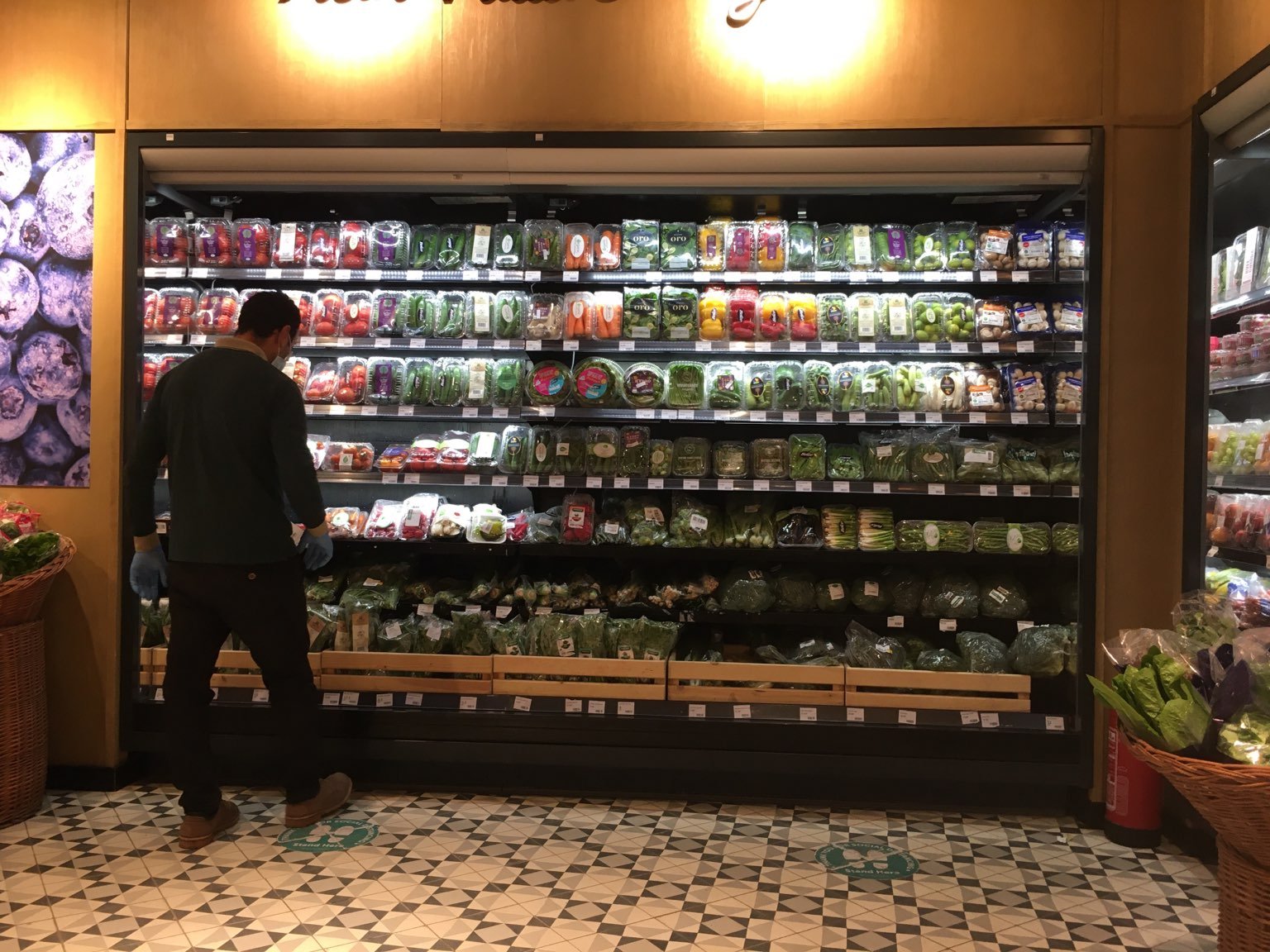
The baby spinach was displayed prominently among other local fresh greens, while the Thai curry paste was nestled in a rack featuring a wide assortment of curries, sauces and other flavorings. I also found locally grown red chilies that resemble serrano peppers — they’ll do. The coconut flakes, however, were nowhere to be seen. Since they were just to garnish the dish I was about to write them off but decided to ask one of the many employees roaming the shop floor for help. He quickly led me to a shelf I had browsed twice before but somehow failed to notice had the coconut flakes, stacked between other dried fruits and nuts.
You win, Gourmet — and not just in this challenge. As I combed the store for my ingredients, I inevitably caught sight of the plethora of Gourmet’s signature ready-to-cook dishes. A week later, I ordered Gourmet’s margarita pizza and three chicken breasts à la provençale, both pre-prepared and needing only to be popped in the oven. Not always having the time to cook, and squeamish at the prospect of having to order out again, I found their ready-to-cook meals the perfect middle ground. Gourmet had won me over as a customer.
This experience summarizes much about the evolution of high-end food retailers in Egypt over the last decade. Increasingly, supermarkets are offering a wide selection of imported foods, organic local produce, their own lines of prepared meals and ready-to-cook items, all packaged and marketed using novel techniques. Regarded as the apex of Egyptian grocery shopping, Gourmet has played an important role in this transformation. Its emergence has helped to shift trends in the supermarket sector that have grown to represent new realities in the consumption and production of food in Egypt.

Before he founded Gourmet, Jalal Abu Ghazaleh owned and ran AM Foods, a wholesale food supplier to several clients in the fine dining business, including the Four Seasons Hotel. Founded in 1996, AM Foods was small, with a handful of employees, and specialized in providing high-quality imported meats and seafood that wasn’t available on the local market.
At the time, Abu Ghazaleh hosted dinner parties and treated his friends to some of his premium steaks, he told Mada Masr. It wasn’t long before they were asking him where they could buy their own choice cuts of meat, and the idea to cater to individual customers first took shape.
In 2006, Abu Ghazaleh brought in a desk for a new employee and gave him a mobile phone to take orders. Home deliveries were carried out by a part-time delivery person who also worked at Mo’men, a popular fast food restaurant. Two years later, Abu Ghazaleh opened his first brick-and-mortar shop off Ring Road on the outskirts of Maadi and named it Gourmet.
Back then, Gourmet’s only means of publicity was word of mouth — and word spread quickly. Gourmet expanded rapidly, and just over a decade later it has established itself as Egypt’s premier high-end food retailer with 15 stores (two of which are seasonal outlets that open in the summer on the North Coast) and an enviable level of brand recognition.
“It was just supposed to be a kind of home delivery business,” Abu Ghazaleh says. “Initially, I wasn’t planning on opening a store, but two years later I did, feeling that a store would make the size of the business something else, and I was right.” From then on, he says, sales shot up and continued to steadily climb over the years.
Yet, Gourmet’s path to success was anything but straightforward. Just three years after opening its first retail outlet, the company’s revenues were severely impacted by the 2011 revolution, with disruptions in supply and new duties imposed on luxury goods.
An even bigger setback came in November 2016, when the government devalued the currency as part of an economic reform program put in place to secure a loan from the International Monetary Fund. The cost of imported goods doubled overnight and the subsequent lack of liquidity — with the Egyptian pound losing half its value — disrupted the supply of many imports.
The devaluation prompted Gourmet to rethink its strategy — one that would come to redefine the company and propel it into a new and lucrative market.
In order to deal with the import crisis, Gourmet pivoted to begin offering a new type of product: locally produced ready-to-cook and ready-to-eat meals, or “food solutions,” in corporate speak. The move proved remarkably successful and Gourmet’s own food products have become one of the main lures for customers and a major source of revenue.
According to Abu Ghazaleh, of the 100 new items that were added to Gourmet’s inventory in 2017, the majority were locally produced, “ready-to-cook” or “heat-and-eat” products. This new business approach was bolstered by a major investment in 2018 by the private equity firm B Investments, which purchased a majority stake in the company for LE125 million.
Gourmet was now competing for a larger “share-of-stomach” — looking to entice customers not only for their grocery shopping needs but for prepared or semi-prepared meals to replace restaurant delivery food.
As a leading retailer in both specialized groceries and prepared foods, Gourmet represents the latest stage in Egypt of a decades-long, worldwide trend toward the increased centralization of food shopping, the globalized availability of ingredients and food products, and of the trading of home cooking for so-called convenience.
***
Prior to the advent of the modern supermarket, shopping for groceries in Egypt, as in much of the world, was a multi-faceted endeavor.
Vana Celic, an 88-year-old Alexandria resident, recalls how in the 1940s, grocers displayed goods like sugar, white cheese and salted fish in large wooden barrels while portions of halawa (sesame candy) would be cut from huge slabs. Everything would be weighed and placed into paper bags. Packaging and branding were uncommon.
The same could be said of Britain in the postwar period, when a single visit to a present-day supermarket replaced trips to multiple shops: a grocery store for basic items like sugar, butter and canned fish; a greengrocer for fruits and vegetables; a butcher for meat; a baker for bread, and the milkman for milk, as documented in the book The Grocers: The Rise and Rise of the Supermarket Chain by Andrew Seth and Geoffrey Randall.
During this same period, upper and middle-income families living in downtown Cairo, like Vana’s, would often go to Al-Souq al-Faransawi (the French market) near Al-Azhar, where food vendors lined the streets displaying their fruits and vegetables in woven circular baskets and sold live poultry from rickety wooden crates stacked high atop one another. Vana remembers how cooks from wealthy households would be chauffeured to the market, where they and other household staff would sit at a nearby cafe, while the vendors would take orders of what was needed and then promptly load it into the car as they sipped their coffees. While these markets still operate widely in Cairo, they are no longer frequented by the city’s more affluent residents.
Relationships with vendors were also far more personal than in modern supermarkets. Vana remembers when she moved to Alexandria during the 1960s, the butcher would call her aunt to inform her what meats were available on any particular day.
In the 1970s, policies of economic liberalization first began to remove long-standing restrictions on imports, prompting a new breed of small grocers to emerge that straddled the line between traditional grocery and supermarket, offering foreign products ranging from Dr. Pepper to anchovies to various cheeses. While these new grocery stores were limited in number, they came to be well-known within Cairo’s wealthier neighborhoods. In Zamalek there was Seoudi (before it converted into a full-fledged supermarket), in Mohandeseen there was Petro, and in Maadi there was Kimo Market.
I vaguely remember supermarkets as a child in the early 1990s. They weren’t as numerous as they are now. But even then, my mother assures me, our food was usually bought separately from the grocer, the greengrocer, the fruit vendor (separate from the greengrocer in Egypt until recently) and the butcher. And the range of products on sale was rather limited.
The customers’ relationships with the local grocery store, butcher and poultry shop is still prevalent in Egypt: 80 percent of retail foods are sold in traditional grocery stores. But the remaining 20 percent — which mostly encompasses wealthier customers — slowly shifted over the years and by the late 1990s, modern supermarkets had become a staple of affluent neighborhoods in Cairo, Alexandria and coastal resorts. At the turn of the millennium, supermarkets continued to proliferate more widely and they began using their bulk purchasing power to offer products at discounted rates compared to their more traditional counterparts.
A stark example of this trend was the entry of Sainsbury’s, the British supermarket chain, to Egypt in 1999. The company quickly opened 100 stores across the country only to pull out two years later, in 2001. Sainsbury’s faced several unforeseen obstacles in penetrating the Egyptian market after what seemed to be a promising start, including a campaign by local competitors accusing it of monopoly practices through its low price strategy, as well as protests against the company for what was perceived to be Zionist affiliations as the second Palestinian intifada was underway.
More tellingly, Sainsbury’s was not well received by wealthier customers “who perceived Sainsbury’s stores as cheap and not offering quality products,” according to a 2014 study. “The company failed to properly investigate its market and its partners, and showed insensitivity to local conditions,” the study found.
Yet the rapid rise and fall of Sainsbury’s did not dissuade both foreign and local supermarket chains from entering the Egyptian market in a more carefully managed way, and they soon began to proliferate more widely. In the 2000s, amid shifting middle and upper-class shopping trends in Egypt, supermarkets like Metro, Carrefour, Alfa, Spinneys and HyperOne opened up. The grocery store Seoudi transformed into Seoudi Supermarket, with an in-store butcher, a baker and hundreds of new products lining its shelves.
Supermarket chains are now a major player in the food retail market. Although they comprise just four percent of the total number of food outlets, modern retail channels — such as supermarkets and convenience stores — nevertheless account for around 20 percent of total sales in the US$17.5 billion food retail sector, and have a projected growth of 15 to 20 percent over the next few years, according to a 2019 report by the US Department of Agriculture’s Foreign Agricultural Service.
It was in this environment that Gourmet emerged on the scene in the late 2000s. By this time, food retailers of all kinds had their shelves stocked with imported goods on offer. Yet Gourmet managed to carve out a specific niche for itself, eventually kickstarting a new trajectory in the evolution of grocery shopping in Egypt.
Hala Said, a mother in her 30s who has been shopping at Gourmet for years, said that Gourmet’s key advantage in the beginning was that it specialized in certain quality ingredients not found anywhere else. These included frozen berries, high quality salmon and tuna steaks, as well as Weber barbeque sets and seasonings, which complimented their exclusive offerings of imported beefsteaks. A 40-year-old friend of mine, Karim, is a longtime Gourmet customer who first began frequenting the store for things like obscure Thai sauces that weren’t on offer anywhere else, or for imported cold cuts that were a step above the industrial cold cuts of companies like Halwani.
All of this catered mostly to a relatively small, affluent sector of the market, but it set the stage for competitors to follow suit. As more outlets began to offer niche imported products of their own, Gourmet continued to retain its edge by delving into the manufacture of prepared foods and ready-to-cook dishes, a move largely propelled by the 2016 currency devaluation.

At Gourmet’s Zamalek branch, two refrigerated display cases stand in an L shape in the back of the store. The shelves are stacked with ready-to-heat foods, including several kinds of soups — such as the popular Egyptian varieties of lentil soup and molokheya — as well as a wide selection of prepared dishes, salad bowls, dips, sides and varieties of marinated chicken, steaks, ribs and kofta, all sold under the Gourmet brand.
While larger supermarkets in Egypt do offer some basic pre-prepared marinated foods of their own, such as shish-tawook and shawarma, the range in Gourmet is much broader, with ready-to-cook meals like chicken provincial, frozen pizza and apple pie, rubs and spices, cold-pressed juice shots and Arabic pastries and desserts.
Given its customer base, Gourmet employs a different pricing model for its ready-to-eat products with higher prices, particularly for traditional Egyptian dishes. For example, an order of Alexandrian foul typically costs just over LE15. In Gourmet, a similar quantity of foul costs LE40. The same goes for koshary, which at Gourmet sells at twice the typical price on the street.
Nevertheless, this range of higher-priced “food solutions” has managed to successfully cater to a range of grocery shoppers. Customers like Hala, for example, swear by the quality of the dishes. I have personally resorted to them when I’m having friends over and too busy to prepare snacks.
While Gourmet may not control a major share of the food retail market and primarily targets what are known in marketing parlance as “Class A” consumers, the company remains a leading market player with a loyal customer base, and continues to impact the entire sector by introducing new types of products that are subsequently emulated by competitors, including food retailers The Grocer and Fresh Food Market.
This trend mirrors other leading food retailers abroad, such as Marks and Spencer’s in Britain. In the 1960s, ready-to-eat meals were offered by a variety of supermarkets, but they were of low quality, as Seth and Randall recount in their book. At the time, Marks and Spencer began introducing higher quality chilled meals in their stores to great success and the product was eventually copied by other food retailers. “Chilled prepared foods, especially recipe dishes, need a segment of people who want quality and are prepared to pay for it, and who appreciate convenience,” they write about Marks and Spencer’s product development.
Gourmet founder and CEO Abou Ghazaleh says he was inspired by Whole Foods, the American multinational supermarket chain that became popular for its wide organic selections. He says the development of new recipes and products is a long process that can go through several iterations, as was the case with their frozen pizza product, which they only perfected after resorting to using mozzarella and dough imported from Italy.
Now, Gourmet’s competitors are increasingly offering prepared “food solutions” of their own. Today, if you call Sunny Supermarket, which relaunched in Zamalek after many years of closure, you will be greeted with a voice recording advertising the store’s “marinated meat line.” Meanwhile, The Grocer published an advertisement in December promoting its prepared Christmas dishes: “Tis the season to get everything seasoned for you, and prepared for you, and ready to pop in the oven but then pretend you did it all yourself. Our ready-to-cook lamb leg is designed exactly for that,” accompanied by a professionally photographed cooked leg of lamb adorned with roasted vegetables and sprigs of rosemary.
“Competitors always take note of what you’re doing, so it becomes a continuous improvement,” Abou Ghazaleh says, adding that the end result is beneficial overall as it increases market size for these products. “Your competitors get better and our challenge is to get better at a faster rate. It’s forever evolving.”

The proliferation of a variety of supermarkets continues to accelerate. Over the span of several months last year, two high-end supermarkets, Oscar and Grocer, opened in Zamalek — an upscale district already brimming with major supermarket and grocery store branches — and another, Alfa Market, underwent a facelift.
Yet even within this market sector, there are concerns about the continued spread of modern supermarkets, which centralize, corporatize and homogenize food shopping, leading some target customers to eschew outlets like Gourmet in favor of more traditional or alternative commercial food sources.
Mostafa, an old classmate who lives in Maadi (a supermarket haven like Zamalek) dislikes supermarkets and describes outlets like Carrefour as “monstrous.” Mostafa’s concerns about supermarkets are centered around his experience as a consumer and the impersonal nature of supermarket chains, as well as the tendency for supermarkets to elbow out small businesses that he considers more trustworthy and whose products he deems of a higher quality.
“I still shop from small vendors —the butcher, the grocer, the corner shop. You know who owns them,” Mostafa says. “Workers in supermarkets don’t care because they’re not the owners. You don’t get the freshest products, which are often stacked in the back to sell the older ones. I prefer vendors that aren’t corporate-owned.”
Mostafa prefers to shop for food at small outlets, both from local vendors as well as from independent sellers of higher-end artisanal products. For example, he purchases his meat from a friend who opened a small butchery and offers high-quality cuts at premium prices. Alternatively, he purchases vegetables from small stores that he says offer similar or even higher quality products than supermarkets at much cheaper prices. Mostafa is also conscientious about the sources of his food. One of the grocery stores he uses is an outlet for vegetables and dairy products produced by women from a village on the outskirts of Cairo, part of a non-governmental project to empower women.
“I like buying locally sourced and locally made products from real people,” he says.
Another friend, Nada, who has lived in Zamalek for over 10 years and loves to cook, has only visited Gourmet four times. She buys her fruit and vegetables from traditional markets or from street vendors. She says the products they sell are fresher, as they arrive on a daily basis directly from growers at dawn and the goods are often sold by women whose families work on the farm. “There are far fewer intermediaries when you buy this way, and the vegetables are better, especially ones you need very fresh, like greens,” she says.
However, consumers like Nada and Mostafa appear to be the exception. Agricultural researcher Saqr El-Nour found that growing culinary trends, such as healthy eating, have largely resulted in consumers purchasing organic foods from city-based vendors who, more often than not, are connected to large businesses that have capitalized on the emerging demand for these products. Organic produce is generally not available in traditional souqs and smaller vendors who offer healthy food options find it hard to compete with large corporate players like Seoudi or Gourmet.
Supermarkets and food outlets like Gourmet still only represent a fraction of the market. Whether their share will grow in the future is difficult to predict, but what is clear is that the supermarket landscape has flourished over the past decade, and Gourmet — that expensive little store that started out with one branch offering Candian lobster tail and certified Angus beef — has been at the center of this transformation.

تقارير ذات صلة

Priced out of protein
How the economic crisis has taken protein out of the mouths of Egyptians.

Understanding the implications of devaluation
Mada Masr explores the impacts of the anticipated devaluation on market prices and external debt.

Keeping Egypt above the breadline: How has the government strategized to supply wheat during a global shortage?
The state looked to local farmers for nearly double what they would in other years
Your support is the only way to ensure independent, progressive journalism survives.
You have a right to access accurate information, be stimulated by innovative and nuanced reporting, and be moved by compelling storytelling. Subscribe now to become part of the growing community of members who help us maintain our editorial independence.
Join us