
Downtown Cairo suffered an hour-long blackout on Sunday night. But this did not prevent the Future Shorts Winter Season at Vent from being one of the most enjoyable events of the year so far. Salma El-Shaffei, a senior art student at the American University in Cairo and long-time friend of Vent’s founders, brought the international pop-up film festival to the space’s regular line-up of concerts, exhibitions and film screenings.
Vent, a cultural space in the guise of a bar that is tucked in a side street overlooking Tahrir Square, was packed with film enthusiasts and artists Sunday night. Most people stayed through the prolonged break in the dark, passing time chitchatting; one group took it upon themselves to entertain everyone and began singing 1980s classics, with the rest humming along. The mood was festive and the wait turned out to be worth their while, as this season’s selection of six shorts from France, Poland, Serbia, Finland and Afghanistan was diverse and exciting.
Fascinated with the programs of the world’s largest short film network, Shaffei was initially pursuing an internship with the London-based film exhibitioner, distributor and events organizer. With no internships available, she followed a different route: applying for a license for a Cairo screening, allowing her to set up the first Future Shorts film festival to take place in Egypt in January 2012. For this screening, which marks the 5th Future Shorts event in Cairo, she also made two additions to the official program to “showcase local talents”: “Scarf,” a 2013 drama by filmmaker Ahmed Emad, and a short documentary on a rice trait grown in Egyptian oasis. The latter is the first production of Ma7sool Productions, an independent company that seeks to document Egypt's diverse food traditions and cuisine.
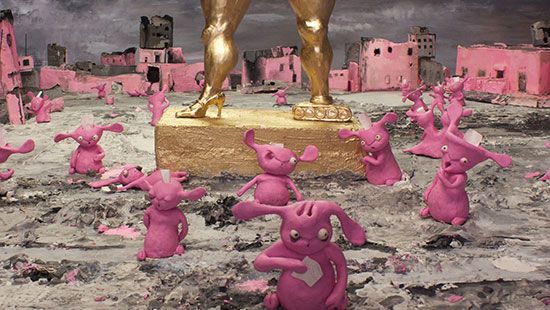
The official Future Shorts selection was more nuanced than the Egyptian showcase. “Rabbitland” (2012) took viewers to a country inhabited solely by pink rabbits. Its topography is similar to a warzone, yet the word “HAPPY” is plastered on every nook and corner. Each morning, the rabbits, which have an empty hole in their heads where their brains would have been, are flocked to the far edges of Rabbitland to cast their votes. It is the “perfect democracy,” as Serbian co-directors Ana Nedeljkovic and Nikola Majdak describe it the synopsis. But it’s the wittiness and dark sense of humor of the seven-minute stop-motion animation, rather than the poignant political message, that holds it together, making viewers simultaneously amused and uncomfortable.
The humor in Finnish production “The Date” (2012) is also a bit unsettling, although it has an entirely different storyline. By director and producer Jenni Toivoniemi, this short takes an arranged mating date for cats as its subject. Tino is our teenage protagonist. He is forced to host the date for Diablo, the family cat, as his mother has to run some errands. And as Mikka, the owner of Nefertiti (Diablo’s date) arrives along with her mom, things start taking an interesting turn. The film is deadpan comedy, contrasting the romantic life of this 16-year-old teenager with that of his stud cat.
Another film that got the Vent crowd giggling was “Blind Spot,” a 2007 production by GOBELINS students Johanna Bessière, Nicolas Chauvelot, Olivier Clert, Cécile Dubois-Herry, Yvon Jardel and Simon Rouby Lazarescu. The three-minute animation plays on a blind spot of a grocery store’s security camera at the time of a robbery. The animation and plot are intriguing and the ending offers viewers a little surprise.
Other films stayed away from comedy, such as the French drama “That I’m Falling” (2013) and “Out of Reach” (2011) from Poland. Both were highly intriguing. The latter is a documentary by Jakub Stozek which follow two teenage sisters, Karolina and Natalia, as they try to find and reconnect with their mother, who was sent to jail while they were children and has since disappeared. What’s interesting about “Out of Reach” is its open-endedness and fluidity. Although the events are dramatic and somewhat tragic, viewers remain engaged throughout the 30 minutes, and the film leaves everyone with more questions than answers.
The Afghan drama “Buzkashi Boys” (2011) follows Rafi and Ahmed, two teenage boys living in hardship. It is by far the best of the screened films in terms of image quality, and offers an interesting premise, particularly for viewers unfamiliar with Afghan culture. The two boys try to pursue their dream of becoming Buzkashi players – a Central Asian sport in which horse-mounted players attempt to drag a goat carcass toward a goal. However, the film loses much with its overtly melodramatic sound track and over-used representation of youngsters following their dreams.
Perhaps the main disappointment of the night was the Egyptian production “SCARF.” Emad executes parts of the scenes in animation while the rest is filmed with real-life actors. The animation parts are impeccable, and the choice to weave the two techniques together holds well throughout the film, in which the titular red scarf floats among the scenes. What brings it down, however, is the dragging plot and the clichéd imagery used to reflect the hardships of a psychologically unstable and delusional young woman – they are sadly reminiscent of the mainstream romance productions that briefly dominated the local film scene in the early 2000s.
Still, overall the night was a great success, and with the exciting plans Shaffei has for the future, such as possibly venturing into the Future Shorts’ Secret Cinema initiative – where a chosen screenplay is adapted to a live performance – there seems there could be many exciting things to come.
The Future Shorts Winter Season was screened at Vent in downtown Cairo on February 23 and February 24.
تقارير ذات صلة
Do-Mystic Uni-Verse
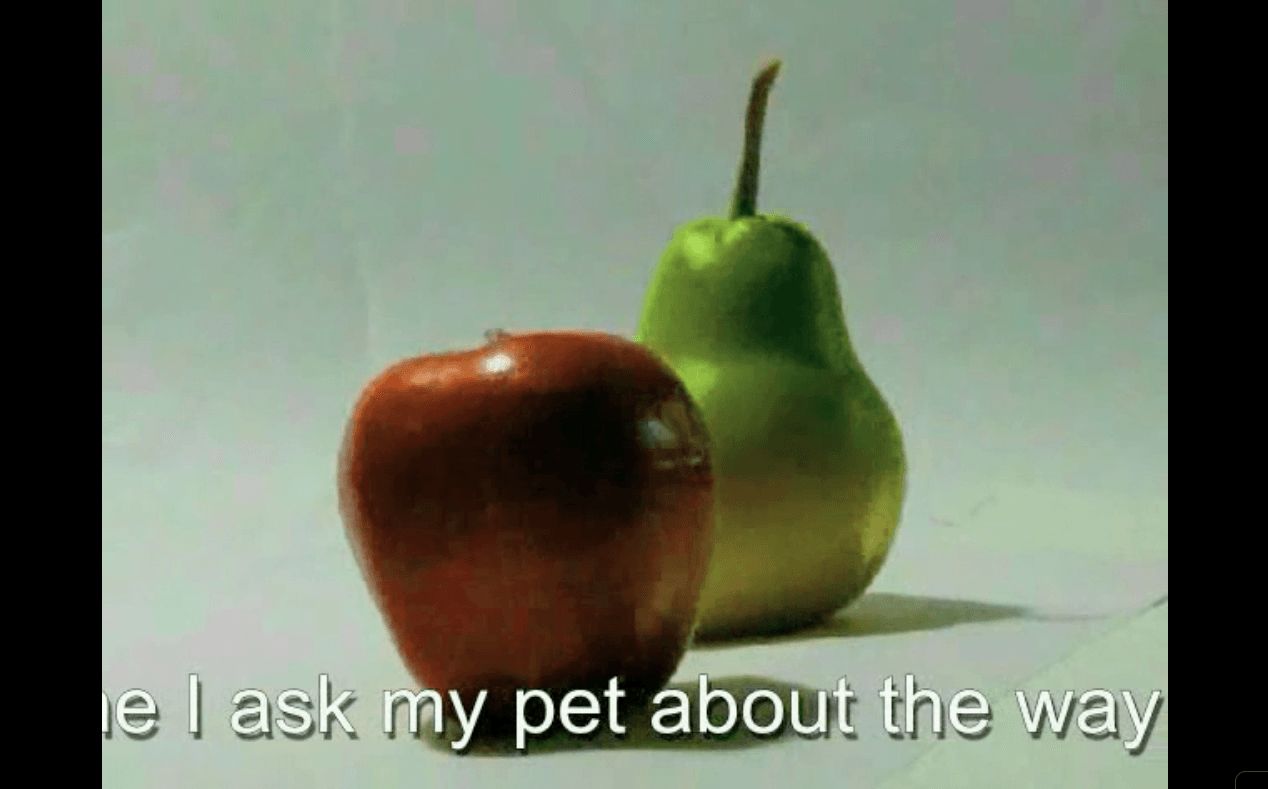
I'm squatting on the floor in the middle of Nile Sunset Annex, watching Walid ElSawi's stop-motion animation video series on a large LCD screen.

Avant-titre | Our bread, our dignity: Bread in Egyptian cinema
This episode of Avant-titre is part of Mada Masr's Bread politics, an eight-part series that takes an in-depth look at bread subsidies in Egypt in the context of recent talk…

Video | Privilege and responsibility: A letter from Carol Mansour
Carol explains why allowing the voices of others to be heard helps to make the world a better place
Your support is the only way to ensure independent, progressive journalism survives.
You have a right to access accurate information, be stimulated by innovative and nuanced reporting, and be moved by compelling storytelling. Subscribe now to become part of the growing community of members who help us maintain our editorial independence.
Join us