
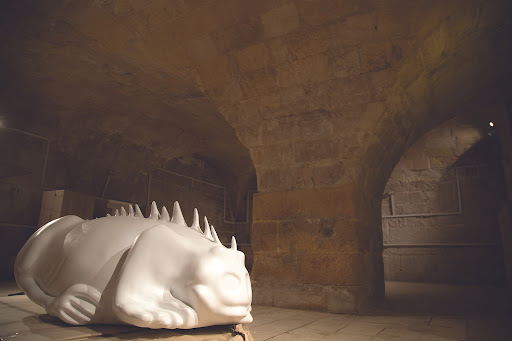
Forever is now, on the art of Art D’Égypte
In October 2017, a new contemporary arts initiative entitled Art D'Égypte staged an exhibition inside the Egyptian Museum in downtown Cairo. The exhibition, entitled “Eternal Light: Something Old, Something New” inserted the works of 16 contemporary Egyptian artists alongside Pharaonic artifacts. The exhibition opening featured distinguished guests from around the world, and was held under the auspices of the Antiquities Ministry.
In the past five to 10 years, Egypt, and specifically Cairo’s independent contemporary art scene, has shrunk due to dwindling resources, state-led institutional closures and security concerns, among other issues. Meanwhile, a new contemporary art scene dominated by public and private stakeholders is emerging, with Art D'Égypte at the helm. While institutions such as the Contemporary Image Collective, Gypsum Gallery, Medrar, SOMA Art Gallery and others still standing from what was once a boisterous independent art scene use contemporary artistic practice to tackle conceptual questions, prop up student artists, or revisit classical modernist works, Art D'Égypte mostly showcases abstract, formalistic and design-driven work poised to wow and, more importantly, sell.
In an epic marriage of state and capital, Art D'Égypte, a private firm with government connections and extensive corporate partnerships, brings these types of contemporary artworks to Egypt’s heritage sites in the effort of “linking the past to the creative present.”[1] Their annual exhibition is a bricolage of heritage restoration, artistic interventions and societal spectacle.
After the inaugural exhibition, two more annual iterations were held, at Manial Palace — built by Ottoman Prince Mohamed Ali Tawfik — in 2018, called “Nothing Vanishes, Everything Transforms,” and at Islamic Cairo’s Moezz Street in 2019, titled “Reimaged Narratives.” Whereas the first exhibition was only open for one night for VIP Egyptian guests and invitees flown in from everywhere from London to the Emirates, the latter two iterations were exhibited for two or three weeks and were catered toward the general public.
Each intervention highlighted a restoration and preservation component. In the Egyptian Museum, the exhibition organizers worked with companies like Philips to restore lighting and sanitary ware as well as secure sponsorship for several vital projects at the museum. In Manial Palace, the organizers also restored the prince’s infamous jewelry vitrine, as well as renovated the entire palace’s 19th-century wood floors. In Islamic Cairo, the organizers worked towards landscape repair for the gardens and equipped all of the heritage sites with fire extinguishers.
***
On April 3, 2021, the Pharaohs’ Golden Parade captivated Cairo and the rest of the world, as 22 mummies were transported from the old Egyptian Museum downtown to their new resting place five kilometers away, the National Museum of Egyptian Civilization. The multimillion-dollar procession featured ancient Egyptian funerary boats, modern celebrities, a concert by Egyptian maestro Nader Abbasi, and other classical Arabic singing performances. President Abdel Fattah al-Sisi tweeted: “This majestic scene is evidence of the greatness of the Egyptian people, the guardians of this unique civilization extending deep into the depths of history.”

Françoise Choay writes that “heritage today seems to play the role of a vast mirror in which we contemplate our own image.[2] Indeed, heritage is one of the most important determinants in the formation of modern societies.[3] In the mid-20th century, the new Egyptian state positioned itself as the rightful inheritor of a breadth of history from ancient Pharaonic relics to the monuments left by Islamic empires, a rhetoric that still persists until today. Beyond its utilitarian function to tourism, heritage, and by extension, heritage preservation efforts, are integral to the ontology of the modern Egyptian state.
During the opening of the inaugural Art D'Égypteexhibition, Khaled al-Anany, antiquities minister, presented the Egyptian Museum’s heritage preservation initiatives and announced the partial opening of the new Grand Egyptian Museum, a US$795 million project set to open near the pyramids next year. The mammoth investment into the Grand Egyptian Museum in a country with a 29.7 percent poverty rate[4] proves the centrality of heritage in the government’s agenda. In a prolific way, preservation efforts assemble future worlds.[3] An inherently teleological act, preservation can be considered an effort to exert control over the future under the pretense of nostalgia.
Launched on September 13, 2021, the exhibition “Cairo International Art District” occupied 12 spaces downtown. [5] The event was sponsored primarily by Al-Ismaelia for Real Estate Development, which has been renovating and recasting downtown Cairo since 2016. Other partners include DHL for logistics, and international bodies such as the US Embassy, the Spanish embassy, the Swiss embassy, the Italian Culture Center, Schneider Electric, Egypt, Al-Sagheer Salons, Nadim Factory, Total, and Lipton. An announcement for the exhibition characterized Cairo’s downtown as “a newly renovated 19th-century district [initially] built by renowned architects, who flooded from all over the world to leave their print on Egypt’s capital when Khedive Ismail decided to transform the face of Cairo’s city center into a postcard-pretty district.” In this configuration of partnerships and stakeholders, there is an effort to revive this cosmopolitan imagination of downtown Cairo.
In urban revival efforts, the intersection of arts and heritage is often seen as beneficial to artists and local communities alike. Artists benefit from receiving commissions to produce their work, and community members benefit from the economic stimulus resulting from increased traffic. But critics call the instrumentalization of art for the advancement of public and private heritage restoration efforts “artwashing.” [6] Artist and academic Stephen Pritchard writes that there are different kinds of artwashing, from corporate artwashing to developer artwashing, and most prominently in this case, “government-led artwashing, in which state and local authorities use art to ‘reinforce social agendas’ and notions of ‘social and civic engagement.’” [7] The practice is thematically detrimental to both the artwork and the heritage in which it is situated.
There is an element of artwashing in Art D'Égypte’s work, where the artwork on display is arguably not important, and is interchangeable — an empty signifier, a visual addendum. An example of this interchangeability is a recent plagiarism incident wherein a key curatorial text written by Gypsum Gallery and published on its website was copied verbatim and republished by Art D'Égypte in the context of another artwork for one of the exhibitions in Cairo International Art District, “Tangled Structures,” featured at The Factory Space. The text, written by Gypsum Gallery in 2014 for Basim Magdy’s artist statement, (Magdy is represented by Gypsum) reads: “Despite a preoccupation with analog film, narrative sequences are seldom linear. Fragments, gaps, and clues suggest rather than tell a story. His videos, in particular, progress like a series of still images permeated with a haunted air that heightens our sense of suspense. In almost all his work, poetic but ambiguous titles add another layer to the narrative. Magdy stretches the boundaries of our imagination to test the logic of the truth which often lies somewhere between reality and fiction.” The text itself is not necessarily easily reproducible — despite what critics of obscurantist “artspeak” might say — which is what makes it so curious that it landed on a tripartite series of paintings featuring abstract, mythical creatures floating in air, portrayed in bright, vivid colors. This is one of many examples of how the range of possibility afforded to an artwork (how it can be interpreted, or how it can interfere, add to, or thwart the space it is presented in) is foreclosed — whether in plagiarized curatorial statements or general statements regarding Art D'Égypte’s mission. As such, in the context of the exhibition, it doesn’t matter what the artwork actually portrays, what style it encompasses, whether it is a pastiche work or an innovative form or a conceptual provocation. The only thing that matters is its “contemporaneity,” which is singularly utilized as a device to highlight or “recontextualize” a specific site.

Artwork that featured plagiarized curatorial text
Art D'Égypte is not a unique undertaking. Over the past 10 years, many national museums and heritage sites from Britain to Greece have staged contemporary art exhibitions to facilitate a recontextualization of historical artifacts and monuments. In these efforts, contemporary art is instrumentalized to imbue a site with cultural significance, create complexity and reframe public perception. Efforts to bring ancient collections to relevance often create a complex ontological crisis. The politics of ancient artifacts in universal museums abroad goes beyond the purview of this piece, but Alice Stevenson makes an apt point about the positioning of contemporary artists in universal museums: “It has been argued that using artists merely shifts the responsibility for developing counter-narratives from the museum to external practitioners, undermining an institution’s resolve to address change itself. [8] Luce Allais dismantles the pretensions of the annotations of contemporary art in museums or heritage sites, such as the pyramids. She says, “There is a real danger that considering the content of each individual monument, however thoughtfully, avoids taking monumental collections for what they have also always been: instruments of territorial management, penetration, and control.”[9] She cautions against the myth of recontextualization — in Art D'Égypte’s case, recontextualization using contemporary artwork — as an effort towards historical complexity, and points to the ways that paratextual efforts are merely efforts to control national narratives.

On October 21, Art D'Égypte will launch its fourth annual exhibition at the pyramids, entitled “Forever Is Now.” The exhibition claims that by joining contemporary and historical works in one exceptional setting, the world’s oldest civilization is setting a cultural agenda for the “here and now.” In a chronological manipulation, this singular event encompasses a tripartite temporality of renewal, rebirth and permanence all collapsed onto one moment in the service of the state’s agenda. By using contemporaneity to preserve the past, Art D'Égypte formulates a vision for the future that is decidedly forever.
The rhetoric of forever is invoked not only by the exhibition’s organizers, or the government funding the event, but also in its reception. In an
interview following the first event at the Egyptian Museum, an attendee said “We had the most elegant people in the world that were visiting Cairo’s Egyptian Museum … it happened … I couldn’t believe it … this is going to last forever.”
The invocation of “forever” is key to Art D'Égypte’s cultural project. In anticipation of this month’s Art D'Égypte exhibition “Forever is Now,” set to take place at the pyramids, let’s ask: if now is forever, then what does tomorrow look like? This edition, which was announced in a private event attended by diplomats, members of parliament and other special guests, is supported by the Ministry of Tourism and Antiquities, the Foreign Ministry and UNESCO, among many other sponsors. In parallel to the exhibition, Art D'Égypte is bringing AI-DA, the world’s first ultra-realistic AI robot, who has featured in world fairs and global expositions. Art D'Égypte’s text describing the robot says, “as a machine, with artificial intelligence capabilities, its artist persona is the artwork, along with its drawings, paintings, performance art, and sculptures. As conceptual art, AI-DA encourages us to reconsider our self-perception through the lens of a humanoid.” Who better to signify forever than AI-DA, the immortal artist and artwork? For Art D'Égypte, AI-DA symbolizes the guiding concept of this year’s exhibition: the temporality of forever.
In order to rescue the future from calcification, and push past the maintenance of the status quo, it is important to allow art to reject the rhetoric of forever in order to imagine a future guided not by teleology, but anchored in rupture. Art D'Égypte, however, is not interested in the potential of art to reshape or reimagine future narratives; we could even venture to say that Art D'Égypte is not interested in artwork altogether.
[1] All quotations from Art D’Egypte were sourced from http://www.artdegypte.org/
[2] Allais, Lucia. “Integrities: The Salvage of Abu Simbel.” Grey Room, No. 50 (Winter 2013).Choay, Francoise. The Invention of the Historic Monument. Cambridge: Cambridge University Press, 2001. Pg 9
[3] Harrison, Rodney, Caitlin DeSilvey, Cornelius Holtorf, Sharon Macdonald, Nadia Bartolini, Esther Breithoff, Harald Fredheim, Antony Lyons, Sarah May, Jennie Morgan, Sefryn Penrose, Anders Högberg, and Gustav Wollentz. "Heritage as Future-making Practices." In Heritage Futures: Comparative Approaches to Natural and Cultural Heritage Practices, 20-50. London: UCL Press, 2020. Pg 35
[4] This is a decline from 32.5 percent in 2018, http://www.xinhuanet.com/english/2020-12/09/c_139576799.htm#:~:text=According%20to%20the%20country's%20official,its%20poverty%20rate%20since%201999/
[5] Al-Ismaelia for Real Estate Development’s Kodak Passage, Cinema Radio, The Factory (formerly Townhouse Factory Space), six shops, Access Art Space (formerly Townhouse Gallery), Rawabet Art Space (formerly the Rawabet Theater), and a shop at 36 Abdel Khalek Tharwat Street, among others.
[6] Sterling, Colin. "Covert Erasure and Agents of Change in the Heritage City." In Critical Perspectives on Cultural Memory and Heritage: Construction, Transformation and Destruction, edited by Apaydin Veysel, 67-83. London: UCL Press, 2020. Pg 77
[7] Pritchard, S. 2017b. ‘A Brief History of Art, Property and Artwashing’, Colouring in Culture, 13 October 2017. Available online: http://colouringinculture.org/blog/artpropertyartwashing.
[8] Stevenson, Alice. "Legacies and Futures (1970–)." In Scattered Finds: Archaeology, Egyptology and Museums, 217-52. London: UCL Press, 2019. Pg 236
[9 ] Allais, Lucia, et al. “A Questionnaire on Monuments.” October, vol. 165, 2018, pp. 3–177., doi:10.1162/octo_a_00327. Pg 4
تقارير ذات صلة
Lara Baladi’s Cosmovision
In Cosmovision, Lara Baladi breaks down photography’s cadre into a discursive unfurling of her becoming from 1996 to 2011, autobiographically performing the logic of the white cube. Shown at Tintera,…
In pursuit of filling art-historical cracks: Chafik Charobim and missed opportunities
Hana Elhaddad considers the effectiveness of the retrospective's curatorial framing

On the creative impulse under violence: What is the point of making art during genocide?
Multidisciplinary artist Ash Moniz has turned art-making into aid relief for Gaza
Your support is the only way to ensure independent, progressive journalism survives.
You have a right to access accurate information, be stimulated by innovative and nuanced reporting, and be moved by compelling storytelling. Subscribe now to become part of the growing community of members who help us maintain our editorial independence.
Join us