
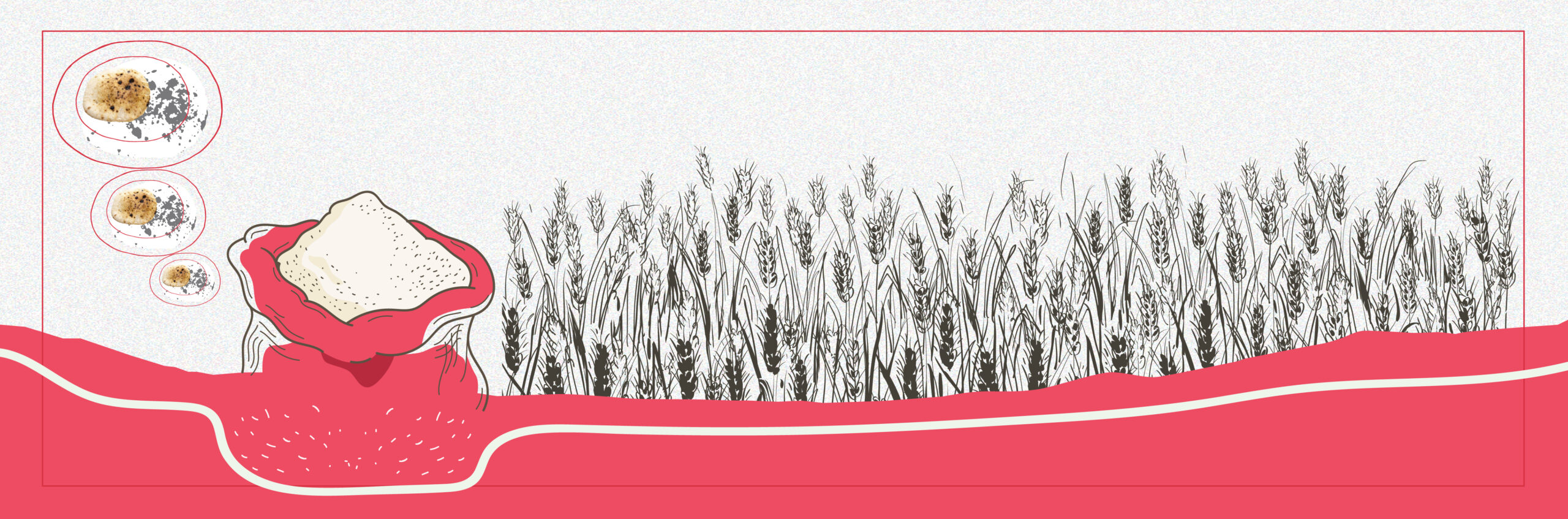
In August, President Abdel Fattah al-Sisi announced that the government was planning on increasing the price of subsidized bread, which helps feed around 70 million people in Egypt, for the first time in 33 years. “It’s time to raise the price of the five-pisater loaf,” he said.
Sisi’s announcement came in light of an increase in bread subsidies in the state budget for fiscal year 2021/22 to LE45 billion. Currently, the cost of producing one loaf of bread is 65 piasters, 5 of which are paid by the beneficiary and the rest by the government. The government has not officially announced how much a new loaf of subsidized bread will cost, nor when the price hike will go into effect, prompting widespread speculation over what form the changes will take; but an important part of the discussion centers on what is known as “flour extraction.”
The bakeries division of the Federation of Egypt Chambers of Commerce sent a proposal in August to the Supply Ministry for a price hike scenario in which the loaf of bread would be priced at 25 piasters instead of five and the daily per capita allotment reduced from five loaves to three. In turn, the size of a loaf would increase to 150 grams from 90 grams, and the flour currently being used, which has an extraction rate of 82 percent, would be replaced with flour that has an extraction rate of around 76 percent, a whiter flour that is used in upscale bakeries.
What exactly is flour extraction? How does it affect the production of bread? And does a reduction in the flour extraction rate actually improve the quality of bread?

Wheat flour is typically used to make bread because its primary protein, gluten, helps dough rise by trapping gas bubbles during fermentation and gives bread its unique fluffy texture. Wheat crops have long ears, each of which contain several grains that are ground to extract flour. The wheat grain consists of three main parts: 1. the outer layer (the bran or hull) which makes up about 14.5 percent of the size of the wheat grain, 2. the wheat germ, which makes up 2.5 percent of the wheat grain, and 3. the endosperm, which contains starch and protein and makes up the largest part — 83 percent — of the wheat grain.

On a very basic level, a grain of wheat is similar to a mango, with the endosperm (the mango flesh) making up most of the grain. To extract flour, mills remove the bran (the mango peel) and take out the wheat germ (the mango pit). The white flour extracted from wheat is akin to the juice derived from the mango. This is what is known as flour extraction.
Wheat milling is the process of separating the bran and wheat germ as much as possible from the endosperm. The endosperm is then softened to be turned into flour. The process of milling wheat grains developed over centuries from the manual use of a pestle and mortar to automated mills. In its current form, the milling process begins by unloading wheat grains into conical basins that are covered with a metal mesh to block impurities. The grains are then taken through a two-stage cleaning process. First, the wheat is filtered and rinsed to remove any impurities. Then, in the second stage, referred to as “wetting,” water is added to the wheat, which causes the husk to swell, and then it gets sieved, with the debris — called chaff — to be sold separately for use in livestock fodder. Three days later, the grains are ground into flour at different extraction rates that vary according to use.
To produce the white flour that is used in homes and upscale bakeries, flour mills use the endosperm of the grain and dispose of the rest of the kernel. For this delicate process to be done efficiently, flour is extracted from the wheat kernels at a rate of 83 percent (the total amount of endosperm in the kernel).
Yet this ideal scenario is practically impossible to achieve, even for the most advanced and expensive mills. What typically happens during the extraction of the endosperm is that it mixes with other components, such as the wheat germ or the chaff. Therefore, to get rid of the wheat germ and chaff completely, mills have to sacrifice some endosperm as well. This is why the total amount of flour decreases in proportion to the amount of wheat that goes into production.
To mitigate the mixture of wheat germ and chaff with the endosperm, mills use machines and sieves that bring the extraction rate to around 72 percent, creating what is known as fine white flour: a flour that is removed of “impurities” and therefore “better.”
Yet this aspiration for white flour has a complex history, involving notions of class and upward mobility and little to do with making better bread. In fact, white flour loses a significant amount of wheat’s nutritional value. Consequently, any talk about reducing the percentage of flour extraction in subsidized bread under the pretext of “improving its quality” is inherently flawed.
The Egyptian government began subsidizing bread in 1941, during World War II. Since then, successive governments have provided various subsidies for basic commodities. Over the 80 years since bread subsidies were first introduced, the price of a subsidized loaf has only been increased three times.
For the first several decades, a loaf of subsidized bread was sold for half a piaster. In the 1970s, Egypt was economically depleted following the 1973 war with Israel and facing a global increase in food prices. As part of President Anwar al-Sadat’s policy of economic liberalization (known as infitah), the government announced the lifting of subsidies for bread and other basic foodstuffs in 1977 in an attempt to reduce public spending and foreign debt. The move prompted bread riots across the country in which dozens were killed and hundreds injured, forcing Sadat to walk back the decision after just two days.
Bread subsidies continued to put a strain on the state budget, and Sadat’s successor, President Hosni Mubarak, worked on reducing subsidies gradually by hiking the price of baladi bread, shami bread and fino bread to 2 piasters instead of 1 piaster, then again to 5 piasters in 1988. At the same time, a loaf of subsidized bread was shrunk to 160 grams in 1984, then to 130 grams in 1991. Subsidies on fino bread were subsequently ended in 1992, followed by shami bread in 1996. Only baladi bread remained as an essential subsidized commodity, with subsidy cut attempts being met with demonstrations and opposition. The price of subsidized bread has remained stable at 5 piasters for the past 33 years, even though the size of a loaf has been reduced several more times under Sisi, reaching 90 grams today.

The bread subsidy program has been a major factor in making Egypt the largest wheat importer in the world. Egypt produces 8 to 9 million tons of wheat annually during the two-month harvest in April and May. During this period, farmers harvest the crops and sell them to the government at a predetermined price. But Egypt’s local production of wheat is not enough to meet the demand for 18 million tons of flour per year. The deficit is covered by imports, primarily from Russia. The government, in collaboration with the private sector, handles the storage and milling of wheat, which is distributed to bakeries throughout the year to produce subsidized bread.
According to Abdallah Ghorab, the head of the bakeries division at the Federation of Egyptian Chambers of Commerce, there are two main types of subsidized baladi bread. The first and more popular is called mawi and is produced by placing the dough on trays covered in bran, to prevent them sticking, and then baked. This type of bread is produced in most governorates except for some coastal governorates like Alexandria, Daqahlia, Kafr al-Sheikh, and cities along the Suez Canal.
The second type — megri — has a less dense crumb (the inner part of the bread) and is produced in governorates that do not make mawi. Megri is placed on a layer of white flour instead of bran before being baked. According to Ghorab, the two varieties of subsidized bread cater to different tastes.
Last year, the Supply Ministry unified the weight and size of all types of subsidized bread. According to current specifications, bread should be made of flour extracted at 82 percent, which means that the bread will contain a percentage of wheat germ and outer husk (or bran), which are difficult to separate from the endosperm. At this extraction rate, “every 100 kilos of wheat yields 82 kilos of flour,” explains Walid Diab, the former head of the mills division at the Federation of Egyptian Industries. The remaining 18 percent is mainly bran.
According to Ashraf Abu Shady, a Cairo baker, the current proposal to improve the quality of bread is to have a flour extraction rate of 76 percent, which means extracting a smaller amount of flour from the same amount of wheat.
But this proposal presents a number of problems. Firstly, it contradicts the ultimate goal of reducing spending on bread subsidies because it will require 6 percent more wheat to produce the same amount of bread, since the total amount of flour extracted will decrease. According to Diab, this will add an additional LE3 billion to the budget annually in order to keep bread production at current levels.
Apart from the increase in production costs, this new “fine flour” that the bakeries division is looking forward to merely alters the appearance of the bread while actually reducing some of its nutritional value.
This seemingly contradictory aspiration for fine white flour has a long history.
While bread markets became prevalent in Egypt during the Ottoman era, breadmaking at home remained widespread in Egypt until the 20th century. In the late 19th and early 20th centuries, white bread — with its “cleaner” appearance — became associated with the upper classes and represented a form of social mobility for many people around the world.
“All of French history in some sense is the story of 90 percent of the population eating a dark bread made of rye, barley, oats, seeking to imitate the bourgeoisie and the aristocracy by ascending to wheat and white,” according to Steven Kaplan, professor of European history at Cornell University.
Technological advancements in the 19th century generally improved the quality of milling, which allowed poorer classes to sometimes be able to enjoy what the rich consumed.
But whiter bread does not necessarily mean better quality. On the contrary, as Diab explains, flour milling essentially leads to the wheat losing some of its nutritional value. A lower extraction rate means removing more components of the wheat kernel. The husk that is removed contains fibers, iron and calcium, while the wheat germ contains vitamins E and B. The white flour that remains contains gluten and almost all the carbohydrates that exist in the wheat kernel, meaning that much of the nutritional value is lost, and chances of weight gain are higher with almost no notable health benefits.
On the other hand, the more we keep of the wheat kernel, the more minerals and vitamins we retain. This is why many countries have resorted to fortifying white bread with minerals and vitamins to compensate for the losses, something that the Supply Ministry, according to Ghorab, does not do.

تقارير ذات صلة
Bread politics
An eight-part series that takes an in-depth look at bread subsidies in Egypt
Q&A: How to save LE8 bn without raising subsidized bread prices
"This problem must be resolved within a framework of social justice"
The state and subsidized bread: Stuck between a strained budget and public anger
The government appears to be tight-lipped about any potential changes to the subsidy system for now
Your support is the only way to ensure independent, progressive journalism survives.
You have a right to access accurate information, be stimulated by innovative and nuanced reporting, and be moved by compelling storytelling. Subscribe now to become part of the growing community of members who help us maintain our editorial independence.
Join us