
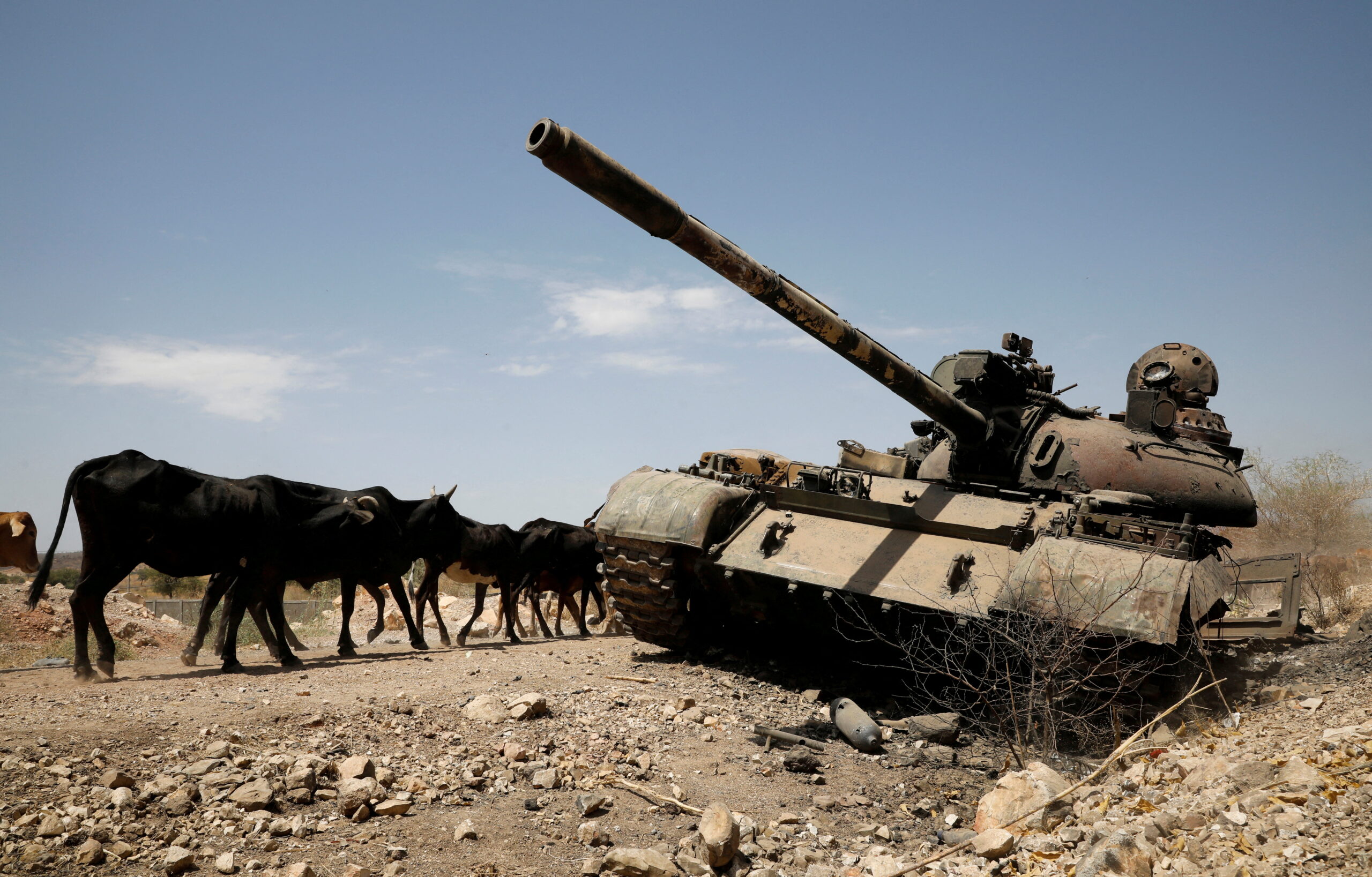
Ethiopian govt, Tigray rebels set for direct talks
Tigrayan rebels and the Ethiopian federal government are set to hold their first face-to-face talks in a bid to end an 18-month-long bloody conflict in the country’s north.
Prime Minister Abiy Ahmed announced on Tuesday the formation of a committee that will hold talks with the Tigray People's Liberation Front, which dominated Ethiopian politics for nearly three decades before Abiy’s ascension in 2018.
In his remarks before parliament, which were broadcast on state television, Abiy stated that the committee will be tasked with working out the details of negotiations over the next 10 to 15 days.
Following Abiy’s comments, the TPLF welcomed the peace negotiations, which it said would take place in Nairobi, in an open letter published on Tuesday night and addressed to the African Union chairman and the presidents of Kenya, Tanzania and the United Arab Emirates.
An Ethiopian official and a high-ranking TPLF source both told Mada Masr that the talks are likely to kick off in the coming weeks.
"Peace talks between TPLF leaders and the Ethiopian government will begin at the end of June or early July," the TPLF source said.
In recent months international pressure has been mounting on the two warring parties to reach a deal.
This includes pressure from the UAE, a backer of the Abiy government’s campaign in Tigray. According to an Egyptian official in direct talks with the Emiratis, the UAE has played a key role over the last month in facilitating the peace negotiations and, before that, the March ceasefire between the two sides. In its letter, the TPLF thanked the UAE for its role, alongside the United States, European Union, United Nations, African Union, Kenya and Tanzania.
The UAE’s footprint in Ethiopian politics may only continue to grow, as it has made a US$20 billion economic development proposal to Sudan, Egypt and Ethiopia in order to bypass the political deadlock over the filling and management of the Grand Ethiopian Renaissance Dam, according to a second Egyptian government official and an informed political source in the Gulf. The deal, which has brought the three countries together for technical talks, would see the Emirates invest in projects across the three Nile Basin countries over the course of seven years, “establishing a mechanism that will make it impossible for any of the three countries to harm the interests of the other two countries,” the government official says.
Abu Dhabi has been lobbying the three countries since the start of the year to move forward with the initiative, and while the UAE has gained leverage in both Sudan, due to Khartoum’s economic and political crisis, and Addis Ababa, due to its provision of military support to Abiy, Cairo has been less receptive so far, the second Egyptian official previously told Mada Masr.
“The UAE says their mediation in the Tigray conflict is going to help them convince Ethiopia to agree on a compromise in the talks they are hosting on GERD,” the first Egyptian official says. “And while the UAE deal is the only option at the table now, we need something more solid on the operation of the dam.”
The Emirates previously played an instrumental role in securing a 2018 peace agreement between Eritrea and Ethiopia to end a decades-long state of war while Ethiopia was under TPLF rule, an agreement for which Abiy won the Noble Peace Prize. The Gulf country has become a major power broker and the principal architect of the security framework in the fiercely competitive Red Sea, with bases in Berbera, Somaliland; Bosaso, Somalia; and several coastal ports in Yemen, where it had fought alongside the Saudi-led coalition since 2015. Most recently it has seen its ally Hassan Sheikh Mohamud return as head of state in Somalia.
The war in Ethiopia broke out in November 2020, when Prime Minister Abiy Ahmed set out to “free [the region] from the control of the Tigray People’s Liberation Front,” following months of tension between the two sides.
After Abiy postponed elections due to the COVID-19 pandemic and refused to step aside at the end of his term to allow a transitional government to rule Ethiopia until public health conditions improved, the TPLF openly defied the prime minister’s authority by holding general elections in Tigray.
The fighting that ensued drew in forces from Ethiopia’s Amhara region, the federal government and Eritrea. The conflict has left thousands of civilians dead and been marked by widespread reports of massacres, ethnic cleansing and widespread sexual assault by Tigrayan forces, Amhara forces, Eritrean forces and the federal military. More than 9 million people have been displaced as a result of the fighting, and parts of Tigray have been plunged into famine.
While the two sides have agreed to come together, the details of the negotiations may prove elusive, as might a comprehensive peace deal.
According to the TPLF source, the rebel group is looking at the talks as means to ensure a resumption of halted public services, with the provision of electricity, banking, telephone, air and land transport services to Tigray set to be high on negotiation agendas.
"Lifting the imposed blockade on the Tigray region, delivery of humanitarian assistance, and the command structure of the armed forces are top agendas on the table,” the source said.
However, according to the Ethiopian government official, the key points for the negotiation will be on whether the Tigray Defense Forces, the military coalition that was formed at the outset of the war in 2020, will remain armed, as well as the issues of prisoners and disputed territories currently held by the Amhara.
During the fighting, Amhara armed groups have pushed into western Tigray, taking control over land that has been administered by Tigray since the dawn of Ethiopia’s federal system.
"It is the declared intention and position of the government of Tigray to reclaim every square inch of Tigray’s territory by every possible means available, peaceful or otherwise,” the TPLF said in a statement earlier this week. "No amount of spin-doctoring or peddling of fictitious historical narratives by the occupying Amhara expansionist elite is going to change that fact. In short, the status of Western Tigray is not up for negotiations.”
For William Davison, International Crisis Group’s senior researcher on Ethiopia, it’s unlikely the two sides will be able to quickly resolve these big intractable issues. Instead, what may well play out is a “slow-moving, slightly ambiguous, incremental peace process” where “the big political questions keep getting punted down the road in the vague hope that compromises will emerge in time,” he argues.
“It seems likely that the federal government wants its military to provide security in Western Tigray along with some form of temporary governing arrangements, perhaps with local administrators being answerable to the federal government. But the question is are either Tigray or Amhara’s leaders going to accept that, along with Eritrea, whose troops currently support Amhara administration of the area,” Davison says. “If the federal government were to try and assume control, there is likely to be further confrontation between Amhara elements and federal troops and possibly renewed clashes between Eritrea and Amhara forces against Tigray’s if they end up battling for the area. So Western Tigray is a major sticking point for sure.”
The question of Tigray’s military might will also prove difficult, according to Davison. “From the Tigrayan perspective, they have built an anti-genocidal force that is essential to protect Tigray and ensure there’s no repeat of November 2020. For its opponents, it’s an unacceptable threat,” he says. “The Amhara believe Tigray’s fighters committed atrocities when they occupied the region and fear they could do so again. From the federal perspective, it is not an appropriate force for a regional government to command, and for Eritrea it’s an existential issue. As with the zero-sum competition over Western Tigray, it’s by no means clear how to split the difference between these positions.”
تقارير ذات صلة

Iran and US claim victory in a war that hasn’t ended. The biggest loser? The GCC
Day 40 of the war between Iran and the United States and Israel was going to be decisive, one way or another. That is because it was the day US…

The Quad War
After the fall of Fasher, Egypt turned to Turkey to find a way to deter the growing Emirati threat
Monufiya and Beheira’s ‘flood days’
Over 1,000 feddans and 100 homes flooded this month. What happened and what’s next for residents?
Your support is the only way to ensure independent, progressive journalism survives.
You have a right to access accurate information, be stimulated by innovative and nuanced reporting, and be moved by compelling storytelling. Subscribe now to become part of the growing community of members who help us maintain our editorial independence.
Join us