
Monufiya and Beheira’s ‘flood days’
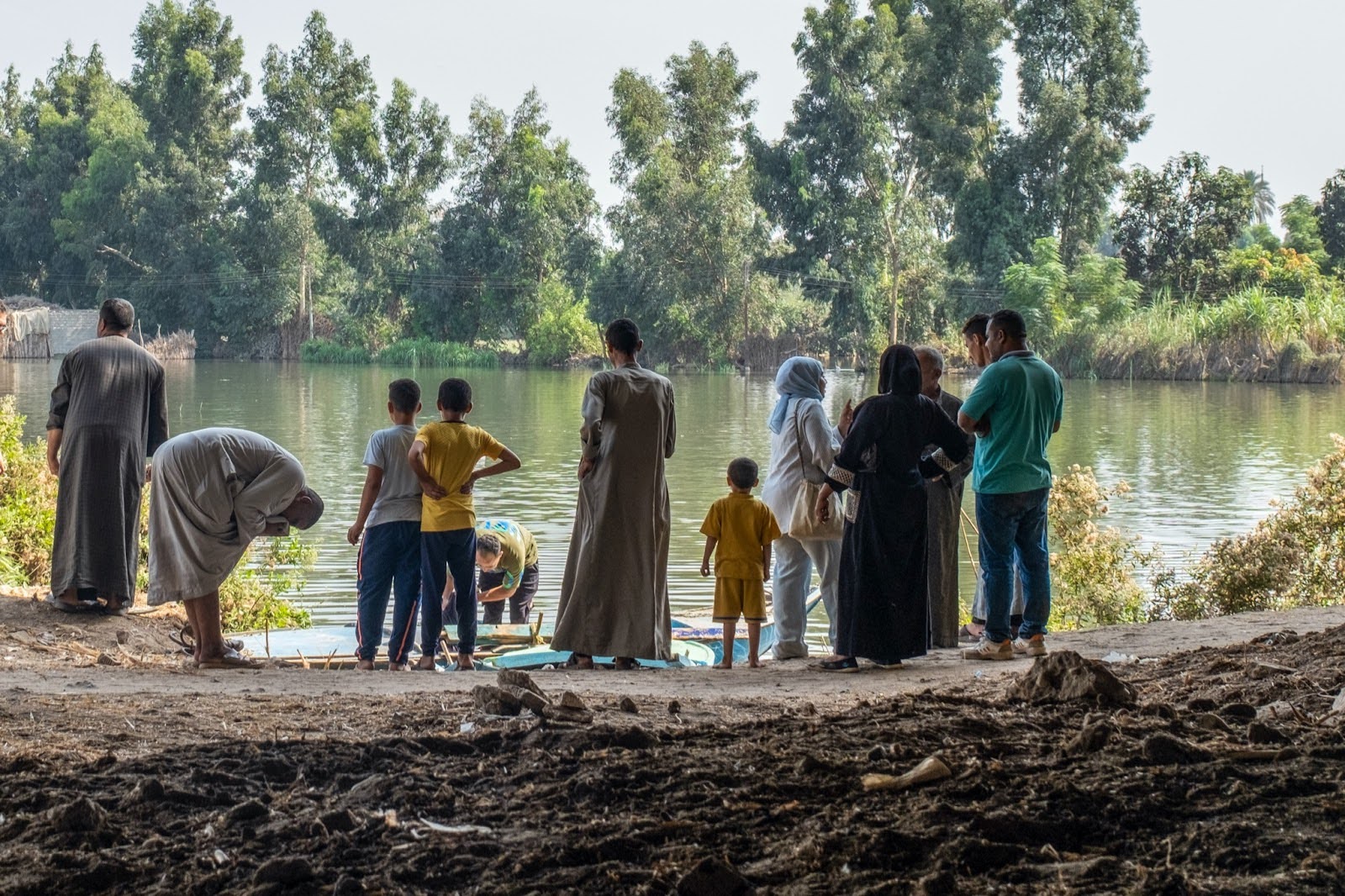
On the threshold of her home, Fayza is sitting washing some utensils in the Nile River that is now at her doorstep.
The washing done, she prepares to head out. She picks up an oar in one hand and the rope tied to the front of a small boat in the other to steady it. For her and her family, there are only two ways to make it from their home in the middle of the water to the outside world: the small boat, or by wading through the water for 15 minutes.
Fayza’s house is built in what are called tarh en-nahr lands, low-lying areas along the riverbanks that have, for decades, acted as natural basins absorbing excess water from the seasonal floods. These lands lie in what is called haram an-nahr, or the river sanctuary — where construction and permanent farming are prohibited by law. The haram an-nahr’s land is state-owned but has long been leased out to small farmers under usufruct contracts.

The people of tarh en-nahr are accustomed to the Nile’s annual rise, adapting their lives around the seasonal flooding. That is why Fayza's family and another family pooled their money to buy the small boat to manage during “flood days.”
But the water levels have been climbing higher in recent years, and this year, it was unprecedented. Fayza’s flooded house in the village of Dalhamo is among 1,261 feddans of farmland and 131 homes inundated in Monufiya and Beheira governorates in recent weeks.
What made this year’s flooding so bad and why were families like Fayza’s so susceptible to the rising waters?
It depends on who you ask.
In the weeks since the flooding, the Irrigation Ministry has placed the blame first on Ethiopia and secondly on the families themselves, who they accused of encroaching on state lands.
But for researchers and residents of the area, the picture is more complex. Any answer about why the floods hit Dalhamo so hard, they tell Mada Masr, must start with the village itself.
***
Dalhamo’s story begins with the construction of the High Aswan Dam in 1969.
Up until that point, tarh an-nahr lands were used as natural flood reservoirs, former Farmers Syndicate head Farid Wasel tells Mada Masr.
With the resulting decline in seasonal floods that came with the dam’s completion, the state began leasing those lands to farmers under usufruct contracts, Wasel says. Over time, they evolved into residential areas complete with basic infrastructure — houses, electricity, sewage systems and roads.
In the common imagination, the High Dam has meant that the banks of the Nile no longer overflow.
But that is not exactly the case. Though the annual floods never matched this year’s severity, they have long been part of life for those who live on these lands. To cope, some families set up temporary huts, where they stay for a month or two until the floodwaters recede, guarding the shelters at night to protect them from theft and looting.

Mohamed Ezzat, who has lived in a house on these lands in Dalhamo since 1996, says his day during the floods begins at 5:30 am. He carries his eldest son on his shoulders and wades 200 meters through the water to the other bank. Then he goes back twice more to take his two younger sons to school. Three morning trips, repeated again at noon when they return.
Ezzat also rents a small fishing boat that he shares with another family for LE300 per month, to help during the flood season. “If my son gets sick in the middle of the day and there is no boat, I carry him on my back and walk across the water,” he said.
In addition to the cost of the boat, Ezzat also pays LE4,500 a year to the Irrigation Ministry for his home and farmland under the usufruct system. “The land yields LE25,000 every six months, after deducting the cost of fertilizers, tractor and harvesting,” he said. Between all that and the daily expenses, his income barely stretches.
But this year, the floods wiped out his entire crop of beans and wheat. “I lost a planting cycle, and all our work went to waste,” he told Mada Masr. The damage didn’t stop there. His house, too, now faces the risk of collapsing.
After this year’s floods, however, the Irrigation Ministry denied that residents had a right to live on tarh an-nahr land, stating that they had brought the losses upon themselves.
In a statement on October 3, the ministry stated that residents had encroached on the flooded lands, planting crops and erecting buildings on them. These areas are not designated for permanent agriculture, which, the ministry said, is why losses occurred. The ministry warned against false claims of “governorates drowning.”
Blaming residents for unauthorized construction overlooks the fact that the state itself provided them with services, which is an implicit admission of their presence, Wasel says. “The citizens alone cannot bear a disaster of this scale,” he adds. “The state must assume its responsibility for social protection. We are talking about hundreds of families who have been living and farming there for decades. The government is obligated to do its part regardless of how it classifies their legal status.”

Karam Saber, the director of the Land Center for Human Rights, tells Mada Masr that the majority of the tarh en-nahr lands are rented by small farmers. The plots are usually very small — some farmers cultivate parts of them, while others have built homes on them.
While acknowledging that using the riverbanks for construction is against the law, since they are leased exclusively for agricultural, an irrigation and hydraulics professor previously told Mada Masr that “the Irrigation Ministry collects annual fees from farmers in exchange for usufruct rights — between LE3,000 and LE5,000 per feddan — so it is not logical now for the ministry to abdicate its responsibility.”
***
The other target for blame in the ministry’s October 3 statement was Ethiopia, for what it described as the upstream country’s “unilateral actions” in managing “its illegal dam in violation of international law.” The ministry said these actions “lack the most basic principles of responsibility and transparency, posing a direct threat to the lives and security of downstream nations and expose beyond any doubt the falsity of Ethiopia's repeated claims that it causes no harm to others.”
President Abdel Fattah al-Sisi doubled down on this point in an October 12 statement, saying the floods in Egypt and Sudan presented “actual evidence proving the validity of our demand for a legally binding agreement to regulate the operation of this dam.”
“This makes it imperative for the international community in general, and the African continent in particular,” the president continued, “to confront such reckless actions by the Ethiopian administration and ensure the regulation of water release from the dam during drought and flood seasons.”
But while the lack of transboundary management of the dam does pose problems for Egypt, water resources professor Nader Nour Eddin says Egypt had plenty of time ahead of the water’s arrival from Ethiopia, and that the waters that flooded Monufiya and Beheira were the result of a preventive discharger.
The water journey from Ethiopia to Egypt takes about 17 days, meaning that the water Ethiopia released on September 26 did not reach Lake Nasser before October 10, and after that, it needs around another 15 days to reach the Delta, Nour Eddin says. This means that the recent flooding resulted from preemptive measures taken by the Irrigation Ministry to lower the High Dam's storage capacity in advance of the expected flood.
Echoing Nour Eddin’s analysis, water resources expert and professor at the National Water Research Center Safwat Abdel Dayem also points out that signs of flooding had appeared in Sudan in early October, and with Lake Nasser filling up, it was natural to drain part of its reserves in anticipation of the coming wave from Sudan.
Former Irrigation Minister Mohamed Nasr Eddin Allam adds another aspect of timing that played a role in the floods. The flooding coincided with the end of the summer cultivation season — when water-intensive crops are grown — and the beginning of the winter season, which requires less water. This, combined with the increased discharges, led to the overflow of cultivated lands, he says.
Allam stresses that the crisis underscores the need for coordination among all three countries before taking any action related to dam management. He points to Ethiopia's continued refusal to sign a binding agreement on the filling and operation of the dam — one that would allow it to achieve its development and power-generation goals while safeguarding the water security of Egypt and Sudan.
According to the Egyptian ministry’s October statement, Ethiopia was expected to begin filling its dam gradually from early July to the end of October, then release water in an organized manner throughout the year to generate electricity — a process meant to protect Sudan from flooding while maintaining Ethiopia’s power supply.
Instead, the statement read, Ethiopia stored more floodwater than anticipated, then opened the spillway gates for a few hours during the dam’s inauguration on September 9. Massive volumes of water — estimated at 780 million cubic meters — were then released on September 27 and flooded Sudanese farmlands and villages, according to the ministry. The surge from the dam coincided with delayed rainfall and unusually high flows in the White Nile river.
The Ethiopian government denied Egypt’s accusations, saying instead that the dam contributed to reducing risks and regulating water flows. “Without the GERD, the heavy rain that occurred over the past few months in the Ethiopian highlands could have induced historical destruction to human life and infrastructure in Sudan and Egypt,” the Ethiopian Water and Energy Ministry’s statement read. The ministry stressed that it has established “the necessary framework for the exchange of information and cooperation with Sudan.”
***
On the ground in Dalhamo, however, the question of what to do now that the water is here was more important than where it came from.
The day following the ministry’s statement, on October 4, dozens of Dalhamo’s affected residents gathered. Some carried documents, while others simply stood in expectant silence. Around them were officials from the Health Ministry and the governorate, Red Crescent teams and charitable organizations. Ambulances lined up next to a mobile medical convoy, while police officers moved among the crowd. Every now and then, a resident’s voice rose, demanding temporary shelter or urgent assistance after the Nile swallowed up their land.
Red Crescent staff moved to record household data and direct people to medical convoys and ambulances. “Field teams are currently working on a comprehensive assessment of families' health, economic and housing conditions, in coordination with the Social Solidarity Ministry and charities,” a Red Crescent employee told Mada Masr.
Thirty-nine families in Dalhamo completely lost their homes and have no other shelter except the lands that were flooded, an official from a charitable organization, who was present in the village, told Mada Masr. Hundreds of other homes were also damaged, but the families have alternative housing. Aid groups have begun distributing blankets and food supplies to affected families, while some are still staying under a nearby bridge.
A few meters away from the Red Crescent and charity workers, the Health Ministry’s undersecretary in Monufiya, Amr Mostafa, was giving instructions to doctors and staff about the medical convoy’s operations. “As soon as we were aware of the rising water levels, we directed health directorates to increase hospital readiness and monitor any affected cases,” Mostafa told Mada Masr. “We also ensured that medical staff and supplies were available and sent out small convoys — mobile clinics equipped with doctors and medicines — to reach the encircled villages and respond to residents’ urgent needs.”
But despite the presence of medical and relief teams, the voices of the affected residents remained the loudest and most urgent. “We want housing. That's the most important thing. We’ve been asking for years. We’ve been living here since 1980, and we’re tired,” one resident says.
In one of the hastily built wooden shelters, several residents sat together after their homes were flooded. “The water drowned us, so we came here with our livestock,” Samia says. “When the water recedes, we’ll go back.”
Beside her sat Hala.
“We can't even find a place to sleep in the hut,” Hala says. “Some people managed to prepare a place for themselves, but we’re still sitting in the water. We lift the beds a little to sleep. We don't know where to go.”
Fayza and her family are sure of what they want. All they ask for is “clean and humane” alternative housing. They no longer want to live isolated but for a boat on tarh en-nahr land.
تقارير ذات صلة
After extreme weather, killing and kidnapping in Bir al-Abd, and people flee raids by gunmen in Abu Araj
A civilian was shot dead by the military in Bir al-Abd, and another was kidnapped by militants.
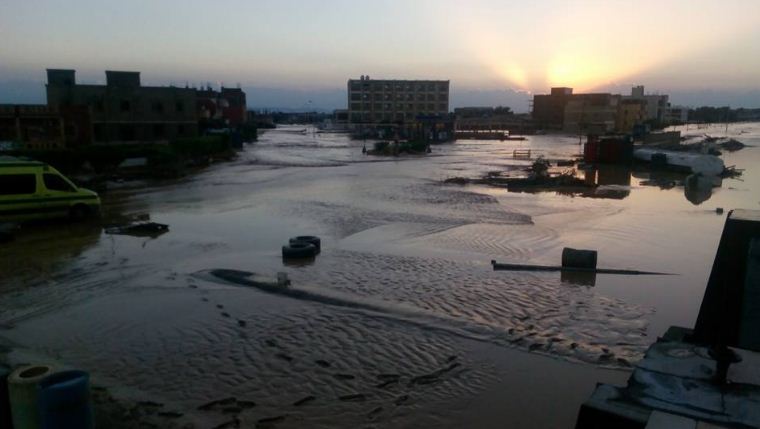
The recurring crises of torrential rains: Who is responsible and how do we deal with it?
Despite expecting annual torrential rain, Egypt continues to suffer from the damaging effects of flooding, raising concerns over preventative measures in place and post-crisis management.
Your support is the only way to ensure independent, progressive journalism survives.
You have a right to access accurate information, be stimulated by innovative and nuanced reporting, and be moved by compelling storytelling. Subscribe now to become part of the growing community of members who help us maintain our editorial independence.
Join us