
Emerging from the generic: Sobhy Guirguis
“Sobhy Guirguis: The Self and the Other,” a selling exhibition at ArtTalks on view from February 4 to 25, marked the first anniversary of the artist’s death at the age of 84.
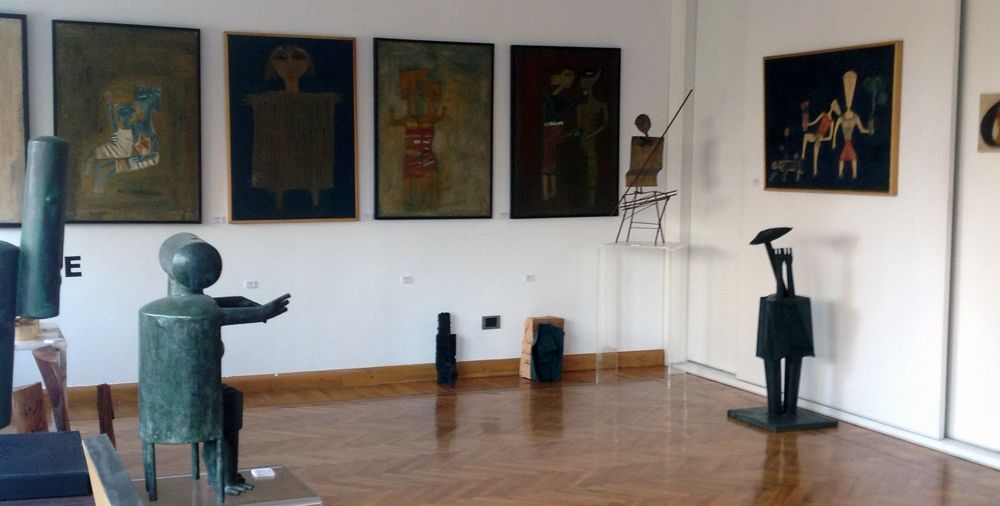
The works in the show, oil paintings on canvas and sculptures of bronze and brass, all shared certain elements. They were all figurative, generally with one or two, occasionally more, stylized human forms in simple poses, standing or reclining. Each figure had a long, straight, thin nose taking up a large part of a square, round or triangular face, and cursorily drawn or modeled eyes. Each was three-fingered and three-toed. They often had an endearing child-like feel about them, with cartoonish proportions and slightly comic, stunned expressions. Many of the works had roughly textured surfaces.
Some featured primitive mechanical instruments — a spindly wheel, for example — reminiscent of pharaonic artifacts. Some had the large eyes typical of Coptic art. All had subdued earthy colors. Overall, the initial effect of the 60 works displayed in the large room, split up into sections labeled with large black vinyl text on the walls, was of the familiar, slightly nationalist nostalgia of a large part of Egyptian art production of the 1960s and 1970s. But many works turned out to be looser and quirkier, funnier and more modest than that mold normally allows: Guirguis was not taking himself too seriously.

“Rest,” a painting of about a meter high, shows a short, mouthless, blimp-like figure balancing horizontally on a pale chair outlined in black. The figure is dressed in a black abeya-like block, and the painting has the umbers, ochres and dim greens of the other paintings. Like them, it also has a large black version of the artist’s signature: “Sobhy G.” The figure lies there, staring at you, its short legs extending stiffly into the air. It is somehow quite real, and a bit funny.
Most of the paintings had empty, void-like backgrounds, and many had sketchy rough brushstrokes, almost impasto. They had simple wooden frames, and like the sculptures, very straightforward titles.

“Fun” is unusual in that there are multiple figures and it has a still empty, but busy, multicolored background. A large sitting figure with a kite-like head built around the frame of the long pointy nose is surrounded by smaller figures doing various activities, like skipping or playing a pipe. It’s in the section titled “The child within,” and its painterly background gives it some sensuous fluid movement that contrasts with the austere filling-in of the other, more static paintings.
The sculptures varied from almost life-size to quite tiny. They often had patinas, generally dull and rust-like, but with some of the smaller ones bright paint-like red and green. They ranged from smooth and bulky to ragged and spindly, some consisting of thin flat metal planes stacked or balanced on top of each other. Apparently Guirguis would often model the work out of wax and use the lost-wax technique to cast in metal, which explains the rough surfaces.

The 50-cm-high “Wisdom” has an uneven disk for a face, the long nose with a round protruding hollow eye on each side, and a small beak-like mouth underneath. It has two tall, pole-like square legs, modeled onto a flat square base with rough-ridged surfaces. A hook-like arm extends from the shoulder of its body to hover around its eye. Despite the title, it’s more like the figure is wiping away a tear than rubbing its chin to think.
“If” is one of the playful small bright sculptures. Several green spikes stick out from the back of its flat rectangular red head. The thin wavy upright plane that its body consists of has writing on it, emphasizing its cartoonish nature.

In the more generic painting “Love” (1990), two pale thin figures with large heads sit facing each other in profile, ancient Egyptian style, on a bluish background only broken by the large black signature, which protrudes into the male figure’s thigh.
The exhibition display was a nice cross between a museum show — with the vinyl phrases, and wall labels with the title, medium, price and sometimes date of the work in English — and a homey, salon-style hang with many works close to each other, diverse types of plinth, and the smaller sculptures lined up underneath paintings. The disadvantage to this was that with many sculptures (like “If”) pressed so close to the wall you couldn’t walk around them, but only see them from the front.
The period in which Guirguis came onto to the scene was when the Ministry of Culture was gaining control of it, under Gamal Abdel Nasser. Many artists of the time, like Guirguis, seemed to make figurative works about the struggle of humanity in general, with nothing too specific or political but with certain nationalistic leanings reflecting Nasser’s interest in Egyptian identity, its strength gained from being part of the Arab world, Africa and Islam. (Other examples could be said to include Kamal Khalifa, Gazbiya Sirry and Gamal al-Sighiny.) Art got less specific, focusing on a vague figurative spirituality with folkloric and ancient Egyptian ingredients. Guirguis’s works seem to clearly belong to that period.
It also looks like Guirguis was one of those artists who spend their lives developing one motif. Originally a sculptor, he graduated from years of art study in Cairo in 1958, and afterwards spent time in Italy. He discovered painting relatively late. From the 1970s onward Guirguis received a fair amount of state support, making public sculptures, winning awards and exhibiting in various biennials, including Venice in 1976. He later had exhibitions at the now defunct Espace Karim Francis and took part in the second Nitaq art festival in downtown Cairo in 2001. A semi-public museum (with no website) devoted to his work was set up in Agamy, near Alexandria, in 1988. It has 50 sculptures on permanent display, and a large “Seated Woman” sculpture outside.

Today, ArtTalks represents and manages the Guirguis’s estate, and its director, Fatenn Mostafa, says the show exceeded her expectations in terms of sales. Curated by Mostafa, it had several good, stand-out works that emerged from the vagueness that characterized similar work made during the artist's time, largely due to Guirguis’s unselfconscious light touch.
All images courtesy ArtTalks/Sobhy Guirguis Estate. ArtTalks: 8 Kamel Mohamed Street, Zamalek, Cairo 01003970141.

Jenifer Evans
Jenifer Evans is an artist and editor. She was Mada Masr's English-language culture editor from 2013 to 2017, while co-running with Taha Belal an art production and distribution outfit called…
تقارير ذات صلة
Buyer beware, part 1: The rise of art fraud in Egypt
The legal case recently launched by the family of late Egyptian modernist artist Abdel Hadi al-Gazzar (1925-1966) against art forgery has opened a Pandora’s box. The investigation seems to be…
A busy year for culture in Egypt, despite everything
An alphabet of important cultural events from 2013.
Lara Baladi’s Cosmovision
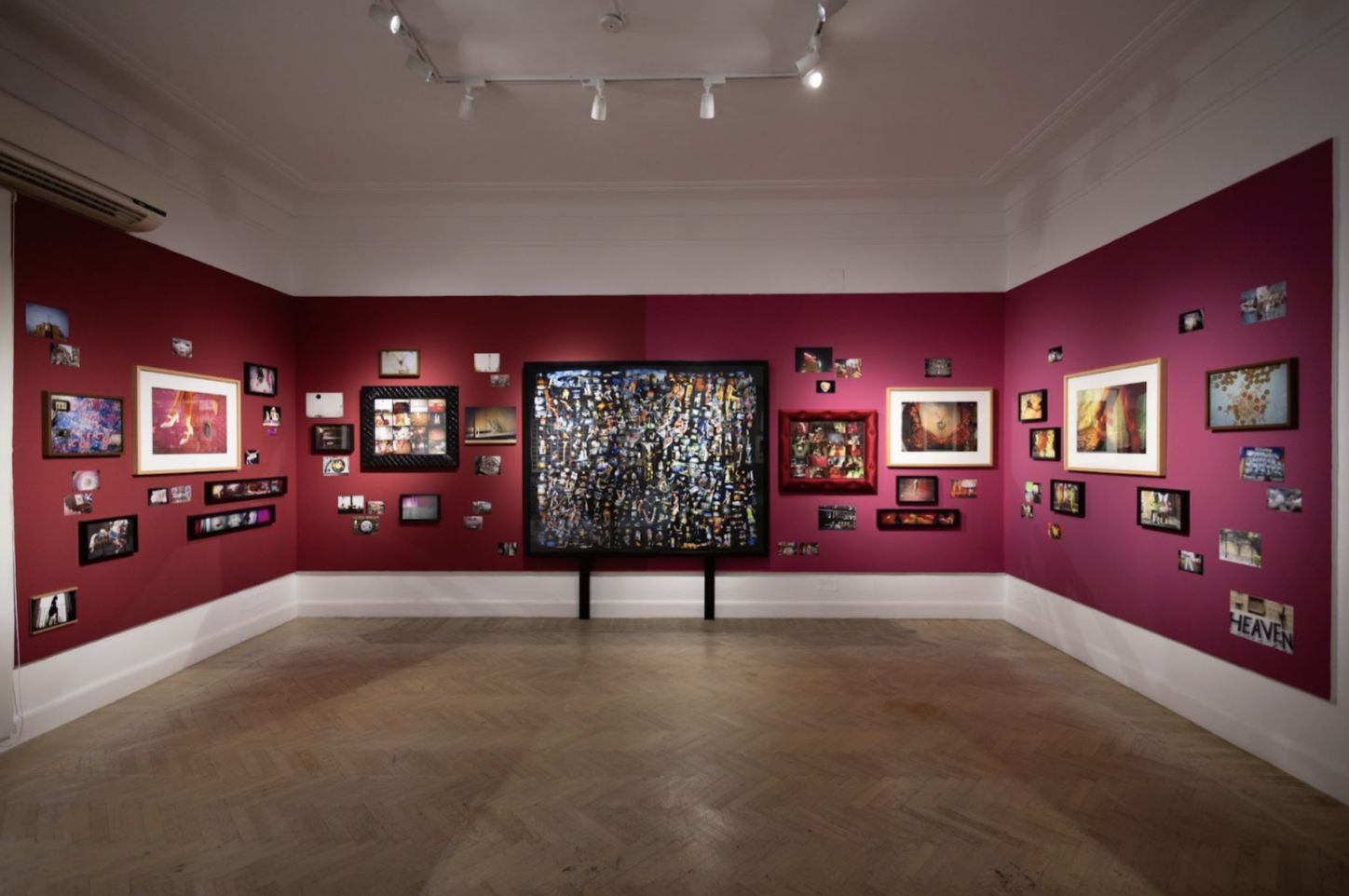
In Cosmovision, Lara Baladi breaks down photography’s cadre into a discursive unfurling of her becoming from 1996 to 2011, autobiographically performing the logic of the white cube. Shown at Tintera,…
Your support is the only way to ensure independent, progressive journalism survives.
You have a right to access accurate information, be stimulated by innovative and nuanced reporting, and be moved by compelling storytelling. Subscribe now to become part of the growing community of members who help us maintain our editorial independence.
Join us