
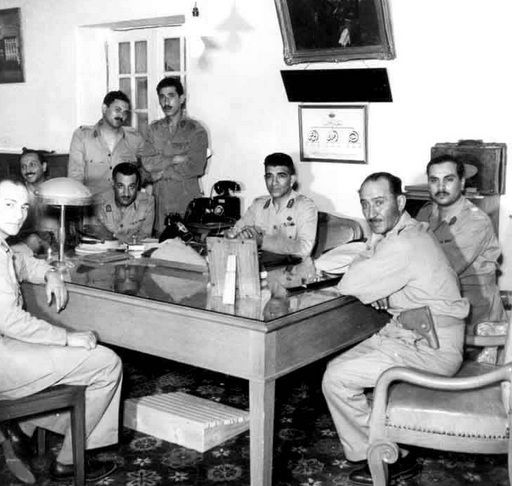
In the office of the Egypt’s Knights party, using titles is more than a matter of courtesy.
The party was founded in August by retired military officers, and even as they venture into civilian political life, most of the members continue to refer to each other by their cherished military ranks.
“In our military oath we say, ‘I will never abandon my weapon until my death.’ We don’t say ‘until my retirement.’ This weapon can be a word or political work," says former General Abdel Rafe Darwish, a founder of the party and strategic expert
"I have fought in four wars, and I consider this to be my fifth,” he adds, referring to his work in the party.
The retired army men initiated Egypt’s Knights at a strategic time. While a party headed by former military men might have been criticized as a not-so-subtle militarization of political life just a few months ago, today, their military backgrounds are more likely to boost the party’s mainstream popularity.
Ever since Armed Forces chief Colonel General Abdel Fattah al-Sisi forced former President Mohamed Morsi out of power on July 3, the military has been hailed as the savior of the people. Since then, the presence of the Armed Forces in political life is not only more accepted, but even encouraged by many.
Darwish thinks the officers’ involvement in politics is a matter of necessity.
“We found that all the parties on the scene are all talk and no action, and are only after power,” he claims.
He saw a gap in the political scene that he thinks only military men can fill. Officers retire at a young age with a unique set of skills that is needed in Egypt now, Darwish insists.
In addition to the ethics and commitment that the military life instills in them, Darwish says that members of the Armed Forces study political science, state building and other sciences that prepare them for political work.
With typical army pride, Darwish says that the party’s name reflects the qualities of knighthood, which also characterize military men. Thanks to their background as soldiers, the party’s leaders are selfless and their only goal is the good of the country, he asserts.
The party is keen on promoting its image as civilian in nature, though it doesn’t deny it maintains strong ties with the institution it hails from, and also has militaristic ambitions.
According to Darwish, retired officers constitute only 15 percent of the party’s members. The presence of renowned politicians such as Ahmed Darrag — a cofounder of Mohamed ElBaradei's Dostour Party who resigned and recently joined Egypt's Knights — helps polish its civilian image.
The party came into the scene with an ambitious and well-researched platform.
“We are not here to be one of 70 parties in Egypt. We have to be the number one party in Egypt!” Darwish confidently declares.
He defines the party as moderate, liberal and committed to Arab nationalism. Egypt’s Knights will run for all seats in parliament and will have a presidential candidate, who would be withdrawn if Sisi runs for presidency, Darwish vows.
“Egypt needs a president who is firm and strong; it needs a president like Gamal Abdel Nasser,” he says.
The party has been working on the ground for months to forge strong relations with the youth, and sponsor income-generating projects to support struggling families, Darwish says, adding that it has offices in most of the country’s governorates.
The party’s agenda focuses on youth development and employment, and developing projects supporting mothers and people with special needs.
One project initiated by Egypt’s Knights is to expand the use of solar energy in Egypt, while another is a long-term program that aims to prepare young athletes for the 2023 Olympics.
The party believes that security should be prioritized above all else. Darwish proposes a preemptive security approach, which would ban all protest activities until the security situation in Egypt stabilizes.
He also suggests that the country adopt a proactive approach when it comes to external threats, and conduct a military offensive against the Palestinian political faction Hamas, which he holds responsible for ongoing attacks in Sinai.
Despite a strong crackdown against Islamist parties and the violent dispersals of Muslim Brotherhood sit-ins that resulted in hundreds of deaths on August 14, Darwish thinks the current interim government is too lenient.
“Protests should happen on sidewalks. If you step into the street you get shot in the foot, if you go into the middle of the street you get shot dead — that’s how it should be,” he firmly states.
For Darwish, Egypt’s Knights represents the best platform to connect military prowess with civilian politics.
He says, “Retired military men are the first line of defense for the military. If it asks, we will cooperate with it, just as we would cooperate with all national powers.”

Heba Afify
Heba Afify, known in journalistic circles as H, is a news reporter who traveled between working for local and international newspapers. She covers a variety of topics from high to…
تقارير ذات صلة
Residents of Qalyubiya agricultural area face eviction to make way for state housing project
It remains unclear how they will be compensated for the loss of their properties
Egypt, IMF agree to smaller loan after sticking points prove political nonstarters. But will it be enough?
Egypt's refusal to acquiesce to two conditions ultimately reduced the value of the loan

Meet the newly remade Union of Sinai Tribes, the force taking over the fight in Sinai
The militant group now faces a new challenge amid an unprecedented level of tribal mobilization.
Your support is the only way to ensure independent, progressive journalism survives.
You have a right to access accurate information, be stimulated by innovative and nuanced reporting, and be moved by compelling storytelling. Subscribe now to become part of the growing community of members who help us maintain our editorial independence.
Join us