
Egypt’s human rights strategy is finally out, but will bring few ‘major developments’ in criminal justice reform, says source
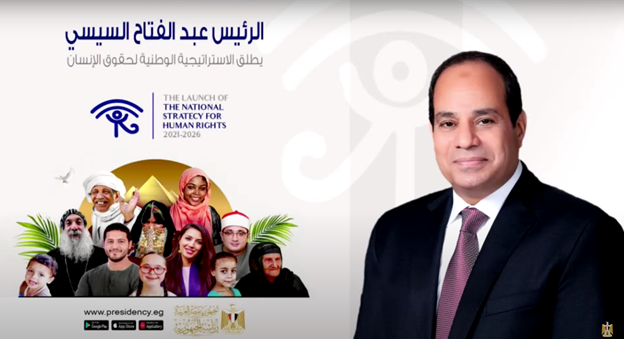
Egypt launched its first national human rights strategy in a high-profile ceremony on Saturday attended by the president, foreign minister and Cairo’s permanent representative to the United Nations that marked the culmination of months of planning beset by delays in the rollout.
In his brief remarks introducing the strategy on Saturday, President Abdel Fattah al-Sisi encouraged civil society to work alongside state institutions to "spread awareness of the human rights culture and to contribute to achieving the aspirations of the Egyptian people.”
However, the president also stressed that the aims of his government stand in stark contrast to those of the January 2011 revolution, which saw millions of people take to the street to oust former President Hosni Mubarak and demand social justice and an end to systematic and widespread human rights abuses.
“The year 2011 and the January revolution were a death certificate for the Egyptian state,” Sisi said, before describing a meeting he had with media professionals in 2011 to discuss the challenges facing Egypt at the time. “My words haven’t changed. I didn’t say ‘bread, freedom and social justice.’ I said that the revolution was an announcement. And I am saying it again now, after time has passed and things have changed, that in my estimation, it was an announcement of the Egyptian state’s death certificate.”
Echoing his past emphasis on state-building, Sisi acknowledged that his government is facing economic problems that have had an effect on the services that the state can provide, citing several examples in education, health care and rural infrastructure, but stressed that he is doing the best he can to fulfill the state’s role of finding solutions even as more can be done.
“My words are honest, sincere, honorable, understanding and aware, and awareness is one of the most important human rights of our country,” Sisi said.
At no point in his speech did Sisi address the state’s handling of political opponents or the abuse of remand detention, which has seen countless people held in custody beyond the two-year term limit by bringing new charges to a “reset” the term limit.
The 78-page strategy, which has been in the making for months and of which Mada Masr obtained a copy after it was submitted to all concerned bodies for review in June, does explicitly address some of the problems in Egypt’s criminal justice system which have long been targets of criticism.
While sources close to the drafting of the document present the strategy as a positive step, human rights workers that Mada Masr spoke to are critical of the state’s failure to meet basic tenets of human rights centered on accountability and restitution for violations.
The strategy contains four areas of focus: 1) civic and political rights; 2) economic, social and cultural rights; 3) women’s rights, children’s rights, disability rights and elderly rights; 4) education and capacity building in the field of human rights.
In the civil and political rights axis, the strategy calls on Parliament to draft legislation to reduce the number of charges in the penal code for which people receive “freedom-limiting sentences” and to implement alternative penalties for the failure to pay debts from contractual relationships.
The strategy also states that there is a need to review the charges to which the death penalty applies and asks state authorities to look into “alternative digital solutions” to remand detention to avoid transferring detainees to courts unless when absolutely necessary, a practice that already began during the COVID-19 pandemic. Remand detention hearings have served as a forum where some detainees can document the abuses they have faced in prison.
In responding to the documented abject conditions of Egyptian prisons, the strategy states that there is a need to continue modernizing punitive institutions, build new prisons, guarantee the periodic prison visits by the National Council for Human Rights — which have been criticized as cosmetic public relations visits — advocate against torture and investigate all torture claims as well as protect torture victims’ rights in accordance with the Constitution, the laws and Egypt’s international agreements.
With regards to litigation and justice, the strategy stipulates the need to guarantee the confidentiality of victims of crimes in cases where the disclosure could lead to personal harm, despite the high profile Fairmont Hotel rape case in which, days after an official complaint was submitted, four of the main witnesses were arrested amid a smear campaign accusing them of debauchery and of framing the men accused of the rape over personal issues.
For the freedom of expression, the strategy affirmed the right to exercise freedom of expression and peaceful assembly, both of which have been severely constricted following the controversial 2014 protest law that has served as the grounds to arrest thousands of protesters and the prosecution’s practice of arresting people for social media posts critical of the state on charges of “disseminating false news.” It also stated that violations should be addressed within the framework of the Constitution and relevant laws, that the state must protect journalists and reporters — who operate in a media landscape nearly completely controlled by the intelligence and have faced abuses and imprisonment — and that there is a need to issue laws to regulate the right to obtain information, data and official statistics.
The strategy also calls for the state to increase its coordination with civil society organizations, the private sector and funding agencies, to support the state’s capacities. With regards to professional and labor unions, the strategy urges the state to provide unions with resources to ensure that elections continue to run and to pass legislative amendments on the matter of providing unions with security guards. As for political parties, the strategy talked about the need to build capacity, leadership skills and organization skills among party members. In recent years, the state has manipulated elections for labor union leadership, both houses of Parliament, and cracked down on non-state aligned efforts to practice parties.
Additionally, the strategy included a section about the state’s commitment to review official educational curricula and the media to purify them of any discourse that goes against the principles of reconciliation and tolerance and promote any kind of hate or extremism. In the same vein, the strategy stated that the state should fight all forms of incitement with proper legal measures. The same section mentioned the “renewal of religious discourse” and the need to continue legalizing churches, despite criticisms of the state’s role in exacerbating sectarian conflicts.
For lawyer Negad al-Borai, one of the civil society representatives who attended the state’s consultation sessions to draft the strategy, the recommendations that form the civic and political axis are the weakest in the state’s new strategy and will not lead to major developments in remand detention or political prisoners.
However, Borai, who praised the strategy as marking the first time the government has committed to specific measures within a stated time frame, attributes this impasse to violations being not related to the need for instituting more laws or regulations but to the Public Prosecution’s failure to fulfill its role. Echoing the incremental progress outlined in Sisi’s speech, Borai stated that Egypt has a base to build on when it comes to healthcare and education, but when it comes to political and civic rights, “we’re just beginning.”
However, Egyptian Initiative for Personal Rights Director Hossam Bahgat tells Mada Masr that President Sisi's speech and everything that has been published about the strategy so far represents a misdiagnosis of the challenges facing the country. The basic principles of human rights, Bahgat says, are putting an end to human rights violations, holding those responsible for violations accountable and then compensating the victims of these violations in order to prevent their recurrence.
“What we heard on Saturday is that the people are the problem, that people suffer from backwardness, extremism, excessive procreation and lack of awareness. The weakness of the state’s administrative apparatus and the systematic and repeated violations that are widespread throughout the country are not, from the government’s point of view, among the challenges facing the human rights situation in Egypt,” Bahgat adds.
Discussions around the human rights strategy began in mid November of 2018, when Prime Minister Mostafa Madbuly issued a decision to establish a Permanent Supreme Committee for Human Rights to be headed by the foreign minister and to include members from the ministries of Defense, Interior, Justice, Parliamentary Affairs and Social Solidarity, as well as the General Intelligence Service, the Administrative Control Authority, the national councils for Women, Childhood and Motherhood and Persons with Disabilities, the Public Prosecution and the State Information Service.
Madbuly assigned this committee with the task to manage the human rights file, replacing the Human Rights Committee in the Justice Ministry and the Universal Periodic Review National Committee in the Parliamentary Affairs Ministry. The decision outlined specific responsibilities for the new permanent committee, one of which was to put forward a national strategy for human rights and its implementation plan.
But the new committee took 20 months to meet for the first time following Madbuly’s decision and started working on July 2, 2020. In October of the same year, it announced that it had come up with an initial draft for the strategy. The committee’s general secretary and the interior minister’s human rights advisor, Ahmed Ehab Gamal Eddin, described the strategy as an “Egyptian roadmap and vision for what we want for Egypt in the near future.”
The committee finished writing the strategy on June 1, 2021, according to two government sources that participated in the writing and who spoke separately to Mada Masr. Both of them stated that the final version of the strategy was presented and approved by all the concerned state institutions, including the security bodies, ministries, councils, authorities and committees involved in its writing, in addition to the president’s office.
The government was initially set to launch the human rights strategy June 20 in a small event inside the Interior Ministry. However, the presidential office intervened to postpone the launch.
One of the two government sources told Mada Masr on condition of anonymity that the most likely reason why the launch was postponed was the presidency’s desire to hold a big event with the participation of Sisi himself and a number of official authorities, public figures, civil society organizations and a few foreign ambassadors to Egypt. For the source, Sisi’s desired attendance at the ceremony was meant to be a pledge to ensure that the strategy is implemented by all of the state’s institutions.
Borai told Mada Masr that the Egyptian Embassy in the United States had previously announced the date of the strategy’s launch on its official Twitter account and tagged the US State Department, which was followed by angry replies saying that the strategy mainly aims to appease the United States, which has been a critic of Cairo’s human rights abuses. Shortly after putting out the tweet, the embassy deleted it and posted another tweet just announcing that the strategy will launch soon.
While Borai believes that the embassy’s announcement was impulsive, a diplomatic source told Mada Masr that the human rights file will continue to be a sensitive issue in US-Egypt relations, adding that during Abbas Kamel’s visit to Washington DC in June, many US public figures and members of Congress reiterated that their support to Egypt is tied to the latter’s progress on its human rights situation.
The diplomatic source, who spoke on condition of anonymity, added that the Egyptian authorities had an expectation that Egypt’s role in brokering a ceasefire between Israel and Hamas in Gaza would help lessen the criticism made by the US against Egypt’s human rights situation, but that didn’t happen.
Over the past year, several high-profile political detainees, some of whom had been held in remand for long past the two-year legal limit, were released from detention, helped by lobbying from the International Dialogue Group, a body led by former MP Mohamed Anwar al-Sadat, which has been presenting release requests to security bodies as well as the head of the Senate. In a recent interview, Sadat emphasized the need to practice politics grounded in reality.
“For many years, civil movements remained in the category of releasing denouncing and condemning statements, which didn’t bring about any results. On the contrary, things got worse. Engaging differently with reality is the solution to helping others and opening real communication channels between both sides,” Sadat said.
At the beginning of this month, charges were dropped and travel bans were lifted for five high-profile figures in civil society after a decade-long investigation into over 20 non-governmental organizations accused of receiving foreign funding to harm national security.
According to several current and former officials who spoke to Mada Masr on condition of anonymity earlier this year, as former US President Donald Trump’s election defeat became clear, officials at the Foreign Ministry prepared a series of memos outlining a number of proposals intended to maintain Cairo’s relationship with Washington under an administration led by Joe Biden and to reassert Egypt’s standing as a key ally, as its historical influence and relevance in the region have steadily waned over the preceding decade.
The memos, which were circulated to the foreign minister and to the president, suggested several domestic policy changes intended to ease criticism of Cairo’s crackdown on political opposition and civil liberties. The memos also proposed a number of foreign policy measures concerning Israel-Palestine, Libya and elsewhere, aimed at reestablishing Egypt’s value as a regional partner to the US.

تقارير ذات صلة

Confinement and disruption: How children are coping with the pandemic
“We have to look after ourselves as parents, otherwise we can’t help them.”
Port Said rape case raises questions about Child Law
On November 13, five-year-old Zeina Arafah was found dead in the coastal city of Port Said with her bones crushed, severed brachial arteries, haemorrhages and signs of shock due to…
The children of the revolution
A few meters away from raging battles between protesters and security forces on Qasr al-Nil Bridge were dozens of children playing Chutes and Ladders. At the neighboring Mugamma administrative building in Tahrir Square, a play area…
Your support is the only way to ensure independent, progressive journalism survives.
You have a right to access accurate information, be stimulated by innovative and nuanced reporting, and be moved by compelling storytelling. Subscribe now to become part of the growing community of members who help us maintain our editorial independence.
Join us