
The children of the revolution
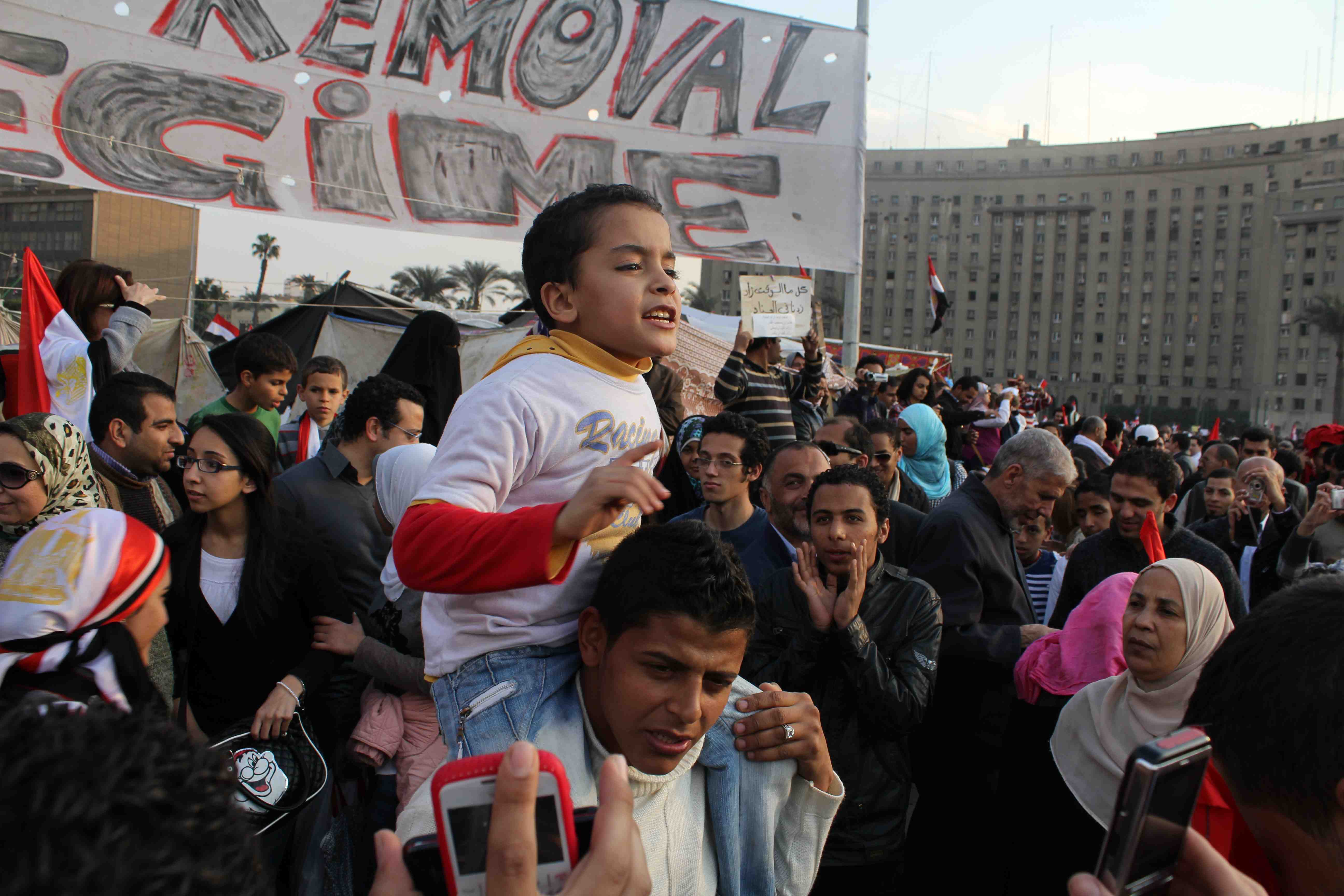
A few meters away from raging battles between protesters and security forces on Qasr al-Nil Bridge were dozens of children playing Chutes and Ladders.
At the neighboring Mugamma administrative building in Tahrir Square, a play area was set up, housing several games and activities, aimed at keeping street children out of harm’s way during ongoing clashes last January.
The initiative is part of ongoing efforts by the Popular Campaign for the Protection of Children to safeguard street children, who often fall victim to violence, detention and torture during protests.
Under military rule, Human Rights Watch documented 43 cases of children being tried before military trials in 2012. The campaign estimates more than 1,000 children have been tried in military courts since the army took power in February 2011.
A recent report by the Egyptian Coalition on Children’s Rights said the Interior Ministry detained 383 children since the second anniversary of the January 25 revolution that led to the end of former President Hosni Mubarak’s rule.
The campaign also claims that 30 percent of the detainees since January 25, 2013 were children. It obtained footage of children being tortured, injured, killed and detained with adults, violating the law.
Usually on the front lines of the most intense confrontations, children often express a strong sense of purpose as they fend off tear gas canisters and rubber pellets. Having stood witness to a revolution, some feel it is their duty to protect it.
However, Maha Maamoun, member of the campaign, stresses it is society’s responsibility to protect children.
“Children see it as a game with the Interior Ministry,” she explains. “It touches on their sense of adventure, this back-and-forth with Central Security Forces.”
Maamoun explains that street children, otherwise marginalized, are enjoying the attention they have been receiving since the revolution.
“People used to treat them like they were worthless, but the revolutionaries started embracing them and gave them that sense of worth and dignity,” she says. “These are things they never felt before.”
Maamoun points out that the children are thus always fighting on the side of the revolutionaries, “not the Islamists and not the Mubarak supporters.”
Protesters also provided street children with shelter during sit-ins, Maamoun says, which helps keep them around.
“They are part of the movement,” she says, “but it is our duty to protect them.”
By the same token, Nelly Ali, a member of the campaign who is known for her work with street children, believes children’s engagement with protests should be “symbolic.” She explains that it has to be “organized, protected and monitored.”
Ali, a human geographer doing a PhD in international childhood studies at Birbeck College, University of London, says there are efforts on the ground to convince children to leave areas where protests are taking place and where violence might flare. While that may work for some, she says, others are adamant on staying behind, “often protecting those who are not as familiar with the streets as they are.”
As Egypt braced itself for mass protests scheduled for June 30 calling for early presidential elections, the Popular Campaign for the Protection of Children hoped to make sure children are not caught in a flurry of violence.
Over the past few weeks, the campaign has been working on an emergency plan, which entails deploying volunteers at gathering points, such as Tahrir Square or the Ettehadiya Presidential Palace, to protect children and keep them away from danger zones.
Maamoun says there will be about 50 people — volunteers and social workers — who will be working in shifts during the protests.
Maamoun explains that the volunteers will be scattered around meeting points, to try and discourage children from participating in the protests or engaging in potential clashes, and talk them into joining the nearby activities.
The campaign has been organizing workshops to train volunteers to identify street children and how best to work with them.
“Volunteers are taught about the kind of danger they could face when dealing with street children, not just from the children themselves, but from their ‘leaders’,” Maamoun says.
A “leader,” Maamoun explains, “is someone who exploits these children, be it sexually or financially, and they may not be that much older than the child himself.”
These initiatives, however, are not exclusive to turbulent days.
Riad Abu Zaid, responsible for the fieldwork at UNICEF, says social workers are trained and deployed to the streets every 20 days to record and monitor cases of street children, as well as organize activities including field trips, games and crafts for them.
During any clashes, however, Abu Zaid says, the volunteers focus on sports activities, which attract the largest number of children.
Volunteers may also encourage them to stay temporarily in a nearby existing shelter, which will also acts as a rehabilitation center that can provide medical attention and legal aid as needed.
Abu Zaid says volunteers have already been on the ground for the past two days, encouraging children to go to shelters. He explains that the campaign will wait and see how the protests go on Sunday, and will decide whether to set up play areas if violence breaks out.
Maamoun says the “shelter’s doors are always open, it’s not a prison … it’s a place where the child can learn, play and is offered different services.”
She says some children naturally resist the idea of leaving the protests and moving to a shelter.
“We don’t take anyone by force, we just give them our contact information so they will know where to find us,” she says.
The Popular Campaign for the Protection of Children works with a network of different child welfare organizations, such as Save the Children, Resala, National Council for Childhood and Motherhood, and UNICEF.
Ali emphasizes the need to promote the campaign’s hotline, 01155500600, so that bystanders can help keep children away from violence, or so specialists can offer legal aid to detainees.

Dalia Rabie
Dalia has a pragmatic perspective on things and has a way of telling it just like it is. This informs her professional practice, with all the humor and wit that characterize…
تقارير ذات صلة
Media businessman Mohamed al-Amin arrested for assault of minors at orphanage he funded
Amin was personally approached by the government to fund the care home in 2020

Innocence behind bars: The fate of Egypt’s minors at the mercy of criminal and military courts
Mada Masr looked into 35 cases of minors who have appeared before criminal and military courts

Sexual assault of 3-year-old exposes school, legal failures
The mother of a three-year-old boy raped by a 36-year-old security guard at a private school in Nasr City last month screamed for justice outside a police station after receiving…
Your support is the only way to ensure independent, progressive journalism survives.
You have a right to access accurate information, be stimulated by innovative and nuanced reporting, and be moved by compelling storytelling. Subscribe now to become part of the growing community of members who help us maintain our editorial independence.
Join us