
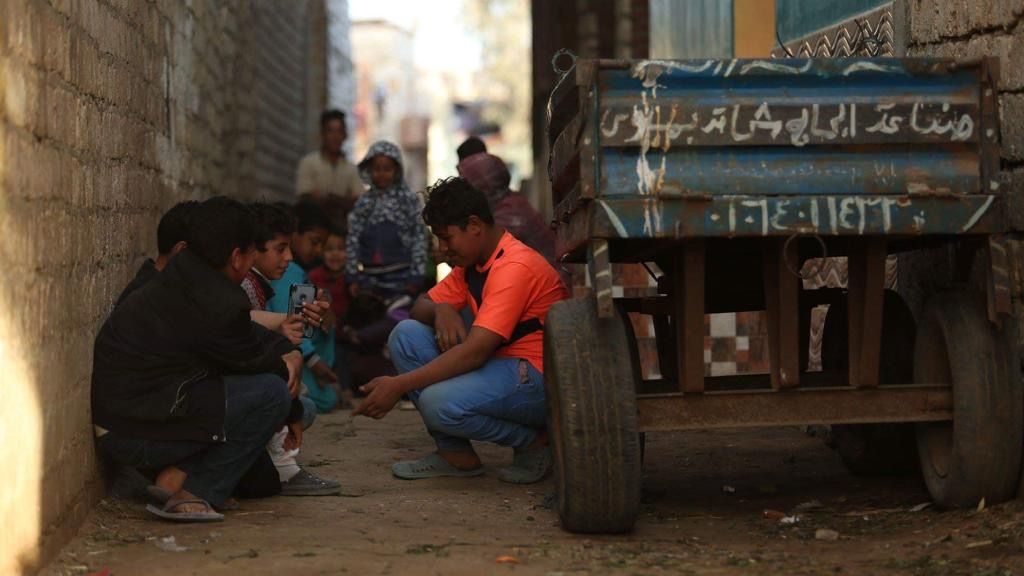
The place: Tanta, Gharbiya governorate, in a reception hall that is violating the ban on wedding parties. The scene: The door to the hall is closed, just in case. A security guard stands outside watching for any approaching stranger. From the camera in my hand, I am mistaken for the wedding photographer and permitted to pass.
The guard knocks on the door three times before it opens, perhaps a prearranged signal with the person on the other side. He takes a drag of the cigarette he has just lit, opening the door with one hand and raising the cigarette to his mouth with the other. With one eye squinted shut against the cigarette smoke, he looks at me with a half-smile, waiting for me to admire his cleverness. Then, turning his face with the leisurely slyness of a fox, he grabs the bottle of Dettol next to him, first spraying me then anointing my camera. He blows cigarette smoke in my face as he closes the door behind me. The opening strains of that Hassan Shakoush song reach me from the few speakers in operation.
“Have a blast,” he says. “There’s no corona in there.”
A piece of cake and an ice-cold soda are suddenly handed to me by someone — a preliminary act of hospitality before the main meal. The someone blows me a kiss and gestures. “Stretch out your hand, don’t be shy!” he says.
I am struck by the sense that there is an implicit agreement inside the hall among the family and wedding guests — who considered me one of their own as soon as I entered — to ignore the outside world and the panic over the COVID-19 pandemic.
I imagine this entire scene would be beyond the comprehension of, say, my mother. She already believes it is near suicidal for me to live alone and eat in the street these days — what would she do if she saw me in such a compromising position as this?
But the situation I found myself in was about more than my need to be outside to try to make a living. It was about more than the attitude of my fellow villagers, who mean no harm to themselves or others when they joyfully gather and generally do not realize the risk or consequences of their actions. It was, I think, about more than this.
Living in the midst of a pandemic, when the only protection is to stay home and maintain distance from other bodies indefinitely, our thoughts about people’s ideas and feelings and what is happening around us are given an unusual freedom to wander. Scientists say we are facing a terrible pandemic that could keep us locked in our homes, not just for a few days, but for months on end, barring the discovery of some unexpected cure.
In the here and now, our criminal act of nihilism poses questions. These questions will not save us from the pandemic, nor do we want them to drag us into the mire of existential angst that is unfortunately increasingly common these days. But let us nevertheless ponder these questions together from our small, isolated rooms, and use them as a common starting point from which we hope to move forward: How does a human being who lives amongst us, who has the same access as we do to traditional and social media, who sees, hears and reads all about the panic caused by the coronavirus cases and deaths, remain unperturbed? Has the crisis revealed anything new to this person or to us? What are they aware of in their indifference?
Leave your logic at the door and step with me into another world, one with its own logic and context — a world we will try to think about together without the Orientalist theorizing that flattens understanding with the confidence of university credentials while ignoring the school of life.

Nihilism of the Egyptian village
In contrast to nostalgia for the idyllic countryside, often imagined through the lens of old films, the countryside today differs little from the city; it shares much of the city’s ugliness, save for a marginal degree of refinement of the air and the people within.
Whereas the city is suffocating and buried alive by traffic, the village is blighted by naked, haphazardly-engineered architectural eyesores, the streets piled with trash whose stink is enough to lay you flat. There are, of course, exceptions to both of these generalizations, but the basic premise holds. I know this prelude is annoying, but it’s necessary as a starting point for talking about the reality of villagers with a degree of abstraction, yet without embellishment or baseless speculation.
Nihilism is the fundamental, animating idea for this character, who comes in many guises. They do not only inhabit only the countryside. You can spot this type of person anywhere, and examples populate the furthest reaches of southern Egypt all the way to Alexandria, with many to be found in the city. After a spot of conversation with him, you’ll find that on the surface they share the same material, moral, and cultural conditions as his peers in any other country: he grinds away at a job for a pittance; he has long been removed from any real self-awareness or health awareness; he has a mobile phone, internet, and television, and knows what’s happening in the world, but he feels it all has nothing to do with him.
With my own ears, I’ve heard him say the same thing in four different governorates — in addition to Cairo, where I live, and Giza, the other half of the city I frequent, where work has taken me since the beginning of the coronavirus lockdown. In any conversation with our friend about the need for quarantine and the use of disinfectants and masks, you will hear, with few exceptions, the same cynical tone. You might hear the same thing from young people, old men, and women in Tanta as you would in Monufiya, Qalyubiya or Fayoum. Not just the same general meaning — the same dismissiveness and disregard for the virus — but the very same words, which invariably end with, “It’s in God’s hands.”
I heard the same thing during the January 25 revolution and its aftermath, in its aftershocks and failures that were as lethal as the virus for some. They saw themselves as wholly outside these events as well. Most people, in fact, are of this type. They literally do not see themselves as capable of influencing any event or anything apart from themselves — anything that they may see on television or online, which is utterly disconnected from their real lives.
Their jobs (which their terrible financial circumstances do not permit them to leave or to pressure their employers for paid leave) and their wages (which do not allow them to buy luxuries like disinfectants and masks) make it difficult for them to take this unseen viral hazard seriously. It is most certainly no greater a hazard than the poverty they experience daily, which engulfs them and overwhelms everything else.
In another governorate, far from Tanta and Gharbiya, I was sitting with some people while wiping down my camera lens. A man approached me, his hand extended in greeting. When he sensed my reluctance to extend my own hand, he laughed and said, “Doesn’t the coronavirus only affect people with a weak immune system? The Egyptian people eat shit all the time. What are you worried about, basha, so long as you’re Egyptian? It’s in God’s hands.”
I’ve got a wound no doctor in the world can cure
In her book, Medicine and Physicians in Egypt: The Construction of a Professional Identity and the Medical Enterprise (1997), French scholar Sylvia Chiffoleau discusses how Egyptian doctors thought of the plague in the 19th century. The same thoughts seem to persist with little change: The plague is the will of God, a punishment from God that we can only submit to acceptingly. Every faithful person should stay in his town as the plague sweeps through, sure in the knowledge that he will only be struck down if God ordains it, in which case he will be a martyr. If you hear that the plague is rampant in a city, don’t go there, but if it comes to your town, stay where you are.
This advice was taken from prophetic sayings, stripped of their context, and relayed by doctors themselves, not only ordinary folk, amid the 19th-century plague. Things have not changed; you hear the same thing today.
Discussing the throngs of Muslim pilgrims during the hajj, Chiffoleau quotes Dr. Salah Sobhi, who once traveled with the pilgrims as a health inspector. If maritime travel in the Mediterranean in the 18th century was an important factor for the spread of plague, he said, the spread of cholera in the second half of the 19th century could be chalked up to the hajj. These intractable crowds and their incomprehensible determination find echoes today in some people’s defiance of orders to shut down mosques.

In the Fayoum governorate, I heard of a man who owns a large grocery in the village who closed it down in solidarity with the mosques. After the dusk prayer, I listened as not a small number of people discussed the permissibility of praying over deceased coronavirus victims and how their bodies could be washed.
Leaving it all to God and His beneficence as a manifestation of devotion and obedience is the essence of a religious conception in whose efficacy these people believe. Its adherents do not toss it aside or mock it or even know it is there except in dangerous times like these.
While this indifference angers some on social media, I think of the child whose parents let him do every rotten thing at home then ask him to be calm and respectful when among strangers, heedless of all those years they should have taught and instructed him. Of course, these people are not children, and there is no one who is wholly responsible for their error, but their limited education and awareness, a result — through no fault of their own — of grinding material and moral injustice and of marginalization, affects their judgment of the importance of certain things. Perhaps that injustice and marginalization is more worthy of anger and mockery.
There’s another story, from decades ago, when bilharzia afflicted around 70 to 80 percent of the population, running rampant in rural areas but affecting urban areas as well. An employee at the Cairo dye works died of schistosomiasis. In a paper published in the Egyptian Medical Association’s journal and cited by Chiffoleau, Dr. Mohammed Khalil Abd al-Khaleq concluded that 24 percent of dye workers were infected with the same parasite that caused the man’s death, primarily because the government decided to let sewage drain into the Ismailia Canal. The very same government then turned around and asked these hungry, unlearned impoverished people to mind their health and demanded that doctors do something about the disease.
The Egyptian medical equation remains unsolved, ultimately defeating everyone, from the time of Imhotep, the first Egyptian physician in history, down to my doctor friend, who I expect will have a stroke brought on by his agitation since the appearance of the virus.

In Youmiyat Tabib al-Aryaf (Diary of a Country Doctor), a memoir written by Dr. Cornelius Buqtur more than 50 years ago, though still relevant today, Buqtur says, “I feel I cannot do much for my patients. I do my best to practice my profession … but they do not need medicine. They need food, sanitary housing, and an awareness capable of absorbing the principles of health in order to maintain it.”
Dr. Kamel Yaqoub, a contemporary of Buqtur’s in the 1960s and 70s, gave voice to the same idea in his memoir, Youmiyat Tabib (Diary of a Doctor, 1961), when describing the village: “Life is as unmoving as stagnant, brackish water. The days are all alike, the faces the same, and the peasants unchanging, just like the sounds that reach me from the window. Even the patients are unchanging … ignorant and dirty.”
The unvarying life of the village has overtaken the city as well, while ignorance and filth have assumed more complex forms. The soil on clothes has become less embarrassing sweat, produced by villagers and city-dwellers alike as they eke out a few crumbs to tide them over until another day of work, in which they are denied freedom, leisure, and just recompense. Unadulterated ignorance has been transformed into a compound ignorance that looks like knowledge. People know things and are aware of them through their phone and television, but their material, psychological, and cultural problems make them unwilling to consciously deal with them. It’s better and more useful to pretend they do not exist.
Doctors — whose rights have also been violated since time immemorial — are left with the job of expressing naïve, childlike shock at their ignorant society, a shock for which neither party is to blame and which neither is capable of rectifying. The shock has been expressed in literature like Yehya Haqqi’s Qandil Um Hashem (Um Hashem’s Lantern, ) and films like Sirat al-abtal (Struggle of Heroes, 1962)by Tawfiq Saleh. And it’s heard today still in the complaints of our doctor friends, recited with rote tedium at the café after a hard day’s work.
Nihilist seeks young man for a serious relationship
In her book, Professors of Despair (2004), Nancy Huston says that, with the evolution of European thought, the utopians came to believe that if a person was destined to be educated, it should be put in service of the revolution. The nihilists, on the other hand, believed that since all human actions were meaningless and destined to fail, suicide was the best option. This stood in contrast to nihilism in 19th-century Russia, where the concept did not refer to people who were indifferent to everything, but to radicals whose creed was encapsulated in the question: What is to be done?
Thinker Yuval Noah Harari believes that decisions made today to deal with COVID-19 will change our lives in the coming years in ways we can’t yet comprehend, despite our full awareness of them. This incomprehension seems to utterly consume our friend, that type of person we mentioned, who does not wish to delve into complicated matters when there is a simpler solution right in front of him: Leave the matter to God, who is above it all and can take care of everything without making complex, costly demands. They prefer their nihilism, which lets them risk going to the mosque despite the ban.
This response does not wait for doctors’ orders. It’s the response of a human being in tune with his capabilities and knowledge, with a mastery of his surroundings, whose credibility and logic we are not here to question; a person as proud and unhesitating as a woman in full blossom [a reference to a Mahmoud Darwish poem], as seasoned as an old-timer. Spoken consciously or unconsciously, it is filled with his religious conviction, superseding all the evidence and facts of officialdom; an officialdom that has nothing to do with him, in any case, showed no prior interest in him and does not consider him a real partner except in times of danger or self-interest. It is wholly rational, then, for this person’s response to be, “It’s in God’s hands.”
It’s the system, you sheep
Looking at various prospects and scenarios for the coronavirus epidemic, writer Nicholas Kristof asked: Will we endure more than 2 million deaths, or will we manage to turn things around? Although the article is focused on the United States, it is widely applicable, considering the best and worst cases in light of social distancing, quarantines, and methods of prevention in a developed country. I imagine that more than a few readers, having taken the necessary precautions, might — without fanfare and perhaps in an irrational, intoxicating moment — come to the same conclusion as our friend, though some may very well be atheists. After reading the reports and hearing witnesses, they, too, may conclude that it’s all in God’s hands.
This nihilism born of residual ignorance might be impervious to sudden instructions about prevention, prudence, and following directions — perhaps because it has found a final outlet through which to express itself; or maybe because of problems that are believed to far exceed the epidemic. Maybe it’s because modern medicine the world over has nothing to offer as of yet. Or maybe because you specifically, as an Egyptian, do not entirely trust the health system and administration, which has offered not even a token gesture of good faith that it will protect us and shelter us from the ravages of time.
Even in China itself — portrayed as the source of pandemic, the root of evils, and the Gog and Magog of the underclass — you will find people in the papers talking about fears of a racist showdown that could sideline China commercially “after the pandemic.” You read of European and US responses and discussions and conspiracies being hatched for “after the pandemic.” I say to myself, after the epidemic we’ll meet our dear friend, shoulder to shoulder we’ll stand [to paraphrase Salah Jahin] — but, my fellows, there must first be an after.
But enough of suspect China. I will avoid talking about those city-dwellers who every day must brave the packed metro and buses and inhabit cramped slums where it is easy to pass plates of food from one balcony to the next. I don’t want to be a nihilist and a rude guest. Now I write to you from a front-row seat in the Fayoum governorate, where I’m watching a football match in a village youth center. The same day, a crowded clothes market was set up in Ashmoun, Monufiya. Despite the distance between the two governorates, they were on the same wavelength, although each pursued a different tactic: the football games were played in the morning, instead of at night, while the market was set up at night, instead of during the day, to outsmart the virus. In a scene reminiscent of the old days, when we would run after the street-cleaning truck, I observed the men and youth of the village watch as a truck came and sanitized the streets amid the spirited ululations of women, imbuing the dreary atmosphere with a bit of gaiety.
تقارير ذات صلة

Devaluation drama and hot money’s return: What happened with the pound’s historic plummet?
'As long as there is more demand than supply, the price of the pound will continue to decrease.'
Q&A: Egypt’s emissions, the environment, and the relationship between air pollution and COVID-19
The loudest voices in this area are not those of environmental scientists, but of investors
Q&A with anthropology professor Hania Sholkamy | On the need to rethink social spending as crisis response after COVID-19
The pandemic exposed flaws in the way social protection is thought about in Egypt
Your support is the only way to ensure independent, progressive journalism survives.
You have a right to access accurate information, be stimulated by innovative and nuanced reporting, and be moved by compelling storytelling. Subscribe now to become part of the growing community of members who help us maintain our editorial independence.
Join us