
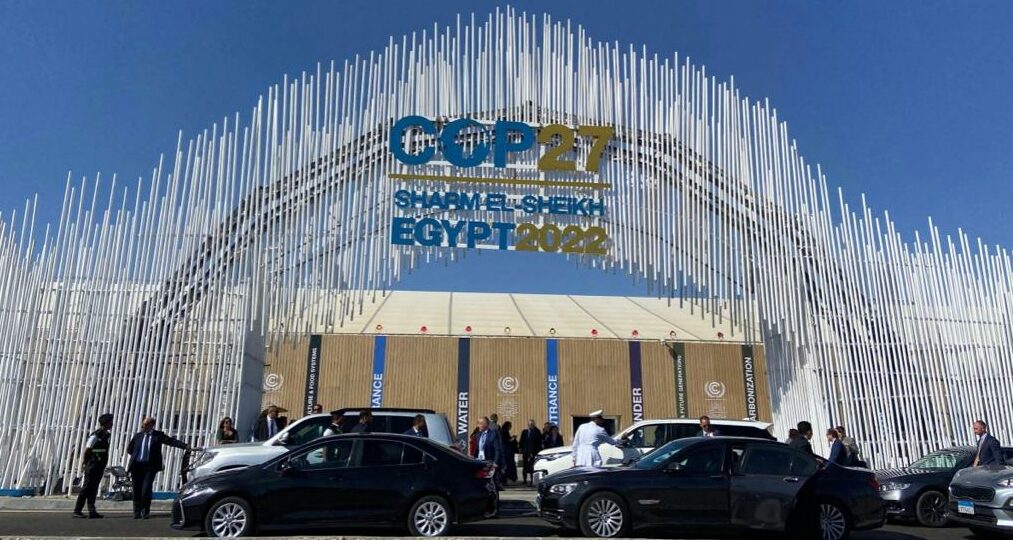
My journey starts each day at 8 am. I take the COP bus that is provided to visitors to the conference for free. The buses arrive every 5 minutes or so. They are all the same but each has a number indicating which route it will take through the city to get to the areas in which COP27 activities are held.
The buses have either a blue or a green sign on top. Blue indicates that the bus is running on natural gas, and green means it is running on electricity. The type of bus, however, does not indicate the length of the ride, and although the destination is fewer than 10 kilometers away, the journey takes almost an hour from Naama Bay to the conference grounds as a result of frequent stops and slow speed. Usually, I spend this hour choosing which sessions to attend and which attendees I would like to meet. A few times, I have spent the lengthy journey chatting with other passengers.
During my first day on the long drive to the conference, my Kenyan friend leaned over to me and whispered in a low, suspicious voice, “Is photography forbidden in your country?” Before I got the chance to answer his question, my friend lowered his voice further and proceeded to tell me a story about one of his colleagues working with a famous Kenyan TV channel being stopped by the Egyptian security forces on the eve of the conference while trying to promote the important summit.
The Kenyan broadcaster was not doing anything out of the ordinary. He set up his video camera in front of his hotel, then stood up adjusting his clothes and reviewing the words he had written about his channel’s presence at the heart of the climate conference. As he began the live broadcast, security forces approached the crew and asked the broadcaster and cameraman for their identification details in full, my Kenyan friend said. Later in the evening, they learned from the hotel management that the security forces had inquired about their stay.
This was strange both for my Kenyan friend and his fellow broadcaster. Why would security forces intervene and interrogate journalists who are officially present in a tourist city to cover an annual international conference in which world leaders discuss the fate of the human race?
As an Egyptian journalist, the behavior was not strange to me. I looked at the ceiling of the bus we were in as I tried to gather my thoughts to justify what happened to his colleague or explain to him the state of journalism and press in Egypt. But it was useless, and I couldn't find anything to say. I smiled, and muttered a response to their earlier question, "Sometimes, yes." Then, I turned to stare out the window, avoiding further embarrassment.
Beyond the wide roads, no one is walking on the sidewalks. Outside the window, I can only see COP visitors either waiting for the bus or sitting in another bus on the road. The city is quiet, and it is not only because of the absence of pedestrians. One of the restaurant workers told me that the security forces told him that should not go out on the street after they finish their shifts. The taxis that once filled the city are gone, too.
But rest assured, security men and their cars spread as far as the eye can see, controlling traffic and ensuring everything flows smoothly. Every once in a while, in the middle of the palm trees, you will find a metal column holding a picture of President Abdel Fattah al-Sisi. Then, you notice the advertisements for the Sharks Bay area in Sharm el-Sheikh, which looks very different now after its “development” to include a massive new yacht marina — transforming the area from a tourist resort abounding in marine life to a yacht marina for the wealthy, resembling the town of Gouna.
Finally, the bus reaches its final destination, where the massive conference hall is located. Inside the hall is “the Blue Zone,” which is secured and organized with the supervision of the United Nations and aided by hundreds of Egyptian security personnel in civilian clothes.
The Blue Zone is reserved for large conferences and high-profile meetings. It is the area where representatives of the countries of the world have gathered annually for 27 years in an attempt to achieve one goal: that human beings do not disappear from existence.
To this end, the Blue Zone is full of serious discussions about terms such as adaptation and mitigation, climate finance, carbon emissions and green transition. Undoubtedly, it is the most important area for the conference. Its significance attracts not only the participants in the conference but also others interested in climate issues all around the world. Climate activists make sure every year to hold demonstrations near the Blue Zone to ensure that the gathered world leaders hear them — but not in the “city of peace” that is Sharm el-Sheikh.
A few days before the start of the climate conference, the governor of South Sinai, Major General Khaled Fouda, toured Sharm el-Sheikh in celebration of the new developments. At one point, near the periphery of the city, he confirmed that this is the area chosen by the governorate to be a space for demonstrations. Fouda stated that “there are cafeterias, restaurants, and umbrellas in the area here. So anyone who wants to demonstrate is welcome.”
But, the government's attempts to stymie gatherings in the Blue Zone were not enough. On the first day, after I entered the conference hall and while I was wandering between its corridors, I was surprised by long lines in the middle of the squares separating the corridors. Confused for a moment, I asked my colleague if something was about to happen, but as I approached them my fears subsided. They're just trying to buy lunch, and I hang around with them for a bit until I remember how important my time is here and I leave. Hours later, I found out that my colleague paid LE345 for a sandwich and a bottle of juice, so I was lucky to have left when I did.
My colleagues and I weren’t just worried about the expensive food. A few months ago, hotels began to prepare for the summit. This “preparation” included a steep price hike, which prompted the Global Climate Action Network, which includes about 1,900 environmental organizations globally, to voice concern about the prices. After the conference began, some hotels canceled the reservations of civil society observers, activists and experts who had already paid for their tickets and booked hotels before arriving in Sharm el-Sheikh.
The Global Climate Action Network reports that there have been many instances in which civil society observers are required to pay two to five times the standard booking price. When they refuse to pay these prices, they are denied accommodation in the event. The organization has directed blame at Egypt’s government for its role in inflating the prices.
Despite the denial by the COP27’s presidency of any government involvement in raising hotel prices, the network viewed a letter signed and dated in Arabic sent by the Egyptian Hotel Association to hotels in Sharm el-Sheikh, describing the summit as a “unique tourism opportunity” and specified the minimum rates for hotel rooms during the conference. In the communication, the cost of a night in a five-star hotel is no less than US$500, and the price in two-star hotels starts from $120.
Amid criticism of the steep prices, President Abdel Fattah al-Sisi issued a decision for event organizers to drop prices by 50 percent and offer water and drink, kiosk workers in the conference told me.
While the first two days that I was at the conference were calm, that did not last long. The environmental focus of discussions quickly turned into a political affair. On the third day of the conference, the Global Campaign to Demand Climate Justice held a press conference, in which it hosted the political activist Sanaa Seif, the sister of writer and activist Alaa Abd El Fattah, who is currently imprisoned in Wadi al-Natrun prison. After the speeches of those present were over, the door was opened for questions. The first question came without surprises. However, the second question was full of them.
In the middle of the audience stands a man who identifies himself as MP Amr Darwish. However, instead of asking a question to the participants in the session, he began delivering a speech in Arabic about Alaa Abd El Fattah, accusing him of “incitement against the Egyptian army and insulting Egyptian women.” Darwish talked about Abd El Fattah's foreign nationality and asked about what he called the "invocation" of his British nationality.
When Saif interjected to call him a “representative of the state,” Darwish took umbrage to the term and began shouting, prompting UN security to remove him from the conference hall.
The day after the expulsion of the MP, I was at the journalists' headquarters in the blue area. I noticed unusual movement among my colleagues, so I asked one of them about what was happening.
“They say something is happening at Gate 1,” he answered.
I quickly made my way to the gate. When I arrived, I found dozens of journalists, photographers, cameras, and some security men, but nobody else.
Journalists and photographers stood looking at each other stupidly. Then a journalist shouted “we almost went to the wrong place. The picture that came to me is of somewhere else.”
The crowd moved to another gate, but we did not find anything there either. On the way back, I asked one of the journalists about the cause of all this commotion, and he told me “the editors-in-chief don’t even know. They all received the same phone call telling them to get the journalists down there because something was happening.”
I was not fortunate enough to be present for the first demonstration in the area. But about half an hour after I returned from the gate, I was surprised to see pictures and videos circulating of demonstrations being held in the place I had just left. Although this may have been one of the few demonstrations that Egypt has witnessed in the past years, it was not the occurrence that surprised me, but rather the people who were participating in it.
The pictures showed a group of children in uniform and women next to them, which reminded me of pictures of childhood school trips. The children carried printed and colored signs showing Darwish's face, which became, overnight, one of the most famous faces in Egypt and the world. Only one girl was holding a sign protesting against ocean pollution, apparently a vestige of the previous day's demonstration. In a television interview with one of the children participating in the demonstration in support of Darwish, the presenter asks what they wanted from the demonstration. The child responds: “Rejecting what’s his name? Alaa? In rejection of Alaa Abd El Fattah and in support of Representative Amr … What’s his name, Amr? Afifi??”
"Amr Darwish," the announcer replied.
However, even after the MP’s name was clarified, the child did not care to repeat it, but rather repeated the sentence. “We are here in support of Representative Amr Afifi.”
***
To get a chance of pace and to distance myself from the supporters of Afifi or Darwish, who seemed to be everywhere, I decided to discover the Egyptian government-supervised “Green Zone.”
I went to attend a lecture on the importance of environmental journalism at this sensitive time. The Green Zone is about thirty minutes away from the Blue Zone on foot, and there is no means of transportation there, even the blue and green buses do not go to this part of the world.
Once you get to the Green Zone, however, the environment feels completely different. The attendees —the vast majority of which were Egyptian— included many medium and low-ranking Egyptian officials, as well as members of the Youth Coordination for Parties and Politicians and dozens of Egyptian channels and newspapers. There were few foreigners in sight.
It was hard to miss the huge sculptures made up of recycled materials representing rabbits, giraffes and other animals that I couldn’t recognize placed on both sides of the Green Zone.
Four speakers led the session being held at the “Roman theater,” where twenty attendees were present — none of whom seemed to show any interest in what was being said. They were instead focused on their phones.
The topics of the discussion were the importance of climate journalism and the difficulties the field faces across different countries. However, when a speaker from South Africa touched on the need to open the public sphere for journalists and researchers and to make resources, like blocked websites, more accessible, the moderator interrupted the conversation and quickly shifted it toward an Egyptian speaker.
At the end of the session, I noticed that someone sitting in the audience was communicating with two girls. He signaled to them to look at their mobile phones, and after a few minutes, the floor was opened to questions. The girls and the man quickly raised their hands, asking meaningless questions like, "how can environmental journalism support the constructive journalism you just mentioned?"
The day and the event were exhausting enough, so I decided to take a taxi to the Blue Zone, which cost me LE80 for a ride that lasted fewer than seven minutes.
At the main entrance of the conference, the road had become flooded. On the opposite side of the road, a car was drawing up the water. The traffic, however, was not being held up by the flood —which occurred as a result of the infrastructure not being built to accommodate the magnitude of people attending the conference.
No, the reason for the halt was that a group of people had gathered in an area of the allocated public spaces between the pavilions, all dressed in green, and bearing the banner of the "Alliance of Civil Forces for Climate" — a coalition that was formally launched only a week beforehand.
Minutes later, a Channel 1 broadcaster appeared, positioned in front of the crowd. The broadcaster began saying something about freedom of opinion and expression and the right to demonstrate.
Then the camera cut. The broadcaster left. The demonstrators took off their green clothes. And they, too, dispersed.

تقارير ذات صلة
Between environmental needs and the profit-imperative: Conversation with Egypt’s chief climate diplomat as govt accelerates green transition
Egypt increased its pledges to reduce the emission of environmentally damaging gasses.
From pushing coal to organizing COP, the greenwashing PR firm Egypt has cozied up to
Hill+Knowlton Strategies has worked to bolster the image of some of the world's biggest oil firms

What’s behind Egypt’s green hydrogen hype?
Many voices caution about the feasibility of establishing a national industry for the product
Your support is the only way to ensure independent, progressive journalism survives.
You have a right to access accurate information, be stimulated by innovative and nuanced reporting, and be moved by compelling storytelling. Subscribe now to become part of the growing community of members who help us maintain our editorial independence.
Join us