
Co-working spaces spread, but lack resources
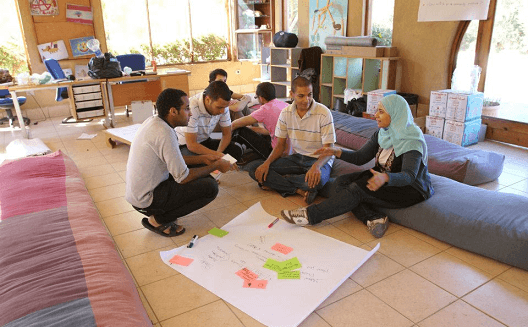
The walls of Al-Maqarr, a co-working space in Cairo’s eastern neighborhood of Heliopolis, are lined with images of its projects.
"During college, we used to hold our meetings in cafes or [youth] centers. This was not a conducive environment to work in,” says the project’s co-founder Sherif Ashraf.
“We started brainstorming in search of a solution that would bring together like-minded youth initiatives and discovered co-working spaces overseas; spaces where you can get work done, connect with other people or learn something new," he explains.
Like elsewhere in the world, co-working spaces have become a growing trend in Egypt. Commonly run by a group of young people who rent an apartment, they provide places for people in different fields to connect and exchange ideas.
Al-Maqarr is open for students to study, hold meetings, brainstorm startup ideas and share skills.
Kareem Rouchdy, an engineer who graduated from the German University in Cairo, used to attend workshops at Al-Maqarr, where he found a business partner to work on a mobile application for mass messaging with. The initiative provides food, an internet connection and consulting services for its users. "It’s full of positive energy and helpful young people, which can't be found in a formal work environment," Rouchdy says.
Rouchdy’s sentiments are echoed by Mohamed Gamal, a computer engineer, who runs online publishing platform Kotobna from Al-Maqarr co-working space. He says this arrangement has saved him LE1000 a month in rental fees. "It's not just a place where you can find services like meeting rooms, a projector, internet, etc. The best thing is that you are part of a network of other people and a community supporting startups, which is very helpful," he explains.
Through his business, Gamal has been trying to respond to what he says is a lack of demand for printed books, by providing young writers with an online publishing platform that people can access through a pre-paid card.
Al-Maqarr also holds networking events where people can exchange experiences and "those who’ve established startups can communicate the obstacles they’ve faced and how they overcame them, so that others can benefit from their experiences and build on them," Ashraf says, adding, "It isn't just about people coming here and paying money to rent a space. We try to provide them with marketing services, promote their ideas and match them up with those working on similar initiatives."
Besides being a business venture, co-working spaces are also about building communities. Al-Maqarr is actively trying to engage the local community in its activities, Ashraf asserts. “We once held a garage sale and asked the neighbors to bring things to sell.”
With this in mind, Rasheed22, another co-working space in Heliopolis, isn’t looking to make a financial profit.
"We aren't just business oriented, there are different ways to pay for using the space," says Ulrike Von Rucker, the founder of a co-working space in Cairo. "People host meetings for others, some buy items for the space. Visitors here carry the responsibility for cleaning the space after using it," she says, explaining that Rasheed22 was furnished by its users and is recycling conscious.
Rucker founded Rasheed22 in 2007 and named it after the street it’s on in Heliopolis. Originally from Germany, she has been living in Egypt for 16 years and came up with the concept after having a baby and working predominantly from home or cafes.
But the legality and financial sustainability of co-working spaces is a concern for those who run and use them. Ahmed Bastawy, co-founder of Icealex, a co-working space in Alexandria that mostly works with technology start-ups, says such spaces need to be more legally credible, as “they exist as social businesses with no legal form in Egypt.”
Icealex’s co-founders are trying to develop innovative products to sell in order to deal with fundraising issues and be more sustainable, although they are also looking for sponsorship opportunities.
But such spaces are still mostly in Cairo and Alexandria, says Salma Rafaat, co-founder of Makan co-working space in Monufiya. "We need entrepreneurs in each governorate to start developing the governorate itself and spreading the culture there."
Rafaat and her co-founders used to meet in their houses to work on projects, due to a lack of meeting spaces in Monufiya. "We created Makan from nothing," she says, "We prepared for seven months … We didn’t have enough money to paint the wood, but our friends helped us. We worked day and night at a time when our families thought we would fail.”
Rafaat and her five partners managed to fill their funding gaps initially by holding activities and courses. But she says they are in constant need of money, as are many co-working spaces in Egypt.
Such spaces have so far mostly worked with the technology sector, something that Anas Mahrous, co-founder at the Maa'mal co-working space in Alexandria, thinks should change. "Most of the investment goes to IT and software development,” he says.
The concept of co-working needs to be marketed to more sectors, Magdy of Al-Maqarr, asserts. "A co-working space should embrace all fields, and include designers, photographers, business modeling and so on, so that when I need someone with specific experience, I don’t have to look outside the space.”
Magdy says such spaces have given entrepreneurs a boost, at a time when there are few opportunities around in Egypt. "If it hadn't been for such entities, we would have left the country long ago."
تقارير ذات صلة
Sexual health and social change: A conversation with Nour Emam of Mother Being
"I have to push myself and leave my comfort zone to reach the people who need this information"
From Fawry to Feloosy, FinTech is finally gaining a foothold
As Egypt’s start-up scene continues to draw attention from global media, expect to hear more about FinTech (financial technology).
Egypt rises to 112 in Doing Business rankings, but officials still displeased
Egypt rose one place to rank 112 out of 189 economies surveyed for the World Bank’s annual Doing Business 2015 report, which measures the ease or difficulty with which entrepreneurs…
Your support is the only way to ensure independent, progressive journalism survives.
You have a right to access accurate information, be stimulated by innovative and nuanced reporting, and be moved by compelling storytelling. Subscribe now to become part of the growing community of members who help us maintain our editorial independence.
Join us