
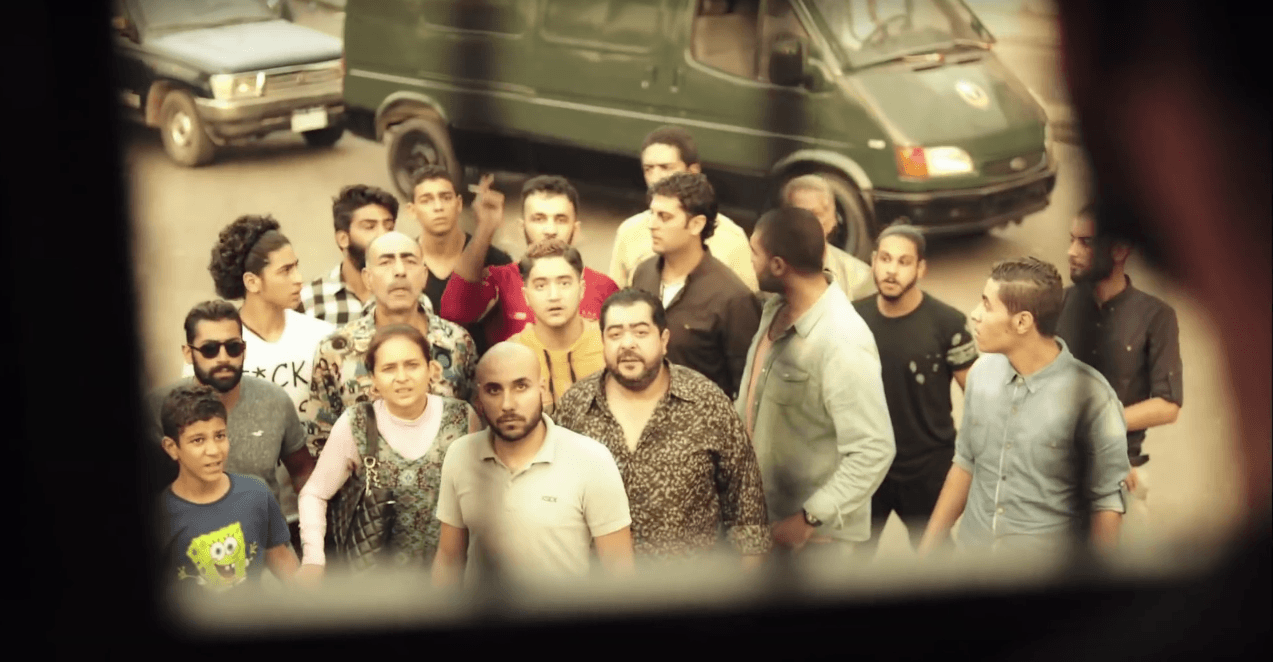
Clash: A uniquely crafted microcosm of Egypt’s sour reality
Like Salah Abo Seif's celebrated Between Heaven and Earth (1959), which takes place in a broken elevator, and Khairy Bishara's surreal Traffic Light (1996), set in a traffic jam, Mohamed Diab’s second feature brings representatives of various factions of society together in a confined situation that they can't get out of.
Just as its predecessors did, Eshtebak (Clash) prompted an inevitable feeling of claustrophobia as I sat through its Cairo premiere this week. Set from start to finish inside a police truck during riots following Muslim Brotherhood-affiliated President Mohamed Morsi's ouster in 2013, it creates a trap for both its actors and its viewers that’s acutely reflective of the current political situation in Egypt.
Having premiered in May as the opening film of Cannes Film Festival’s prestigious Un Certain Regard section, Clash has garnered favorable reviews internationally. While enjoying this positive reception abroad, it received a full-on attack from Egyptian state television presenter Amany al-Khayat. In a report on her show Ana Masry (I Am Egyptian), she accused the Cannes Film Festival of having a political motive for screening Clash. There was also a video report on Diab himself, which pointed at the fact that he studied film abroad and hinted that he gets paid by foreign forces to corrupt the image of Egypt, giving the example of his first feature film, 678 (2010), which tackled sexual harassment.
The report said Diab shows Egypt as a moving prison, as a country that suppresses freedoms and is in a civil war. It claimed that the film's ending suggests the only way out of the crisis is through reconciliation with the Brotherhood – even though the film actually ends on an ambiguous note.
The Egyptian Creativity Front, a pressure group established by artists after the 2011 revolution, has filed a lawsuit against the program. And despite reports claiming that the Ministry of Interior banned the film – which its production company, Film Clinic, denied – Clash will be in Egyptian cinemas from July 27.
The film opens inside the empty, dark green police truck, and we see light from its windows shift around the interior as a written statement gives us a sense of the narrative's timeframe. Then we spend almost 100 minutes stuck in the world of the characters who get picked up by the police one after another, building up to about 20 people in the 8-meter-square vehicle. They include two local AP journalists, one of whom carries a US passport, military supporters, revolutionaries, Brotherhood members, supporters and jihadists.
Nelly Karim plays a nurse protesting against the Brotherhood with her husband and son — when they get arrested, she stands in front of the truck throwing rocks at it in order to get herself arrested too. Karim shines throughout as a protective mother and as a nurse who ends up interacting with several people by treating their wounds. She also supports the only other female character, Aisha (May al-Gheity), an Islamist girl arrested with her Salafi father. Actor Khaled Kamal gives life to a thug, who is also well-scripted and probably the most compelling and layered character in the film.
Fights erupt between the factions represented by these detainees, but also within them. The pro-military group, which includes a middle-class family, two mahraganat DJs and a mobile repair shop owner, call the journalists spies. Some Brotherhood members agree on a leader to deal with their issues, ignoring other Islamist protesters in the truck, which causes tensions between them throughout the journey.
As the truck moves toward the Islamist protest, we see clashes between the protesters and the police through the truck’s windows, creating incredible, carefully planned real-time interaction between the convincingly chaotic, fiery attacks outside and the tense action inside.
The camera never leaves the truck. We only see outside from its windows, doors or rear-view mirrors. The camera's hand-held movement, masterfully created by Ahmed Gabr (678, Asmaa), brings a realism to the film – creating a sensation that we are in the truck, experiencing the fights, hardships, attacks and boiling heat. Another notable moment comes when the truck runs into protesters with laser pointers and the green lines act as the lighting for an otherwise dark scene. This maximum use of our limited sightlines is really where Clash triumphs.
Music also plays an interesting role. In intense scenes where the truck is caught in clashes and tear gas, sounds of thumping and gun shots fade out into electronic music. In another scene, a wannabe mahraganat DJ plays Okka and Ortega's Haty Bosa ya Bet (Give Me a Kiss Girl) on his hidden phone as a way to escape the madness. As we move from a close-up on the young man (Ahmed Malek) to a wider shot of the truck’s interior, the mahragan music becomes a melancholic oud song.
The AP journalist who has been filming the truck's stories with his hidden camera watch (he continually proclaims his desire to get this footage out: “It could change everything”) captures a quiet moment when everyone listens to a Brotherhood member recount his audition for a film in the past. We understand from this moment that all these characters participated in the 2011 revolution. One character says “Those were the best of days.” Silence follows.
More hopeful is the fact that the film emphasizes the similarities everyone shares in this experience. Everyone is hot — so they walk around to take turns next to the window. They share the bottle of water given to them. They give each other privacy to urinate in the empty bottle. And they discuss their football affiliations — Ahly or Zamalek.
Clash also clearly differentiates between the members of the Central Security Forces dealing with riots, who traditionally serve as part of their compulsory military conscription, and higher-ranking police officers. It focuses on the conscripts’ human side, while the officers are portrayed as brutal.
In spite of the heaviness, numerous moments earnt laughter from the audience. Generally, the script by Diab and brother Khaled Diab (both also involved in writing the blockbuster Gezira franchise) is well-paced, with realistic dialogue and characters — which is not to say there aren’t some cliches and unnecessary scenes here and there.
Overall though, Clash is deeply moving and deeply horrific. It captures this pivotal moment in Egyptian history, where the society has become deeply divided and easy to manipulate, and at the same time it is a powerfully visceral filmic experience in itself.
Clash is showing with English subtitles at City Stars in Nasr City, Point 90 in New Cairo, Americana Plaza in Sheikh Zayed City and Nile City on the Nile Corniche.
For another take on Clash, see here.

Rowan El Shimi
Rowan El Shimi is a culture journalist from Cairo, but she often finds herself working on stories all over the country, especially Alexandria. She covers a range of topics in culture, mostly…
تقارير ذات صلة
Unworkshoppable cinema: A visit to the 11th Cairo Video Festival
Recently, I finally got to see Payal Kapadia’s All We Imagine as Light (2024), winner of the Cannes Grand Prix. I was lucky to experience it in a theater and…
The thin thread between misogyny and emancipation
Faten Hamama gives a rare, realistic portrayal of the frustration experienced by women in Egypt

Detox | No drama
#31: Without the drama, though — both on-screen and in all our lives — what's left to explore?
Your support is the only way to ensure independent, progressive journalism survives.
You have a right to access accurate information, be stimulated by innovative and nuanced reporting, and be moved by compelling storytelling. Subscribe now to become part of the growing community of members who help us maintain our editorial independence.
Join us