
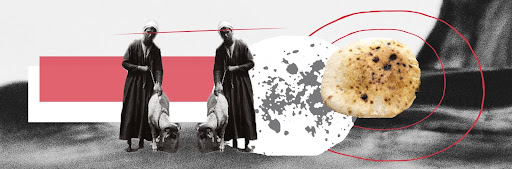
In late October, Supply Minister Ali al-Moselhi announced that the price of a loaf of subsidized bread would remain fixed at 5 piasters for the time being. With the ministry having concluded its pricing study for subsidized bread, all that was left to decide regarding a new price was the “appropriate” timing, Moselhi added.
The minister’s comments came two months after President Abdel Fattah al-Sisi’s announcement that the time had come to increase the price of subsidized bread, which has been nominally stable since the 1980s.
At first glance, these announcements appear to be a stone thrown into still water. Yet, by tracing the political history of bread subsidization in Egypt, the step that the Sisi government seems ready to implement is only the latest in a series of negotiations that have played out since the 1950s over bread’s place as a staple in the diet of most Egyptians, nearly 30 percent of whom live below the poverty line.
The centrality of bread is reflected in the sum allocated for bread subsidies in the government’s annual budget (around LE45 billion for 2021), which has been consistently subject to negotiation between the state and citizens under opposing pressures: the chronic financial crisis afflicting the Egyptian economy and the potential provocation of political and social unrest.
Egyptians consume about 180–210 kg of bread per capita annually, nearly three times the global average of 70–80 kg per capita. This has led to Egypt becoming the world’s largest importer of wheat, producing some 121 billion loaves of subsidized bread per year.
Large scale availability of bread allows Egyptians to restructure dietary patterns during times of economic crisis that elevate poverty rates. In comparing data collected by the Central Agency for Public Mobilization and Statistics (CAPMAS) for the expenditure rates on food commodities by the poorest 10 percent of the population before and after the crises, prompted by the exchange rate liberalization in 2016 and the implications of the COVID-19 pandemic, we find an increase in the consumption of bread, grains and oils compensating for a decline in that of meats, vegetables and fruits. the poor are thus obtaining their necessary calories from the cheapest food: subsidized bread.

The politics of food subsidies in Egypt can be traced back to the 1940s and coincides with World War II, beginning with the subsidization of a few resources on a limited scale to shield the poorest groups from the impact of disruptions to the supply chain caused by the war.
However, the wider public’s entitlements to subsidized food commodities began during the rule of former President Gamal Abdel Nasser. This was part of a new social contract between the state and citizens whereby the latter, from a Nasserist perspective, surrenders “false” political rights in favor of “the freedom of a loaf of bread,” according to historian and Nasser era researcher Sherif Younis in his book The Call of the People: A Critical History of the Nasserist Ideology. The provision of bread was a tool to feed the propaganda machine with the legitimacy of achievement.
From 1952 until the March 1954 crisis that saw Nasser oust Mohamed Naguib and cement the military’s control over politics, subsidized food entitlements were intended to ensure the loyalty of the rural population. Following 1954, the Nasser regime turned its focus to urban hunger and consolidated its legitimacy by intervening in the pricing of goods, especially food commodities, in something akin to a war that must be won by the officers for the people, as Younis describes in his study.
Nasser’s strategy was to raise the standard of living in return for popular support that overlooked the decimation of political rights by granting entitlements that addressed the wealth imbalance of the monarchy era. This strategy relied on top-down policies that served a fragile social contract on the one hand, and disregarded issues such as sustainability and resources on the other. Through this social contract, the regime made itself responsible for providing bread by any means.
Yet, issues of sustainability and resources for the provision of subsidized bread were and still remain the principal question. At the time that the Nasser regime decreased the rent rates of agricultural land for small farmers — the most important pillar of his agrarian reform — to amount to approximately seven times the land tax, small scale farmers were forced to adhere to fixed, below-market pricing for strategic crops such as wheat, according to Saker El Nour and Mohamed Ramadan’s book Mrahrah Bread: The Political Economy of Food Sovereignty in Egypt. Without this measure, the state would have been unequipped with the resources necessary to provide subsidized bread to “feed the urban workforce.”
Yet, behind this disparity between the state-controlled price and the market price for the purchase of wheat was a “hidden tax” imposed on small farmers, according to Ramadan. In other words, small farmers were made into the financiers of subsidized bread and food commodities, facilitating a de facto transfer of economic value from the countryside to urban centers and limiting the capacity of the former to produce financial surplus, which is reflected in the steep poverty rates of the countryside in comparison to cities, Ramadan says.
However, this reliance on the extracting value from the countryside was short lived. Small farmer's role in subsidizing bread was linked to a period when local wheat production surpassed imports in meeting local demand. But by 1961, the ratio of locally produced to imported wheat became equal, and, with the continued decline of local production and the reduction of agricultural land, wheat imports eventually grew to provide for 78 percent of local demand by the mid-1980s.
The increase in wheat imports meant that the bread subsidy system was integrated into the world economy, making it harder for the government to impose price controls. The vagaries of the world economy made themselves apparent almost immediately, as international wheat prices saw a sharp rise during the first half of the 1970s. This was compounded by the fact that, only a few years prior, the Egyptian economy had suffered a recession following the failure of a five-year plan that the state put forward to establish its own productive resources and the subsequent defeat in 1967, which saw military appropriations claim the lion’s share of state resources, a situation that continued under President Anwar al-Sadat until the 1973 war.
Taken together, these factors pushed the state’s debt to a high of US$5.7 billion in these years, accounting for 42 percent of GDP at its high point, according to Half-baked, the Other Side of Egypt’s Baladi Bread Subsidy by Samer Soliman, political economics professor at the American University of Cairo. This led creditors to demand economic reforms that ushered in an agreement between Egypt and the International Monetary Fund (IMF) in 1977 for US$600 million in loans.
The structural adjustments primarily sought to reduce the deficit by decreasing expenditure, which, for the first time, placed everyone in direct confrontation with the fragility of Nasser’s social contract. In Cairo and other governorates, the 1977 bread riots erupted less than 24 hours after the announcement of an increase to the prices of bread and other food commodities in the subsidy system.

With nearly 100 people killed, hundreds injured, and the military on the streets for the first time since 1952, the government decided to backtrack on the price increase. Following the riots, the rest of the decade saw an unexpected expansion of the food subsidy system to include 20 commodities, including red meat, poultry, fish and certain legumes.
The expansion of the food subsidies was not only a political decision stemming from the riots but was made possible, in the opinion of Soliman, by increased rents. By the early eighties Egypt’s economy had several new sources of rents: income from oil, the reclamation of the Suez Canal, the restoration of tourism and the rise in remittances from workers abroad, along with the flow of US dollars to Egypt as a reward for ratifying a peace agreement with Israel. Taken together, this revenue footed the bill of the bread and food subsidy system, which had increased as a percentage of public spending from 15.5 percent in the year of the riots to 20.5 percent by 1980.
Yet again, this was done without ensuring the sustainability of resources or the enactment of policies to improve the standard of living and to empower citizens so they may dispense with bread subsidies.
By the time Hosni Mubarak assumed power, there were three givens: the bread riots were a turning point within the political memory, there was an economic crisis, and there was a need for the regime to establish its legitimacy. The state continued to subsidize bread and food commodities, further increasing public spending. Revenues were growing, but so were the loans to finance the budget deficit, until non-tax revenues collapsed and tax revenues gradually declined throughout the 1980s, falling from 30 percent of GDP to 20 percent by the end of the decade.
Doubts surfaced anew over the social contract between the state and citizens: revenues, a large portion of which financed the subsidy system, were unable to meet the growth in public spending while the authoritarian regime refused to surrender the political benefits secured from subsidization.
In 1987, Egypt sat down again with the IMF to hash out an agreement for an economic program that required controls on spending through an increase in the printing of money, which led to an inflation rate of around 20 percent by the end of the 1980s and to the fall of many below the poverty line.
Pursuant to the agreement with the IMF, Egypt was forced to adhere to an economic austerity program. Gradual yet fundamental modifications were made to the bread and food subsidy system as part of this program, Prices for 10 food commodities initially added to the subsidy system in the 1970s were liberalized, while other goods were excluded by the Supply Ministry from ration cards. The number of people on the subsidy rolls was also cut, with the registration of newborns into the rationing system suspended starting in 1989.
While subsidized baladi bread — with an extraction rate of 82 percent — retained its position as the only food commodity that was not subject to the quota system, making it indiscriminately available to all, its price increased from 1 piaster per loaf in 1985 to five by 1989, and the government terminated its subsidization of shami bread with an extraction rate of 72 percent while continuing to subsidize fino bread with an extraction rate of 76 percent.
While the 1987 agreement with the IMF failed to achieve any of its fiscal goals, Egypt’s participation in the international coalition during the Gulf War led to the cancellation of half of its debts and required it to implement a new structural adjustment agreement with the IMF in 1991. This agreement succeeded in reducing the deficit from 6 percent to 0.6 percent of GDP within four years, but Soliman explains that what succeeded was the financial, rather than economic, reform, meaning there was not a surge in production or growth in individual income.
In the early 1990s, the government identified another, less burdensome method to cut the costs of baladi bread subsidies, which was to reduce the weight of each loaf by 13 percent, from 150 to 130 grams. Moreover, a research paper published by Japan’s Institute of Developing Economies suggested that the Mubarak regime may have deliberately reduced the quality of baladi bread to achieve “self-targeting,” encouraging families to opt for open-market bread if they are able afford it in place of the poor-quality subsidized bread.

In parallel, the state adopted “policies of structural violence,” in the words of Nour and Ramadan, whereby it liberalized the rental rates of agricultural land in 1992 and lifted the government’s agricultural input subsidies through a law that allowed for annual rates to increase gradually from LE200 to LE10,000 per feddan by 2019.
These policies contributed to further impoverishing the rural population, which benefits from only 30 percent of total food subsidies, including subsidized baladi bread, despite being the largest segment of Egypt’s poor according to Andre Croppenstedt, an economics expert at the UN Food and Agriculture Organization.
Additionally, according to Croppenstedt, changes made to the supply chains in the 1990s, most prominently the privatization of a number of links, including bakeries, warehouses and mills, led to a rise in corruption. Incidents of theft, leakage, and waste throughout the supply chain, as well as the resignation of then-Supply Minister Khaled Hanafy after it was revealed that local and imported wheat were being mixed, provide a clear illustration of this corruption.
Throughout the 2000s, the government attempted to reduce subsidies, according to researcher Yuko Ido, by deducting from quotas, raising prices and removing pasta, beans, lentils and ghee from ration cards.
With the global financial crisis and global food crisis of 2008, wheat prices rose by 130 percent, leading to a surge in the cost of importing wheat and a shortage in the supply of subsidized bread. This shortage culminated with incidents of people being killed at bread lines, prompting Mubarak to request the military’s intervention. At the same time, the prices of food commodities soared, with inflation rates reaching 23.6 percent by July 2008. The state was forced to take a step back once again, out of fear of social unrest and the potential negative effects of food shortages, and decided to qualify those born between 1998 and 2005 for ration cards, resulting in the number of cardholders jumping from 38 million in 2008 to 63 million in 2009.
Following the revolution and the restitution of a military-led regime, the government has renewed its conviction that terminating bread and food subsidies is one of the economic reforms necessary due to chronic fiscal crises. The new government took a familiar path with the 2016 restructuring agreement with the IMF, which aimed to reduce the deficit by decreasing expenditures and all forms of subsidies, particularly energy. This is absent any improvement in the quality or quantity of subsidized food items. Sisi's government has also continued the Mubarak-era tactic of reducing the weight of each loaf, gradually cutting it from 130 in to 90 in 2020.
In parallel with a persistent reduction to quotas for poor-quality subsidized bread and food commodities, poverty rates reached a 30-year high in the two years following the implementation of the 2016 structural adjustment program, with as much as 32.5 percent of the population falling below the poverty line in 2019, according to CAPMAS data. Many others now live on the edge of poverty.
Against the inability of development plans to provide quality employment opportunities that could lift many out of the cycle of poverty, the need for the subsidy system and, above all, for bread, is indispensable. No one enjoys being dependent on government subsidy programs. Yet, the reality is “this subsidy program will become unnecessary once general living conditions are improved,” as expressed by development and economic rights researcher Osama Diab, “and thus, if the government is serious and effective with its development goals, bread subsidies will fade away with minimal effort and impact on society.”
تقارير ذات صلة
Bread politics
An eight-part series that takes an in-depth look at bread subsidies in Egypt
Q&A: How to save LE8 bn without raising subsidized bread prices
"This problem must be resolved within a framework of social justice"
The state and subsidized bread: Stuck between a strained budget and public anger
The government appears to be tight-lipped about any potential changes to the subsidy system for now
Your support is the only way to ensure independent, progressive journalism survives.
You have a right to access accurate information, be stimulated by innovative and nuanced reporting, and be moved by compelling storytelling. Subscribe now to become part of the growing community of members who help us maintain our editorial independence.
Join us