
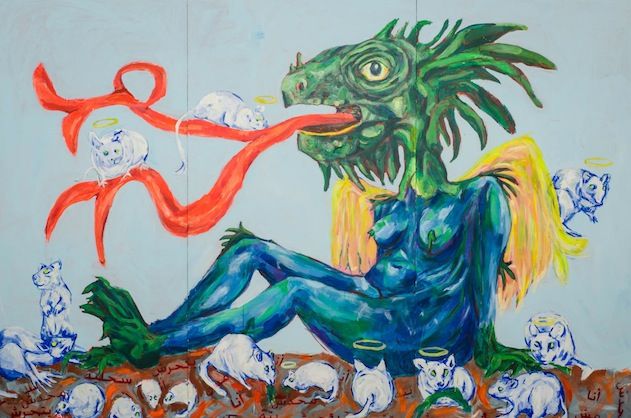
‘Brain Damage’: A varied and refreshing painting show
At the top gallery of Darb 1718 Cultural Center is a massive portrait of a man with a yellow halo against a pale blue background. His melancholic eyes continue to haunt me long after I leave. His gaze is penetrating, his features expressive and overwhelming. Everything else in the room recedes into the background. The sheer size of the painting — executed on three adjacent wooden panels — must also have an effect, as it fully occupies the wall from floor to ceiling.
The painting on the next wall shares the same color palette. But the rectangular bodies of the men and women in it seem more like the building blocks of a sculptural piece or houses in a time-capsuled village from the past. “Estrangement,” as 29-year-old Haytham Sherif titled his series, builds on the styles of Egyptian folk and Coptic art. But it seems very fresh in its energy and use of color.
Sherif works with acrylic paints, digital photography and sculpture. He also makes films. Feeling that there is little room for his kind of work in the Egyptian commercial art scene, he joined seven other artists at a new workspace called Wust El Balad Studio nine months ago. Together they formed the Kalb Balady (Stray Dog) collective. “Brain Damage” at Darb 1718 is the group’s first public exhibition.
The works comprising “Brain Damage” are quite varied. They only share their scale — each work is at least two by three meters in size — and a loose theme about the effect of social conditions in Egypt, including access to quality education, on people. This theme was inspired by a wall mural, also titled “Brain Damage,” which street artist Mohamed Khaled had created on Mohamed Mahmoud Street in downtown Cairo. The mural was painted in Khaled’s signature black and white strokes — the only color used was red, showing blood dripping from three human brains.
Nine months ago, Khaled was contacted by Cairo-based management consultant Herve Pourcines to start a studio in downtown Cairo. Pourcines, who wished to support new artistic talents in Egypt, provided the space and materials, while Khaled was asked to invite artists to use the studio. A range of artists, including political cartoonist Makhlouf and street artist El Zeft, began frequenting Wust El Balad studio to work on various projects. There were two conditions: that they experiment with working on much larger scales than they were used to, and that they share experiences with the other artists. The core group of eight artists named themselves Kalb Balady to reflect the influence of street art on their work in terms of its aesthetics and its tackling of ongoing events.
A walk through the exhibition reflects this intended diversity. Khaled presents a selection of mostly black-and-white paintings on wooden panels capturing the military regime’s violence over the past three years. Having studied painting at the Helwan Faculty of Fine Arts, it was important for Khaled to have a “gallery audience” see his experiments with the medium, which he feels are different from the classic works common in most commercial galleries in Zamalek.

The inspiration from street murals is also evident in the paintings of Ghadir Wagdi and Fajr Soliman — although each one is unique. Wagdi’s work focuses on the status of Egyptian women, while Soliman tackles problems of poverty and sexual harassment through paintings of morphed human-beasts. Anonymous street artist Maghraffiti also worked through the West El Balad studio; at Darb 1718 he is exhibiting his first experiments with a dot drawing technique.
The work of Amro Okacha, on the other hand, has a graphic-novel style. Okacha studied animation at the Higher Institute of Cinema. His paintings reflect lucid narratives through a single frame that presents a scene on which the audience can reflect and develop a story. One stand-out painting in the “Brain Damage” exhibition shows a startled crowd on the street. Okacha replaces the head of his protagonist in the background with Cairo’s common public transport vehicle: the blue and white microbus.

Razan Saeed is the only artist in the exhibition working with collage. Her huge collages comment on mainstream media’s propagandistic performance since the January 2011 revolution began. Grounded in the mosaic murals she studied at the Helwan Fine Arts School, she decided to take her experiments with paper collage to a new scale.
The range of styles shown in “Brain Damage” is refreshing, and a much needed addition to the local art scene. It emphasizes painting as a living and contemporary medium that can engage the public. This is particularly important given the formal classical training artists receive in local schools.
Putting aside the blurb on Kalb Balady’s Facebook page stating that the “new street art movement” is “the most and only relevant form of modern artistic expression in Egypt today,” what the group has managed to do, using the Wust El Balad studio as an incubator, is present an exhibition of intriguing and diverse two-dimensional artworks that seems to touch on people’s concerns without being overtly didactic or preachy.
The eight artists plan to continue working together and include new artists in Kalb Balady. While their next projects remain unclear, their energy seems quite promising.
Brain Damage is showing at Darb 1718, Kasr al-Shamaa Street in Old Cairo until December 15. Nearest metro station: Mar Girgis, tel. 0223610511.
تقارير ذات صلة
In Fustat, cultural center Darb 1718, pottery factories face demolition
“Old Cairo is one of the seven oldest cities in the world doing pottery art"
Exhibition showcases hazards of plastic waste
Visitors to Out to Sea? The Plastic Garbage Project, an exhibition at Darb 1718 in Old Cairo, are greeted by a floor-to-ceiling heap of rubbish.
Lara Baladi’s Cosmovision
In Cosmovision, Lara Baladi breaks down photography’s cadre into a discursive unfurling of her becoming from 1996 to 2011, autobiographically performing the logic of the white cube. Shown at Tintera,…
Your support is the only way to ensure independent, progressive journalism survives.
You have a right to access accurate information, be stimulated by innovative and nuanced reporting, and be moved by compelling storytelling. Subscribe now to become part of the growing community of members who help us maintain our editorial independence.
Join us