
Band of the week: Rami Abadir
There are very few times in life when it is appropriate to lay down in the middle of a room while listening to throbbing electronic music. More often than not, if you’re back-down on a dance floor, you can guarantee getting kicked out of the club.
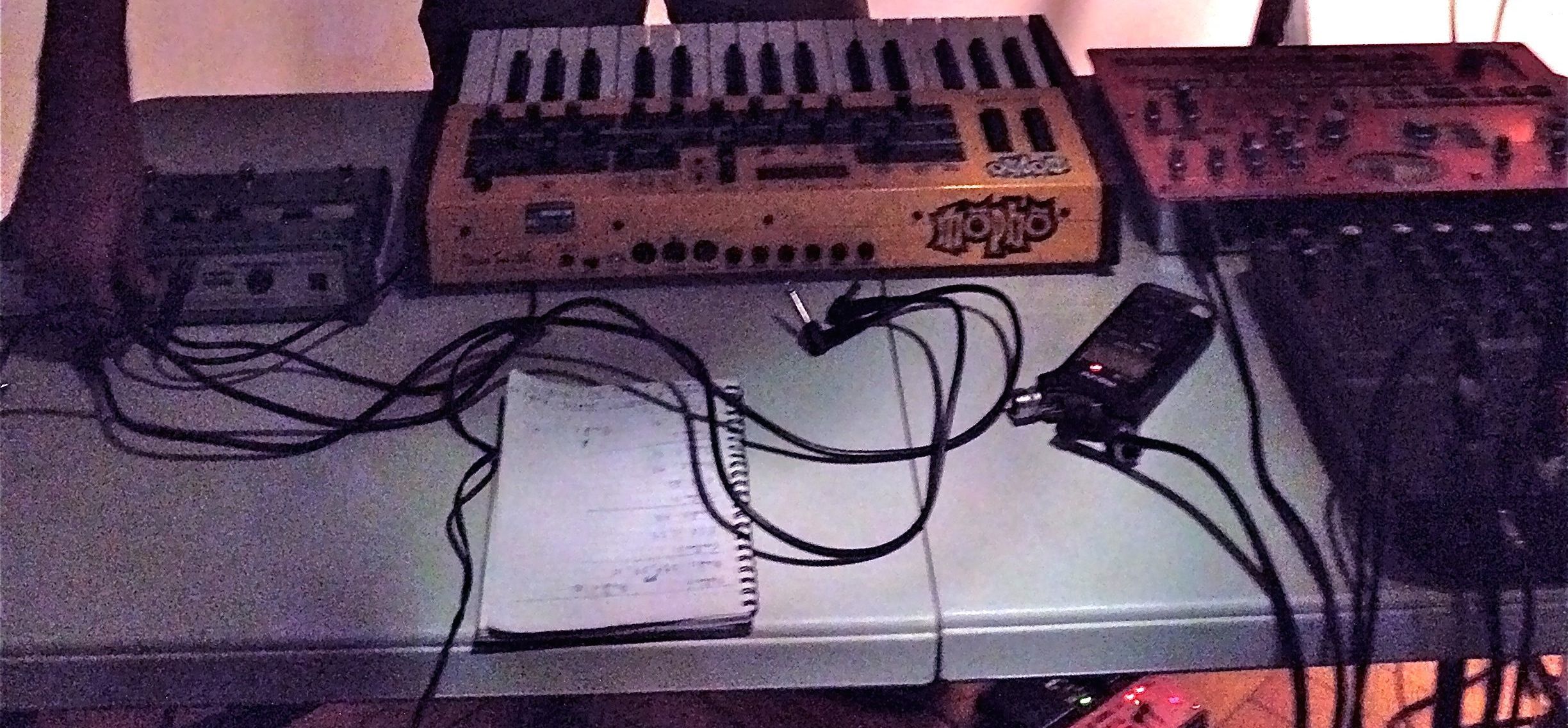
But the other day at Medrar’s space in Garden City, musician and writer Rami Abadir defied those odds with a live analogue set played out on an Korg ElecTribe SX drum machine, a DSI Mopho Monophonic synth, a DSI Evolver synth, a couple of guitar pedals, and, as Dandin.me put it, “nary a laptop in sight” (more on this later).
For the duration of the hour-long set, about 50 people lay back, watching artist Islam Shabana's 3-D visuals react to the swirling synthesizers and warm penetrating sounds of analogue instruments.
But the visuals were the weakest part of the show. I dig the idea of 3-D visuals, but these images seemed generic and preset, contradicting the ideas behind the music. The visuals were abstract and geometric, and have been described as resembling screensavers, but the almost phallic structure they were projected upon was worse.

Keying up alongside Abadir was Mustafa al-Sayed, also shuffling back and forth between two analogue synths, a Kurzweil PC3LE6 and a Korg Prophecy.
The two musicians have been performing with this instrumentation together since their first show in April 2014 at Balcon in Heliopolis. Abadir says the set has changed since then, and while it is largely improvised, he and Sayed rehearse by jamming until certain patterns can be identified, and structures for introductions are set in place. Kind of like improvised jazz; bands know the intros and patterns they will play within, but improvise the scales, melodies and harmonies.
Says Abadir: “The baseline could be a single note from start to finish, but the sound texture around it changes, the mood alters, or the scale changes — or I use two notes and a different arrangement.”
It’s pretty obvious that Abadir and Sayed are speaking a melodic language of their own — a breakbeat tongue of funky drum dialects and analogue layers that mesh to create an incredibly original live set. The artists are dynamite together, but for the purpose of this month’s Mada Mix, it’s Abadir — the guy behind the drum machine, two synthesizers, the delay pedal and the Roland RC20 loop station — that we will focus on.
When my colleague Mohamed Adam told me about Abadir a year ago, I instantly took a liking to his SoundCloud, but I didn’t fully understand until hearing him live.
Online, his music is darkly atmospheric, diverse in a most post-modern sense, and very visual. It reminds me of the Chemical Brothers’ soundtrack work, which always manages to meet a film’s images perfectly. A prolific production archive, Abadir’s SoundCloud has become a conversation between digital software and analogue hardware. It’s work that fits alongside other forms of contemporary art, such as dance, film and installation.
Having begun his music career in 2001, the 32-year-old engineer made the cross-over into electronic music from rock in 2010 due to the sonic and structural confinement he felt playing with rock genres. Seeking more freedom in his compositions, Abadir went solo with inspiration from US avant-gardistes like John Cage, David Byrne and Steve Reich, and local electronic artists such as Amr Hefny and Mohamed Ragab.
Particular SoundCloud favorites of mine are “Zaat” and “A dialogue with my friend the believer.” There’s also the soundtrack from Abadir’s collaborative performance with artist Mohamed Allam, “My Nineties.” Made up of samples from leading 1990s pop musicians, including Hamid al-Shairi, Hesham Abbas, Amr Diab and Simone, the soundtrack is a window into that decade’s sonic identity, and manages to stand on its own.
While Abadir’s online production archive is wondrous, his live analogue show really shocks and awes. I can imagine even those uninterested in electronic music could get satisfaction out of his performances with Sayed. Due to the depth and resonance of the analogue sound and the knowledge that these guys are producing it almost entirely live, the sounds are not what you get with DJs behind laptops. Visually, as well, it beats watching another robotically bobbing head behind an Apple computer. There’s a human factor to Abadir’s performances that is not present in the live sets of 95 percent of Egypt’s electronic musicians. Sometimes Abadir and Sayed miss notes, or the beat gets too fast or too far gone.
“Everything is self-produced,” Abadir explains. “There are some vocal samples, but they’re very deconstructed. The sounds from the synth are all sounds I’m creating. I don’t like to use the programmed presets. So I reset certain sounds. And that’s the beauty of the synth over other instruments. You can pull out an infinite number of sound textures or colors from it. It synthesizes many sounds — I’ll never be able to play a violin sound exactly, but I can get pretty close with these analogue machines.”
The process usually begins with Abadir creating sounds on the Electribe drum machine. He creates the rhythm section by laying down a basic beat: programming the kick, deciding the B.P.M. He adds a second kick, maybe with some hi-hats. He then uses more drum parts to add textures, while controlling the pitch, adding resonance, reverb and so on (check out a tutorial video on the machine here). He adds melodies using the synthesizers on the Mopho key, which allows for real-time control and tweaking. The machine is known for its bassy sounds and a “push-it” button which allows him to use both hands to alter them — with the “tap-tempo” feature he can adjust the tempo in real time by tapping a button directly on the sequencer (see here). Abadir also uses the Line 6 delay effect pedal to keep the sound from getting too dry — this adds various types of effects, ranging from “gritty” to “rhythmic” to “psychedelic.” The Roland RC20 loop station helps create a fuller sound by programming samples or sounds and looping them over and again, freeing up his hands to dance from machine to machine. Then there’s the DSI Evolver, which allows him to process external audio and has a deep, unique-sounding synth (see here).

While the set at Medrar was perfectly compatible with a seated or reclining audience, there were moments where I could have easily gotten up to dance. Even the down-tempo moments released such an immense vibration that it is almost impossible to feel impervious to the music.
According to Abadir, he and Sayed plan to record their sets, but in the same way the music is made. Instead of recording the drum tracks, then the synth tracks, then the vocal samples, they will record the entire set live as it’s being produced.
“I play basic patterns, but I progress them intensely throughout the set,” says Abadir. “When we do our solos, I know it’s not perfect, there are errors, we miss-strike a note occasionally, but that creates a dynamic and human center. I want to break this overproduced perfection that is found in most electronic music these days. I want to get away from all that compression in most music now. I want to say that electronic music can have a human factor and thus become more dynamic and far more colorful.”

Maha ElNabawi
After graduating from the American University in Washington, DC with a Bachelors degree in Business, Maha began her publishing career in NYC with indie pop culture magazines, the likes of…
تقارير ذات صلة
Not to salute the parrot: Strolling through the sound of Egypt
Music is marking territory, but what sort of map is this?
Conceptronica: On the elitism of contemporary electronic music
Such works are also prone to overtheorization in an attempt to create a sense of legitimacy or depth

Rupture and possibility: How the coronavirus crisis struck Cairo’s indie music scene
Where does music lie in the deafening quiet of a deadly pandemic?
Your support is the only way to ensure independent, progressive journalism survives.
You have a right to access accurate information, be stimulated by innovative and nuanced reporting, and be moved by compelling storytelling. Subscribe now to become part of the growing community of members who help us maintain our editorial independence.
Join us