
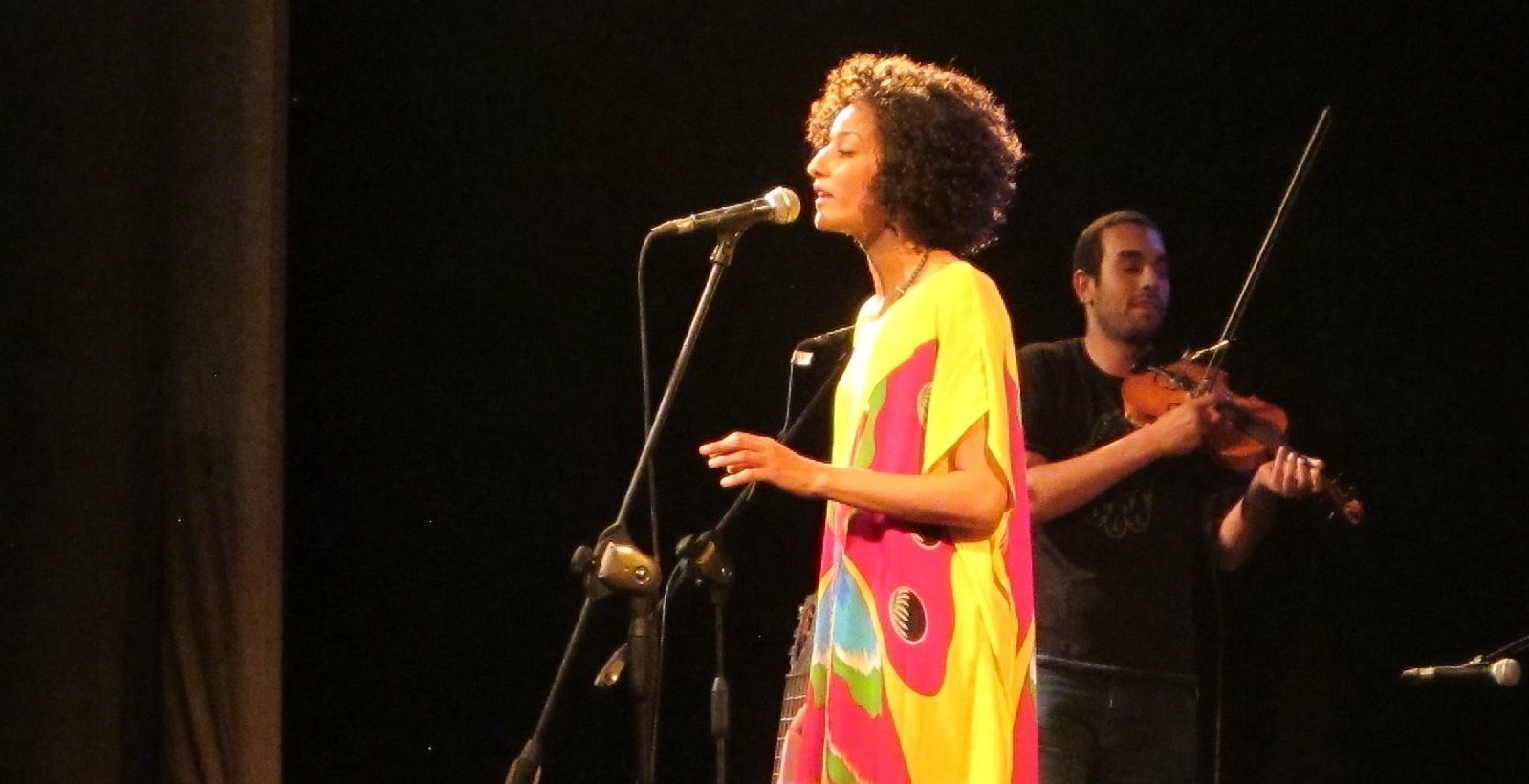
Band of the week: Badiaa Bouhrizi
Badiaa Bouhrizi lingers around backstage, warmly greeting fans lined up outside the curtains following her concert at Al-Azhar Park’s Geneina Theater in May.
The fans, in their late teens and early twenties, ask for autographs and selfies, reminiscing excitedly about past concerts they’ve attended by the Tunisian singer. Journalists also line up to ask her about the political climate back home.
“The resistance must continue,” she replies. “There is no compromise in the matter of freedom of speech.”
The feeling behind these sentiments was also one of the main elements of her performance.
Her sound, which she calls “Netassaya,” a “new sound of Northern Africa,” is rooted in malouf, a traditional music found in Tunisia, Algeria and Libya that Bouhrizi learned to sing in school choir, like many Tunisians. At some point she picked up the guitar. She once told me in an interview that as soon as that happened, reggae came naturally. She spoke of first hearing Bob Marley’s “Could You Be Loved,” of his wild hair and closed eyes, and his energy almost eclipsing the music.
The Geneina concert was part of Al Mawred Al Thaqafy’s biennial Spring Festival, which consists of several weeks of film, art, theater and music. It’s the concerts that draw the biggest crowds, and Bouhrizi’s spilled over with young Egyptians, many listening from just beyond the bushes surrounding the sold-out theater.
Indeed, Bouhrizi has long had a fan base in Egypt, and it's clear why.
She debuted here in 2011, also at Al-Azhar Park. I remember her sound and stage presence as radiant, as she strummed her acoustic guitar alongside German percussionist David Kuckhermann. Switching between eastern and western-style percussion, the set traveled across guitar-based folk, soul and jazz, and was brought together by the ever-present core of malouf. Also clear was the influence of classic Arabic music stars like Oum Kalthoum and Fairouz, and of Palestinian resistance poet Fadwa Touqan.
This time Bouhrizi returned to Egypt with a new band and a fuller sound. She performed with a violinist playing tense, melancholic Eastern scales, an electric guitarist, and percussionist shifting between a western drum kit, the cajón, and tablas.
By the time she reached the third song, “War,” an adaptation of Marley’s song of the same name, the crowd were captivated, many singing along to the words by heart. It's a remarkable rendition: The reggae guitar is still present, but the words are sung masterfully in classical Arabic.
Between songs, Bouhrizi goes off on political rants, about police brutality and the need to continue resistance in Tunisia and Egypt. She asks questions, like “Were you there on Jan 25?”, to which the audience nods with an air of quiet defeat, only to cheer louder when she starts exclaiming again.
“The police must calm down, they must calm down!” she repeats over and over.
Bouhrizi is no stranger to police brutality. In a 2011 interview, she explained to me that her brother, a socio-political rapper, was arrested for his dissent music. The police planted hash on him, as they do to many dissident artists. He was jailed for over seven years and only recently released.
In her own way it seems that Bouhrizi is always protesting something. In “Manifesto,” it is her brother’s incarceration, but in other songs it’s a subtler protest to prove that modern Arabic love songs can also have substance.
“Singing about love is not cheap when it comes from a heart that wants to be true,” she told me.
Later in the set, Bouhrizi performed a personal favorite of mine, “Galoua Blue,” a soulful number that opens with a bluesy chord progression and languorous vocals. It reminds me of the neo-soul wave that began in the 1980s with socially conscious lyrics on top of jazz, rhythm and blues and African sounds, usually with a strong female vocalist, like Erykah Badu or Lauryn Hill.
Bouhrizi’s music is atmospheric, it drifts in ebbs and flows — the mood hangs together through a pleasantly woozy sense of something positive emanating from the music, and yet an intense feeling of resistance remains present in the energy of her sound. Her music is percussion based, but also relaxed, personal, funky and filled with immense soul.
“We adapt too fast to certain things, and forget other things too quickly,” she told me. “But when it comes to freedom of speech, and my work as an artist, all I can say is that it is a battle. It’s still a battle.”

Maha ElNabawi
After graduating from the American University in Washington, DC with a Bachelors degree in Business, Maha began her publishing career in NYC with indie pop culture magazines, the likes of…
تقارير ذات صلة

Mada Mix: El-Morabba3
El-Morabba3’s second album leaves politics behind but pushes regional indie music forward
Mada Mix: On student heavy metal band Worsens
A new Cairo band synthesizes a classical German poem with quintessential heavy metal sounds for their debut album
Mada Mix: Ta7t El-Sefr and Hawas
Like many bands that emerged after 2011, these two differ from their predecessors in several ways.
Your support is the only way to ensure independent, progressive journalism survives.
You have a right to access accurate information, be stimulated by innovative and nuanced reporting, and be moved by compelling storytelling. Subscribe now to become part of the growing community of members who help us maintain our editorial independence.
Join us