
A-Z of progress and setbacks for Egyptian women this year
On International Women's Day, here is Mada Masr's A-Z of the experiences and challenges Egyptian women have faced this year.
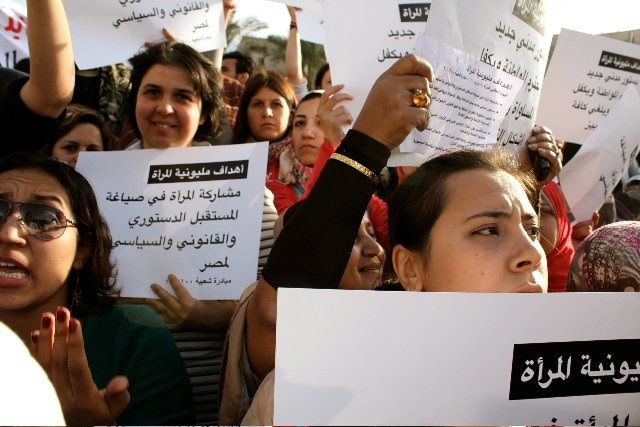
A is for the Armed Forces, who were called on to open their doors to female conscripts by members of the Moganada Masriya (Female Egyptian Conscript) campaign that made its first public appearance in May last year. The women, some donning camouflage pants and combat boots, gathered outside Cairo University carrying banners and chanting, “I carried the revolution on my shoulders … Our president, our president, let our girls join our army.”
B is for the BuSSy Project, the storytelling group forced to cancel its performance 500s last March due to content deemed inappropriate by the Cairo Opera House's Hanager Theater. While co-producer Hakawy International Arts Festival for Children cited “technical problems,” 500s director Sondos Shabayek said the show was halted because the theater's management disapproved of the script. BuSSy’s focus is on gender issues, and this show was based on the daily struggles and dilemmas faced by teenage girls, told through stories collected by the BuSSy crew in tandem with high school students.
C is for a series of comics tackling sexual harassment plastered on the walls of metro stations across Cairo as part of the “What will you do?” campaign, launched last October by the non-profit group Imprint Movement in collaboration with Al-Moltaqa for Consulting and Training. The comics addressed the challenges women confront on a daily basis — from dealing with victim-blaming culture to feeling unsafe in public space, aiming to show the effects of sexual harassment on Egyptian society as a whole.
D is for a campaign against domestic violence launched by UN Women in collaboration with the National Council for Women. Mateskotoosh (Speak Up) featured striking billboards mounted across the country in December. During the day, the billboard showed a girl with a message reading, “Once upon a time, a princess fell in love with a prince. Do you know this story?” Come night time, the billboard lit up and revealed bruises and scars on her face.
E is for the Eid holiday in July which saw a much hyped initiative to employ more policewomen to tackle the sexual harassment for which the holiday has become notorious in recent years. Videos and pictures of the female officers violently reprimanding alleged harassers were both lauded and criticized for different reasons. The Interior Ministry’s department for violence against women said it arrested 84 alleged harassers over the break.
F is for the first verdict against a doctor for illegally performing female circumcision. In January 2015, Raslan Fadl was sentenced to two years in prison for killing 13-year-old Soheir al-Batea, who died when she was administered a fatal dosage of anesthesia during the procedure. Under Article 246 of the Penal Code, female circumcision is punishable with a minimum of three months to a maximum of two years in prison, and a maximum fine of LE5,000. Fadl was initially acquitted, which sparked international outrage. The ruling however was never actually applied and Fadl was later tracked down by reporters and appears to be living freely and working in a government hospital.
G is for Give Mom Back her Name, the name of the campaign launched by UN Women tackling the taboo associated with revealing a mother’s name in public. In March 2015, on the occasion of Mother’s Day, the campaign encouraged social media users to change their profile pictures to their mothers’ names with the hashtag #MyMothersNameIs.
H is for the headlines that fixated on the looks of three female ministers who were sworn into a 33-minister Cabinet last September, rather than their credentials or the lack of female representation. “The babes of Sherif Ismail’s government,” trumpeted the headline of an article in the privately owned newspaper Sout al-Omma profiling the three women. Another article published by the privately owned news site Al-Arabiya ran with, “Three ‘beauties’ join Egypt’s new Cabinet, but still not enough?” Nabila Makram, the minister of immigration and Egyptian expatriate affairs, was widely criticized for dressing “inappropriately” after she attended the swearing-in ceremony in a short-sleeved dress.
I is for Ikhtyar collective, a group of feminist men and women, who in December had a crowdfunding campaign to support their work. Describing itself as a knowledge hub on sexuality and gender, working in Arabic is essential to the collective’s mission. By developing resources and discussions in Arabic, the group hopes to help the Egyptian feminist movement narrate its experience in its own language and develop its own theories factoring in the local context.
J is for last November’s Justice Ministry announcement to create special courts for cases of violence against women in order to ensure they are processed quickly. The idea was formulated in collaboration with the British Council in Egypt as part of the My Rights initiative to combat violence against women. The Justice Ministry reportedly allocated spaces for support centers in courts in the four governorates with the highest rate of violence against women: Cairo, Alexandria, Aswan and Tanta.
K is for the kerfuffle caused by Reham Saeed who just last week received an 18-month sentence and a LE15,000 fine for violating an assault victim's privacy after she aired personal photos of the woman without permission on her show. She was sentenced to an additional six months imprisonment and a LE10,000 fine for libel and slander in the same incident. Last October, Saeed interviewed Somaya Tarek, who was assaulted by a man in a Cairo mall, on her show "Sabaya al-Kheir" (Charity Girls) on the privately owned Al-Nahar channel, hinting that it was Tarek’s “revealing” dress that may have triggered the man to harass her. Following the interview, Saeed aired personal photos of Tarek on the beach in a bikini, and others with her holding a bottle of whiskey or appearing to be scantily clad.
L is for the launch of the National Strategy to Combat Violence against Women in June 2015. The strategy was outlined by the National Council for Women at the behest of then Prime Minister Ibrahim Mehleb. It is set to be implemented during the period 2015-2020 in coordination with governmental and non-governmental organizations. While rights groups welcomed the move, they also criticized the lack of definition of the forms of violence facing women, particularly sexual violence.
M is for Maya Morsi, the new head of the National Council for Women, who was elected in February. Morsi is succeeding Mervat al-Talawy, who held the position since 2012. She was elected following Sisi’s decision to reshuffle the council. Morsi previously worked as the regional gender practice team leader at the United Nations Development Program, and as the Egypt country coordinator for UN Women.
N is for “Not a Shame,” the tagline for a campaign promoting the importance of sexual education as a means to address sexual and reproduction-related problems. The campaign, Sexual Education: A Need, Not a Luxury, was launched as part of the 16 Days of Activism Against Gender-Based Violence last November by the Egyptian Initiative for Personal Rights (EIPR), the Cairo Center for Development (CCD) and the Tadwein Center for Gender Studies.
O is for just one female MP heading one of 19 committees in parliament. Amena Nosseir was elected head of the Education and Scientific Research Committee. Members of parliament were allocated to 19 different committees and elected temporary committee heads.
P is for the amendments to the prison law introduced in October that allow female detainees who give birth inside prison to keep their children for up to four years, instead of two years. Death penalties for female prisoners giving birth can also be halted for up to two years after the birth of their children, instead of the previous two months. Human rights advocates warned that despite these gains in general the law gives greater powers to prison administrators.
Q is for the quota system that was lifted in 2012, paving the way for an unprecedented 87 women in parliament, which convened early this year. Women were elected to 73 seats, while the remaining 14 were appointed by Sisi, out of a total of 596 seats. In 1979, the quota system was introduced, allocating 30 seats for women as a minimum requirement. It was amended and lifted several times until it was reinstated in 2010, allocating 64 seats for women. When it was lifted in 2012, female representation in parliament at the time was less than 2 percent.
R is for the first female football referee to oversee a men’s football match early last year. Sarah Samir was assigned by the Egyptian Football Association (EFA) to referee a football match between Wadi Degla FC and Talaea El Gaish SC. Samir told media that her ambition is not only to referee at Egyptian Premier League matches but also the World Cup.
S is for squash, a sport in which Raneem al-Welily made history by becoming Egypt’s first-ever female squash player to become world champion last September, a spot held by Malaysian Nicol David since 2006.
T is for “tourism marriages,” a phenomenon tackled by a decree by the Justice Ministry issued in December, setting the price tag for Egyptian women if they are to marry foreigners 25 years or more older than they them at LE50,000 in investment certificates. While this requirement has been in place for decades, an amendment only increased the sum of the investment certificates, which are required to be in the bride's name, from LE40,000 to LE50,000. The decree is aimed at curbing "tourism marriages" whereby wealthy foreigners marry younger Egyptian girls. It was criticized by women’s rights groups, however, who decry the certificates as a form of trafficking.
U is for the Cairo University battle over the niqab. In October 2015, university president Gaber Nassar banned female faculty members from wearing niqab on the grounds that the full-face veil hinders effective communication between professors and students. A group of professors appealed the order, but in January, the Administrative Court ruled in favor of Nassar’s decision. This February, he also banned all female medical staff working at the university’s hospitals from wearing niqab, maintaining that patients have the right to know the identity of the medical staff treating them. This prompted dozens of Cairo University students, faculty members and medical staff to protest against the decision, which they called a violation of their personal freedoms.
V is for vice. A report by Daftar Ahwal — an independent information platform that provides analysis on major pieces of information regarding political events and social issues in Egypt — claims almost eight times more women than men were charged with vice crimes in 2015 (873 women, compared to only 114 men). They include 689 cases of suspicion of prostitution, 59 cases provocative dancing, 85 cases of consensual sexual practice, 113 cases of public sexual acts, 6 cases of wife swapping, 23 cases of electronic publishing of sexual material, 2 cases for making statements, two for producing literary works and 8 for producing artistic products.
W is for weightlifting. 43-year-old Egyptian weightlifter Fatma Omar won the World Weightlifting Cup for disabled athletes in Malaysia this month.
X is for remove your headscarf, a call made by journalist Sherif Shoubachy last April, encouraging veiled women to rally in Tahrir Square and take off their veils. The rally, which was scheduled for the following month, never materialized.
Y is for young women ages 18-29 who only represent 18.5 percent of the total Egyptian workforce, compared to over 50 percent of young men, according to UN Women. The total participation of women ages 15-64 is 23 percent, compared to 72 percent of men, according to CAPMAS.
Z is for zero amendments to many laws that discriminate against women, including adultery laws, rape, abortion and domestic violence laws.

Dalia Rabie
Dalia has a pragmatic perspective on things and has a way of telling it just like it is. This informs her professional practice, with all the humor and wit that characterize…
تقارير ذات صلة
Egypt’s space program raises questions around education, scientific research spending
The government’s announcement that it approved a project to build an Egyptian space agency has raised questions about the feasibility of launching a scientific project like this in light of…

Interview: X’s new restrictions fail to protect users from AI image manipulation
Mada Masr spoke with digital helpline coordinator Tasneem Mounir on why X’s ban falls short
Navigating digital consent violations: Speak Up’s founder talks partnering with Pornhub
In February, Speak Up partnered with Aylo — parent company of Pornhub and other adult websites
Your support is the only way to ensure independent, progressive journalism survives.
You have a right to access accurate information, be stimulated by innovative and nuanced reporting, and be moved by compelling storytelling. Subscribe now to become part of the growing community of members who help us maintain our editorial independence.
Join us