
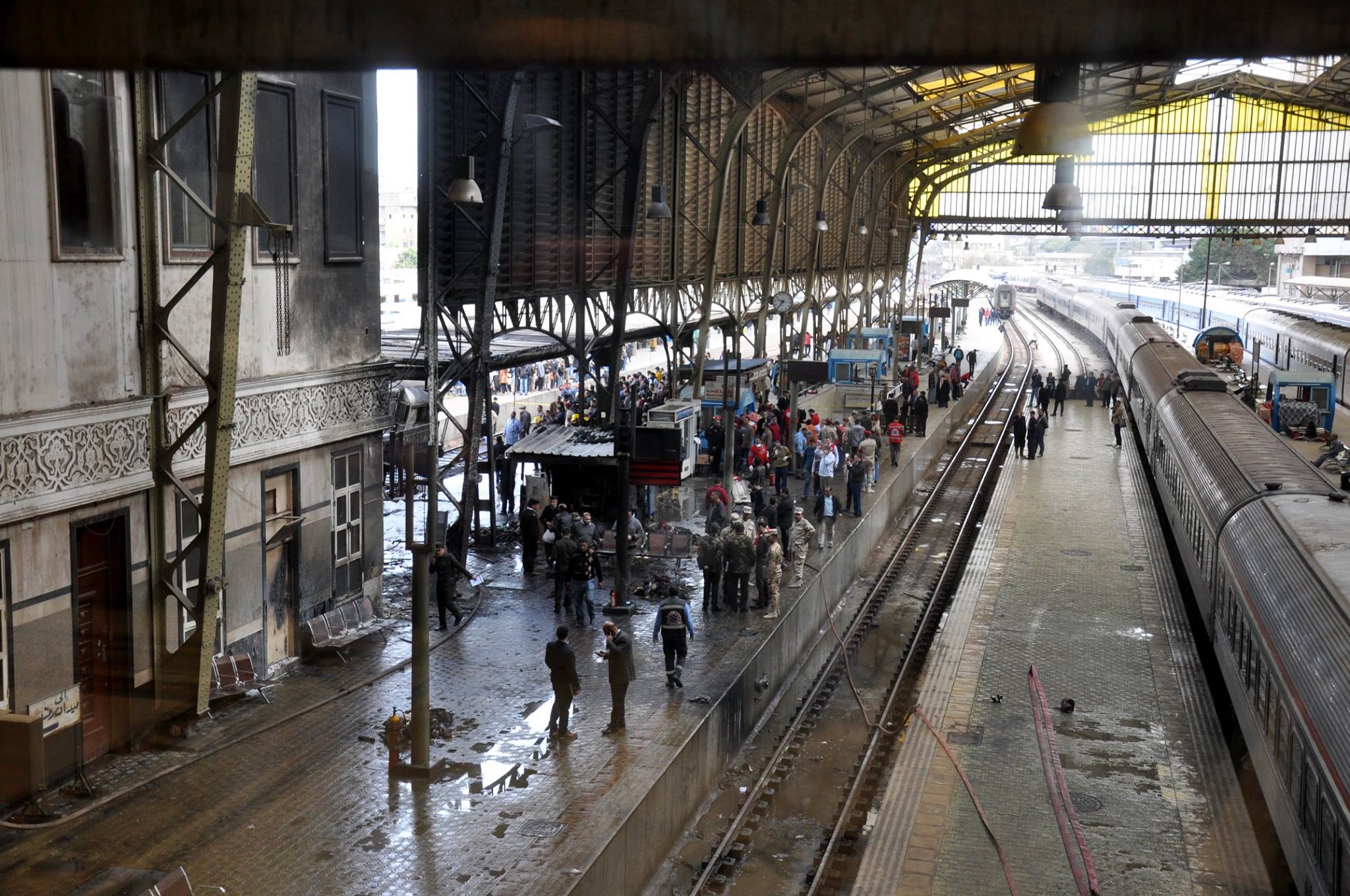
In Abu Ghattas, three kilometers away from the platforms of Cairo’s central railways stations, two trains nearly collide. It is a small event in the early morning of February 27, but the conductors of each train cannot settle who is to blame. A verbal altercation breaks out, with each pointing to the other. One of the men steps out of the train’s conductor booth to confront the other, but he forgets to set the break.
After a short time jostling, the still-manned railcar manages to clear the path of the other train. But in circumventing the problem, a new issue is created: The two cars touch, edging the conductorless train into motion. In the video footage that would emerge hours later, several people can be seen chasing after the runaway train and an impending disaster.
The official narrative, released by the Public Prosecution on the day the railcar crashes in Cairo’s Ramses Railway Station, ends here.
But shortly before the fatal accident, the conductor attempts immediate damage control by calling the North Cairo signal tower, says Hashem Rabeh, a train conductor employed by the Egyptian Railways Authority.
“Are you kidding?” an official answers, before the line cuts. The railcar continues hurtling toward the station, its fuel tank exploding after it slams into the concrete buffer stop at the end of the line. Twenty people standing on the adjacent platform are set alight and killed, and two of a reported 45 injured later die of the wounds they sustain.
The incident has been framed as a tragic result of drug use, and officials moved to place the blame squarely on the shoulders of the conductor, who was arrested — along with five other railway workers — a mere hours after fleeing the scene and charged with wrongful manslaughter and negligence. Public opinion was significantly swayed when the conductor himself claimed responsibility for the accident in an interview with TV host Wael al-Ebrashy that aired on the evening of the accident.
And although forensic evidence found that only one of the six railway employees apprehended had narcotics in their system at the time of testing (the conductor himself tested negative), Cabinet is working on introducing new legislation allowing the termination of public servants that test positive for drugs.
While Rabeh insists that he has no sympathy for the conductor of the train, as leaving the railcar without a conductor was clearly a grave mistake, he asserts that these fatal crashes do not seem to be isolated incidents. Where were the existing safety mechanisms meant to prevent accidents like this? And if this driver is to blame, will the next one also be at fault?
Railway traffic primarily depends on four accident-prevention measures to ensure safety: The first is a device that can be manually used by a conductor to bring the train to halt within 24 seconds of sending a signal. If this fails, the conductor can use a control switch called the “dead man switch” to send another signal to the control tower, after which the tower can intervene and halt the train within another 24 seconds. The third is a train-protection system called “automatic train control,” which can allow the signalling towers to automatically halt the train if something unusual happens.
If all three initial measures fail, the last preventative tactic — deliberate train derailment — can be activated. The signal tower official will disconnect the tracks, causing the train to be dislodged before it crashes.
These multi-layered safety mechanisms are theoretically capable of preventing train accidents. However, a combination of factors have rendered them effectively a formality and have left safety on Egypt’s railways largely down to each overworked and underpaid conductor’s ability to prevent errors.
The first part of the larger problem with Egypt’s railways, according to Rabeh, is that authorities prioritize running the journey schedule on time at the expense of safety measures. “If all trains have to meet safety standards, half of Egypt’s daily trains will not run because most of them are damaged,” he says. “I’m not exaggerating.”
While it might appear that the deterioration in safety standards comes from a lack of financial resources necessary to carry out maintenance and increase safety procedures, a closer look at the figures suggests the issue is rooted in purposeful austerity measures.
This is clearly illustrated in a recent report published by Mada Masr, which highlighted a “steady decline in investments in facility development, with expenditure rates reaching negative levels in 2017/2018 and 2018/2019.” The report also pointed to the “increased dependency of the Railways Authority on borrowing, at the same time when it appears to be heavily constrained by paying off its debts.”

This is driven home by the fact that the financial statement issued by the Egyptian Railway Authority for the fiscal year 2017/2018 shows that the authority had returned LE274 million that was allocated for maintenance to the Ministry of Finance.

There was meant to be an influx of funding to renovate the railway system after the last major train crash occurred in August of 2017, when two trains collided in Alexandria, killing 44 people. At the time, former Transport Minister Hesham Arafat prepared an emergency plan with his colleagues to salvage the railway facility. They outlined its technical capacities and the resources needed to solve some of its major issues.
A few days after the crash, Arafat announced in a press conference that the government would adopt a railway development plan, with a $1.5 billion fund provided by the European Bank for Reconstruction and Development.
In December, the Egyptian Railway Authority published a statement summarizing its achievements for 2018, which included the maintenance of thousands of kilometers in the railway and the rehabilitation of railcars, which cost US$10 million and “led to the optimization of the train schedule and the complete end to railcar malfunctions,” according to the statement.
This US$10 million figure, however, is significantly less than the LE274 million (US$15.6 million) earmarked for renovation that the authority returned to the Finance Ministry, and little seems to have changed to stem the high rate of train accidents.
According to CAPMAS, there were over 1,000 accidents in the first six months of 2018 alone.

Against the backdrop of these cuts in funding and deterioration in services, labor conditions have also eroded workers’ ability to adhere to minimal safety protocols.
Rabeh uses the typical Cairo-Aswan Dam trip to illustrate the turmoil of railroad workers. “We start preparing four to six hours before each trip, to check on everything before leaving to Assiut. This is a trip that takes around seven hours — more if there’s a delay,” says Rabeh.
After arriving to Assiut, another train crew takes over to resume the journey to the Aswan Dam. The crew on the Cairo-Assiut portion of the trip get a six-hour rest, which may be reduced to two or three hours in cases of delay. They then take over the return train from Assiut to Cairo, which takes at least seven hours. The total time it takes to prepare for and operate both trips could exceed 24 hours.
Nine hundred train journeys take place in Egypt every day. Each train needs one conductor and an assistant conductor, which means that 1,800 employees are required daily to operate the trains that run nationwide. According to Rabeh, a combined 4,000 conductors and assistant conductors are employed by the Egyptian Railway Authority, and so employees must operate three trips every week each. This comes out to each conductor having to work at least 270 hours per month — 70 hours over the maximum number of working hours stipulated by Egypt’s labor laws and 100 hours over recommendations made by the International Labour Organization.
Rabeh explains how conductors are not sufficiently compensated for the amount of work they do. As a train conductor of 23 years, his monthly income does not exceed LE4,600.
Train conductors can expect to make between LE2,000-LE6,000, significantly lower than the salaries of metro conductors, which, according to Arafat, can sometimes reach LE8,500. “Some of the train conductors who were assigned to work in the metro refused to come back to the railways due to the massive wage disparity and the different work environment,” says Rabeh.
All of the aforementioned factors cause tremendous stress on train conductors and other railroad workers. Rabeh cites the rising prevalence of chronic diseases, such as cardiovascular diseases and diabetes, due to the stressful nature of railroad labor. Ashraf Raslan, the head of the Egyptian Railway Authority, referenced this issue during a meeting with Parliament’s Transport Committee after the Ramses crash.
Rabeh states that he attended more than one meeting with transport ministers, in which he would relay the difficult circumstances that railroad workers have to endure, including inadequate financial compensation and harsh working hours.
Train conductors have asked to cut daily trips in half and only work on locomotives that have safety measures installed. They have acquiesced to postponing any discussions regarding raising wages in exchange for improving railway safety. But according to Rabeh, no one has responded to their requests.
During an official meeting that was attended by Arafat, Rabeh recalls an official telling him that railroad workers must accept the situation and work with “the existing capacities” — as they have done for the past 50 years.
تقارير ذات صلة
Riding the privatization train
New legislative amendment opens door to private participation and fears of price hikes
Maadi’s Street 250 plant shop owners root in after verbal eviction orders
The shop owners were told that they would not be eligible for compensation
8 major railway incidents in Egypt
Mada Masr has compiled an account of major rail disasters since 2002's fire in Ayat
Your support is the only way to ensure independent, progressive journalism survives.
You have a right to access accurate information, be stimulated by innovative and nuanced reporting, and be moved by compelling storytelling. Subscribe now to become part of the growing community of members who help us maintain our editorial independence.
Join us