
A coup divided, a war ignited
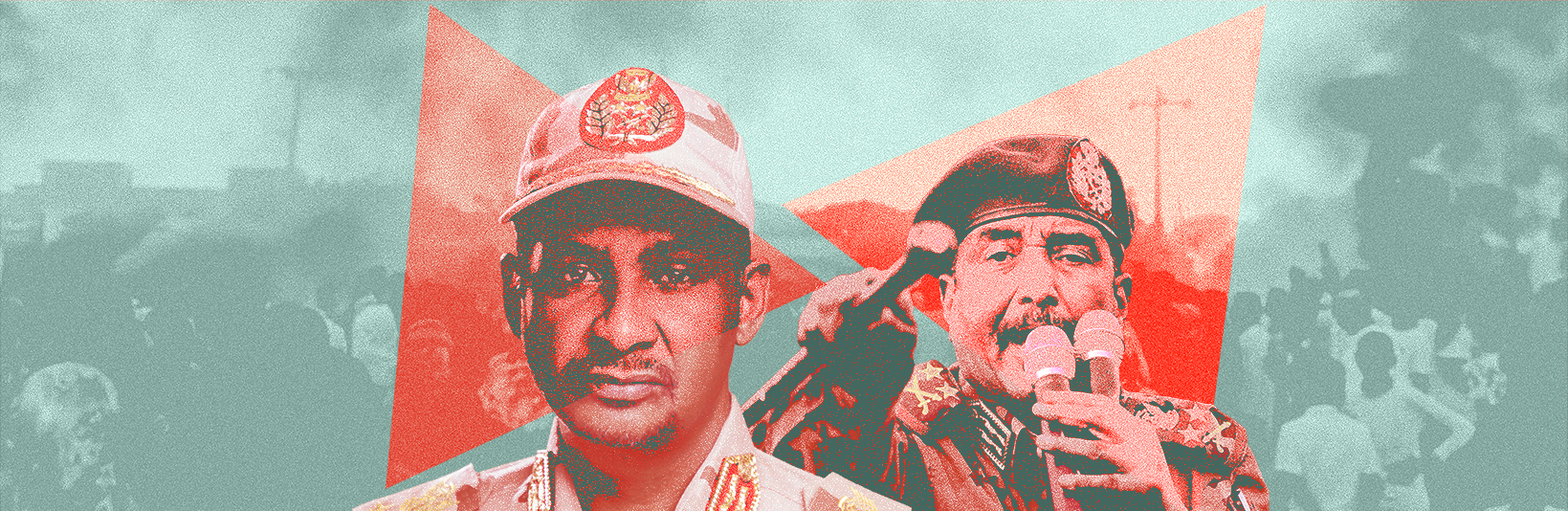
It is February 23, 2022, a mere four months after the coup that toppled Sudan's transitional government and left Mohamed Hamdan “Hemedti” Dagalo standing as one of the country's two most powerful figures. And on this day, as the leader of the Rapid Support Forces, the paramilitary group that once fought anti-government rebels on the peripheries of the country, he is preparing to cement his political ascension.
The plane that is to fly him to the Russian capital of Moscow is on the tarmac, and he is ready to play his hand. He and his brother Abdul Rahim Hamdan Dagalo have undertaken a flurry of foreign visits in the past few weeks, and the Russia trip should tie a bow around his plans to out-jockey his political rival, General Abdel Fattah al-Burhan, who had been his partner in power from when the two came together to oust former President Omar al-Bashir in 2019 to their move against the civilian component of the transition government in 2021.
If Hemedti can manage to revive an agreement to establish a Russian port on Sudan's Red Sea coastline and, in turn, secure public backing from Moscow, he will have completed his political transubstantiation: from a cattle herder to a paramilitary henchman deployed to fight counterinsurgencies on the peripheries of the country to a politician sitting at the heart of Sudan's geographic seat of power holding forth with world leaders on the global stage. It would be a real coup.
But when the leader of the Rapid Support Forces touched down in Moscow that night, he was not only greeted by Russian officials looking to secure a stronger foothold in Africa but by the news that the invasion of Ukraine had begun as well.
Undeterred by the snafu, Hemedti threw caution to the wind in a typical show of bravado. “Russia has the right to defend itself and its people and citizens in accordance with the laws and the constitution,” he told the press at the Moscow airport.
The comment prompted a chorus of condemnation from Western pundits and media outlets in a newly polarized world harkening back to Cold War vintage.
Far away, back in Khartoum, Burhan, the other face of the October 25 coup, had finished his agenda for the day ahead of schedule after meeting a local delegation at the presidential palace and was headed home to sleep in calm.
The contrast between the nights of the two leading figures, deputy chair and chair of the post-coup military council, couldn't be more stark.
And that was by design. Sudanese military generals had been fully aware that the timing of Hemedti's visit to Moscow was "a leap into darkness," as one Sudanese military source put it to Mada Masr. Despite the high political risks associated with the visit, the generals were betting that any benefits gained from the visit could be shared among them and that expected losses would fall on one person: Hemedti.
Talk of Hemedti's visit to Moscow began at the end of December. However, Burhan delayed his deputy's trip, suspicious of Hemedti further consolidating relations with Russia, given that the RSF is working with the Russian mercenary group Wagner to run a lucrative gold trade in Darfur, where Hemedti built his power base.
But when Russia's invasion of Ukraine appeared imminent, Burhan encouraged Hemedti to go ahead with the visit, putting him at the center of what he knew would be a storm around the countries' bilateral relations, two Sudanese military sources say.
The tension between the two rivals is now out in the open, with their forces clashing on the streets of Khartoum and around the country since last week. The two sides are vying for control over strategic sites, with the Sudanese Armed Forces' air supremacy proving a major advantage so far, pushing the RSF out of key areas in Khartoum. Hemedti ratcheted up the rhetoric in the ensuing days, going on the air to call Burhan a criminal who will be hunted down and calling for foreign intervention to oust the general, whom he has labeled an "Islamist."
This fighting has taken its toll on Khartoum, where RSF encampments and military infrastructure sit next to residential areas, and Darfur most prominently. As of April 26, the Sudanese health ministry stated that at least 512 people have been killed and over 4,193 injured across the country since the beginning of the clashes.
However, this tension is not weeks or even months old. Over the past year, Mada Masr has spoken to officials in Cairo, sources in regional capitals, foreign diplomats and a range of Sudanese military, political and security sources to chart the emerging conflict. What emerged is a picture of the political structure established by the October 25 coup, in which Burhan and Hemedti ousted their civilian cohorts in government, that started unraveling almost immediately, descending into a state of paranoia and a fierce rivalry between the two leading figures. This unraveling set off downstream competition between domestic and foreign actors looking to secure old and new footholds in Sudan up for grabs.
The ouster of Bashir in 2019 ended nearly three decades of pariah status for Sudan, opening the door to re-establish ties with the West and rebuild an economy shattered by sanctions and corruption. With this opening came opportunities for various domestic actors to present themselves as political, economic and security stewards to actors looking to secure influence in a country that has a strategic position on the Red Sea, serves as a gateway to the African Sahel belt and boasts rich reserves of gold, water and oil resources.
And those ties began to form. The West promised billions of dollars in financial assistance to a new civilian-military transitional government, and the Gulf promised large-scale investment in ports and agriculture. But the October 25 coup plunged Sudan back into a kind of isolation. Western countries suspended their promises of aid after Former Prime Minister Abdalla Hamdok, the face of the civilian government, was kidnapped. But now, the political stability that Bashir's sectarian and authoritarian policies had given was gone, and in its place was a fractured security establishment looking to secure its own ends.
The presidential palace and the General Command of the Sudanese Armed Forces are just over two kilometers apart from each other. Burhan, who juggled both roles after the October 25 coup, faced concerns on both fronts. At the general command, Burhan faced the specter of a military institution that has ousted three generals from power in the last 55 years. Historically, economic crises have acted as the main catalyst mobilizing the Armed Forces to move on the presidential palace in response to popular uprisings. After all, Burhan had done this himself four years ago, when he ousted Bashir on the back of economic strain and popular demands.
But Burhan's eyes often wandered away from the economic crisis unfolding under his watch, even as it wreaked havoc on the lives of millions of Sudanese and the already shrinking middle-class minority.
Instead, the general's attention was mostly focused on his bedfellow in power, Hemedti. Over the last year, intelligence officials close to Burhan and military leadership have established backdoor channels to Hemedti's close circles to monitor his political moves and communications internally and abroad in an attempt to identify the network that supports Hemedti domestically and abroad and prevent him from further advances, a Sudanese intelligence source told Mada Masr.
Hemedti equally has worked to outflank the general.
This dynamic brought a brinkmanship to Sudanese politics that has stymied any real path forward.
This was apparent to one prominent foreign diplomat familiar with the political situation in Sudan, who, in the month after Hemedti's visit to Russia, told Mada Masr that it was clear that the October 25 coup had been a "big miscalculation" that had set the ball rolling toward a political catastrophe. What's more, the diplomat said, this was not the opinion of foreign actors but also of “whoever was behind the coup and had supported it.”
In the immediate aftermath of the October 25 coup, both Burhan and Hemedti were focused on trying to form transitional governments that could ensure their continued influence, and both were courting foreign backers.
Hemedti's backing came from the United Arab Emirates.
He and his brother, accompanied by a delegate of senior officials, made an unannounced visit to Abu Dhabi in February to make arrangements to form a new government, with Emirati plans that he would have put the RSF commander at the center.
Crucial to the Hemedti-UAE plan was the governor of the Darfur Regional Government, Minni Minnawi, the leader of the largest faction of the Sudanese Liberation Army that fought against the Bashir government.
Hemedti and Minnawi, once rivals, had become close during the Juba peace negotiations, in which the RSF commander led the state's post-revolution mandate to integrate Sudanese rebel groups. Their rapprochement was hastened via the mediation of former Chadian President Idriss Deby.
According to sources close to the governor, Minnawi secretly visited Abu Dhabi in mid-February after Hemedti and his brother left. On Thursday, February 24, Minnawi announced his return to Sudan after a European tour that included Germany, the UK and France, but the sources said that Minnawi actually flew from Abu Dhabi to Germany, then to Paris, before returning to Khartoum.
In Abu Dhabi, discussions centered on how the street's influence on Sudanese politics could be diminished, sources close to RSF decision-making circles and the sources close to Minnawi told Mada Masr. In the meantime, the UAE would work to improve Hemedti's image and prepare him to run for president when the transitional period concluded, a move that would not be possible without the support and financing of the federal rule in Darfur, represented by Minnawi. In turn, Minnawi was to receive generous financial support from the UAE via development projects that could be used to convince people in Darfur to vote for Hemedti. Darfur, Sudan's most populous province, could hand Hemedti a victory in an election after all, the sources said.
However, for the UAE, one of the sources close to the RSF says, it was urgent to put a government in place as soon as possible. The UAE “does not desire a constitutional vacuum. The Emiratis said that a cabinet should be formed in any form as soon as possible, as it is ensured that Hemedti wins the elections that come later,” one of the sources close to the RSF said.
These closed-door talks coincided with Minnawi's public call to compress the transitional period. “The transitional period should be shortened to focus on election arrangements via a strong political, civilian and military partnership that does not undermine any of our historical demands and symbols, while representing the margins and including the refugees and displaced populations in the transitional process.” Minnawi wrote on Twitter.
The Emiratis' support for Hemedti against the civilian component and Burhan rests, according to the RSF source, on the threat a civilian cabinet could pose to the UAE's access to Sudanese fighting forces, which had been essential to their intervention in Yemen and Libya.
And this is why, if push came to shove in the conflict between Burhan and Hemedti, the UAE was willing to throw its weight behind the RSF commander, according to the RSF and Minnawi sources.
An Emirati political source confirmed the Gulf state's ties to the RSF commander, telling Mada Masr that Abu Dhabi had transferred hundreds of millions of dollars to Hemedti to secure Emirati interests in Sudan.
However, this plan hit a major hurdle with Hemedti's tumultuous Russia visit and the outbreak of the Ukraine war.
According to a Western diplomat in Khartoum, “the US told the UAE that Washington could sanction Hemedti and his top aides if the UAE were to try to push him higher.”
Burhan waited for this exact kind of negative response to Hemedti's Moscow visit to materialize, and then he flew to the UAE in early March — his first foreign trip since the October 25 coup.
According to a source briefed on the meeting, former Sudanese Prime Minister Abdullah Hamdok traveled to the UAE during Burhan's visit to meet with the general and Emirati officials.
Over the course of the four days, Burhan, Hamdok and Emirati officials, including Emirati ruler Mohammed bin Zayed, discussed the demands of Western powers, especially the US, to limit Hemedti's influence gradually due to anger over his political activity, financial influence and diplomatic moves, according to a Sudanese security source. This anger peaked with the RSF commander's visit to Moscow and the remarks he made after the trip about granting Russia a military base in the east of Sudan, the source says.
Bin Zayed told Burhan that Hamdok needed to return as prime minister as soon as possible, to which Burhan showed a willingness to agree, according to the security source.
Hamdok, however, demanded that Hemedti's influence be curtailed before he considered in earnest a return to the premiership and that the RSF commander be removed from the transitional government's economic committee, a body meant to manage the economic crisis and made up of members of the cabinet and the transitional Sovereignty Council and headed by Hemedti.
According to Sudanese military sources, there was a mutual agreement between Abu Dhabi and Burhan about limiting Hemedti's influence after the backlash from the Moscow visit, but they disagreed on the means and the execution. Both Burhan and Hamdok wanted to ramp up efforts to control Hemedti, whereas the Emiratis advised them to be patient. This patient approach, the sources told Mada Masr, was an indication that the UAE-Hemedti plans were not going to be stopped even after the serious threat that Burhan's moves had posed to them.
And while Burhan had been open to the return of his former partner in power, Hamdok was facing other obstacles, most notably significant opposition from senior figures in the Sovereignty Council and from Sudanese Armed Forces leadership, at the top of which was Sovereignty Council member Field Marshal Shams-Eddin Kabbashi, the security source says.
The rocky relationship at the top of the military command was confirmed by several Sudanese military sources, who told Mada Masr that Kabbashi and Yasser al-Atta had been pushing back against Hemedti and blamed Burhan for Hemedti's expanding influence. Outside the council, other senior military generals, such as Sudanese Armed Forces Chief of Staff Mohamed Othman al-Hussein and Land Forces Commander Essam Eddin Karar, who was later referred to retirement by Burhan, were also showing strong opposition to Hemedti, the military sources told Mada Masr.
The erosion of Burhan's standing with the military leadership came to the fore after a January visit by Hemedti to Ethiopia.
“The disagreement between Hemedti, Atta and Kabbashi escalated when he was asked to request that the Ethiopians delay the third filling of the Grand Ethiopian Renaissance Dam,” the Sudanese security source says. “However, he went rogue and met with the Ethiopian Armed Forces' chief of staff to discuss the Fashaqa file, upon the Emirati's request.”
The Fashaga area between Ethiopia and Sudan has long been a site of potential dispute. Jabal Abou Toyour is part of the Fashaga locality, an agriculturally rich 600 km strip along the Sudanese-Ethiopian border. Ethiopia has allowed farmers to cultivate Sudanese land for decades, while former President Bashir turned a blind eye to the incursion.
In November 2020, Sudan deployed troops into Fashaga to reassert its sovereignty in the area, seizing upon the Ethiopian government's involvement in the civil war in Tigray.
According to informed Egyptian and Sudanese sources, who previously spoke to Mada Masr, Egypt provided “substantial assistance” to Sudan in the Fashaga battle through assistance with intelligence and other logistical support, the sources said.
An Ethiopian source informed of Hemedti's meetings with Ethiopian officials confirmed that the RSF commander went off script in the January 2022 meeting, saying that the two sides agreed to disarm Tigrayian fighters who took refuge in Sudan — fighters the two sides believed had received assistance from Egypt and the Sudanese military. In exchange, the source said, Ethiopian Prime Minister Abiy Ahmed promised to support Hemedti's plan to push Burhan out.
The Sovereignty Council in Khartoum, however, vehemently rejected the Emirati proposals regarding the situation on the border, the Sudanese security source says. This caused a serious clash between Hemedti and Atta and Kabbashi, who verbally quarreled with Hemedti until Burhan intervened and asked them to apologize to Hemedti. They did not apologize.
Thus, while Burhan was able to tamp down Hemedti's ambition, his own camp was not unified and the Emiratis were content to play a waiting game.
In this state of unsettled affairs, Hamdok never accepted a return to the premiership, and Minnawi and Hemedti's positions began to diverge, with the rebel leader eventually placing himself in the military camp. The political stasis of the pre-Abu Dhabi meetings persisted.
Looking on from the outside, Cairo was aware of Burhan's fragile position and equally wary of Hemedti, who government officials in Cairo frequently refer to as "the UAE's man."
“Cairo's worries are building up regarding the current developments in Sudan day after day, not only because Burhan has failed to reach an agreement with political forces on a consensus government, but also because he was not able to even form a consensus-based technocrat government. ,” an Egyptian official told Mada Masr in March 2022.
In Cairo's estimation, Burhan was facing significant challenges, and not only from Hemedti. According to the source, Cairo viewed Burhan as relatively weak within his own circles, including among senior officers and in political spaces. This was apparent when he was hesitant to publicly receive an Egyptian delegation because he didn't feel this would help him with the streets or the brass.
This situation made it clear to Egypt that it “has to accept that the military cannot be the sole ruler of Sudan,” the foreign diplomat familiar with the country told Mada Masr in March. “Egypt decided that Burhan needs a political base to be able to move forward and to have a government before Sudan falls into economic chaos.”
To serve this purpose, Egypt decided to host a series of political talks with Sudanese forces that could work with each other as much as with Burhan, the diplomat says.
In these talks, "Egypt tried and failed to convince the civilian political leadership to agree to a pragmatic framework that could give them the best portion of their demands, including the framing of a new constitutional document and the choosing of the prime minister," the Egyptian official said. “The proposed arrangement would have kept Burhan as a main partner, especially in security files, with the armed forces under his command. While some [of these meetings] achieved more success than others, even the meetings that could be described as somehow fruitful were not bulletproof. There remains suspicion, lack of confidence, or sometimes negligence from some of the political leadership.”
The suspicion Egypt faced from Burhan and political actors largely torpedoed its efforts to gain influence.
"Despite facilitating more than 20 meetings in the past year, bringing together various Sudanese politicians, Egypt has yet to succeed in its goal of creating a strong foothold for itself within the Sudanese civilian political movement, a strategy that had been drawn up in an attempt to forge alliances with elements from both the civilian opposition and the military but which has so far failed to deliver on that," a second Egyptian official told Mada Masr in November 2022.
These marathon meetings, in the eyes of the Sudanese political source, were an attempt to correct Egypt's singular security focus in Sudan from the 2018 revolution until the October 25 coup, which had earned Cairo such suspicion.
While Egyptian officials had told Mada Masr earlier that Egypt had been lobbying Western capitals to give Burhan a chance to solidify his position, the Sudanese political source highlights the relative lack of influence Egypt could reasonably provide to Burhan in the midst of a political crisis.
“Egypt has nothing to offer Sudan. Politically, it has, since 2013, embraced a military dictatorship that the Sudanese revolution is against. Now, Egypt is coming to realize that it has hardly any serious political base for its interests in Sudan,” the source says. Egypt is blaming Burhan for failing to play his hand well. But in reality, there was no way for Burhan to play it well.
And so, while Egypt still viewed security as a priority and was willing to continue to work pragmatically toward that end with Burhan or another armed forces figure, it had to find a political base in light of its failings to gain traction in the civilian political movement. Thus, Cairo began to place more emphasis on opening channels with old political players it could do business with, including Bashir-era intelligence maestro Salah Gosh, Democratic Unionist Party leader Sayed Mohamed Othman al-Mirghani, and close associate Bashir Bakri Hassan Saleh.
Gosh and Mirghani returned to Sudan from exile in Egypt at the close of 2022 and early 2023, Mirghani publicly on a plane provided by Egypt and Gosh more quietly, according to the Sudanese security source, the Sudanese political source and a source close to Gosh. While Saleh is still in detention in Sudan, he enjoys a sizable influence within Sudanese military quarters.
In Mirghani, Egypt was hoping to introduce an alternative to the Islamists who Burhan had begun to court in the latter half of 2022 and, through Gosh, to strengthen the role of security and intelligence agencies, according to the Sudanese political source.
And in Saleh, Egypt was “hoping to create a new set of alliances for Egypt within the Sudanese establishment to counterbalance the pro-UAE and anti-Egypt momentum that Hemedti was leading,” the Sudanese political source explained.
Egypt hoped that these figures would be useful in navigating the transitional process that was being steered by a new framework agreement, which, if approved, was to usher in a new transitional government.
The agreement — which was signed by the Sudanese Armed Forces and an alliance of civilian groups led by the Freedom and Change Coalition on December 5 — was to grant wide defacto powers to a civilian government, which was set to be formed pending a final agreement. These powers included control over the leading intelligence body in the country, the former National Intelligence and Security Service (rebranded as the General Intelligence Service), and the police. The military's role would also be formally limited under the terms of the agreement to a security and defense council headed by the prime minister.
A leading feature of the deal was to settle the longstanding contentious issue of the Rapid Support Forces' incorporation into the military. The paramilitary group has existed as a parallel security body with broad, unchecked financial and military power and has long fought against greater oversight.
However, the deal was far from a national consensus, with prominent armed groups and the resistance committees — grassroots organizations that have mobilized popular street-level opposition to military rule — targeting it for criticism.
Thousands of civilians took to the streets outside the presidential palace to protest the framework agreement as it was being signed, challenging it as an extension of the coup.
Field Marshal Kabbashi also publicly criticized the agreement, saying that the political forces who signed the agreement were not enough to solve the political crisis and criticizing the marginalization of the armed forces.
In the estimation of the Sudanese security source, who spoke to Mada Masr in December, “While the framework agreement was the best that could be reached at the time, it faced challenges that from the beginning could undermine the hopes pinned on it, especially since the parties themselves suffer internal divisions that are increasing day by day.”
“The main issues that should have been dealt with through this agreement were postponed for a later time,” the source added, “and most of the issues included in the terms of the agreement will not be implemented, and others may be renegotiated down the line.” line.”
What this meant in practical terms, according to the source, is that all the parties that became involved in the framework agreement process, from Burhan to Hemedti to the civilian factions, were essentially “betting” on it as a tool to weaken their opponents, even if the agreement itself was insufficient to each of them.
At the regional level, the framework agreement's biggest sponsor was Saudi Arabia, which had convinced the UAE to take a back seat, after its failures to bridge the divides between Burhan and Hemedti.
“The Saudis, through intensive contacts, made tremendous efforts to convince all parties that signed the framework agreement of its feasibility, including Burhan, and sought Emirati help to persuade Hemedti to accept the new process,” the security source says.
However, according to several Egyptian officials and a Gulf-based political source, Egypt was not happy with the status of the military in the framework agreement and seized upon its fundamental ambiguity and the discontent toward it to try to push ahead with its plans for re-entering the political field.
Thus, in early February, Egypt initiated a series of political consultations with 85 representatives of 35 parties and movements as well as representatives of civil society organizations in Sudan affiliated with the military and former regime, including Minnawi and Mirghani, that formalized itself as the Democratic Bloc.
Cairo's thinking, according to the Sudanese security source, was that it would secure a win whether its initiative was successful in replacing the framework agreement or not. Even if its efforts were not successful, by creating a competing political bloc, Egypt would demonstrate the need to restart negotiations for the formulation of a more "inclusive" agreement.
These efforts looked to be in vain. Despite the fact that the Democratic Bloc had grown into an influential voice, by mid-March, Khalid Omar Yousif, the spokesperson for the framework agreement political process, had announced that the various parties had agreed to form a new transitional government on April 11. A deal appeared imminent as recently as March 29, before the inking was delayed until April 6 due to disputes over the integration of the RSF into the military.
It was in these weeks that inklings of war were beginning to appear. Despite his opposition to the framework agreement, Minnawi sounded an alarm in all of his public speeches, steadily warning of the potential for an outbreak of violence.
And violence came. When April 11 arrived, instead of a new transitional government, news began to spread from the RSF deploying forces to the Merowe Air Base, about 430 km north of the capital. According to a military source who spoke to Mada Masr at the time, the RSF did not respond to requests from the military zone command in the city to withdraw and stationed themselves in an empty space adjacent to the airport.
Two days later, the RSF deployed thousands of armored vehicles to several locations in Khartoum.
Then, on Saturday, April 15, fighting between the two sides broke out.
Given the vested interests of various regional parties in the conflict, it is possible that the fighting in Sudan may develop into a full-on proxy battle.
The detention of 27 Egyptian soldiers stationed for joint training exercises at the Merowe Airbase by the RSF as soon as the fighting began was a lightning rod issue for Egyptian officials, multiple government sources told Mada Masr. While top officials were wary of accepting Emirati mediation, they ultimately agreed to UAE mediation to have the soldiers transferred to the Egyptian embassy in Khartoum.
“The UAE stands as a major hurdle for all the diplomatic and security work that Egypt is trying to do. Ultimately, Egypt is working on the Sudan issue with the full realization that the UAE is not going to give up on its major economic scheme to control all of the Horn of Africa, either for its stake in the gold trade or for the ports.” another Egyptian official says.
While several major outlets have reported on Egyptian involvement in the ongoing raids in Sudan, a military researcher focused on Egypt doubts the scale of this involvement.
“There is a discrepancy between the Sudanese Air Force's relatively modest capabilities and that of the Egyptian Air Force, which would be able to conduct flights at scale and with a degree of precision unseen in the conflict so far,” the researcher says. “Egypt's current priorities in Sudan appear to be focused on containing the situation and facilitating the repatriation of its citizens, a position that would favor indirect military aid to help prevent the SAF from ceding strategic ground to the RSF rather than aggressive intervention that could altogether compromise Cairo's stance and put it into a quagmire.”
But now, the moment of political jockeying following the October 25 coup is over, and a protracted conflict seems to be setting in as both sides are averse to a true ceasefire, according to several sources who have spoken to Mada Masr in recent days. “It has become impossible for Burhan and Hemedti to have a deal,” a New York-based Arab diplomat says. It is now a 100 percent zero-sum game. One side has to be defeated before a political process could start.”
Sudanese military security sources have echoed the same sentiment: “There will be no negotiation with Hemedti.”

تقارير ذات صلة

The return to Sudan: Redrawing politics from square one
After more than a year and a half in Cairo, Um Mohamed is back to her home in Khartoum. But like many of the hundreds of thousands who have heeded…

The Quad War
After the fall of Fasher, Egypt turned to Turkey to find a way to deter the growing Emirati threat
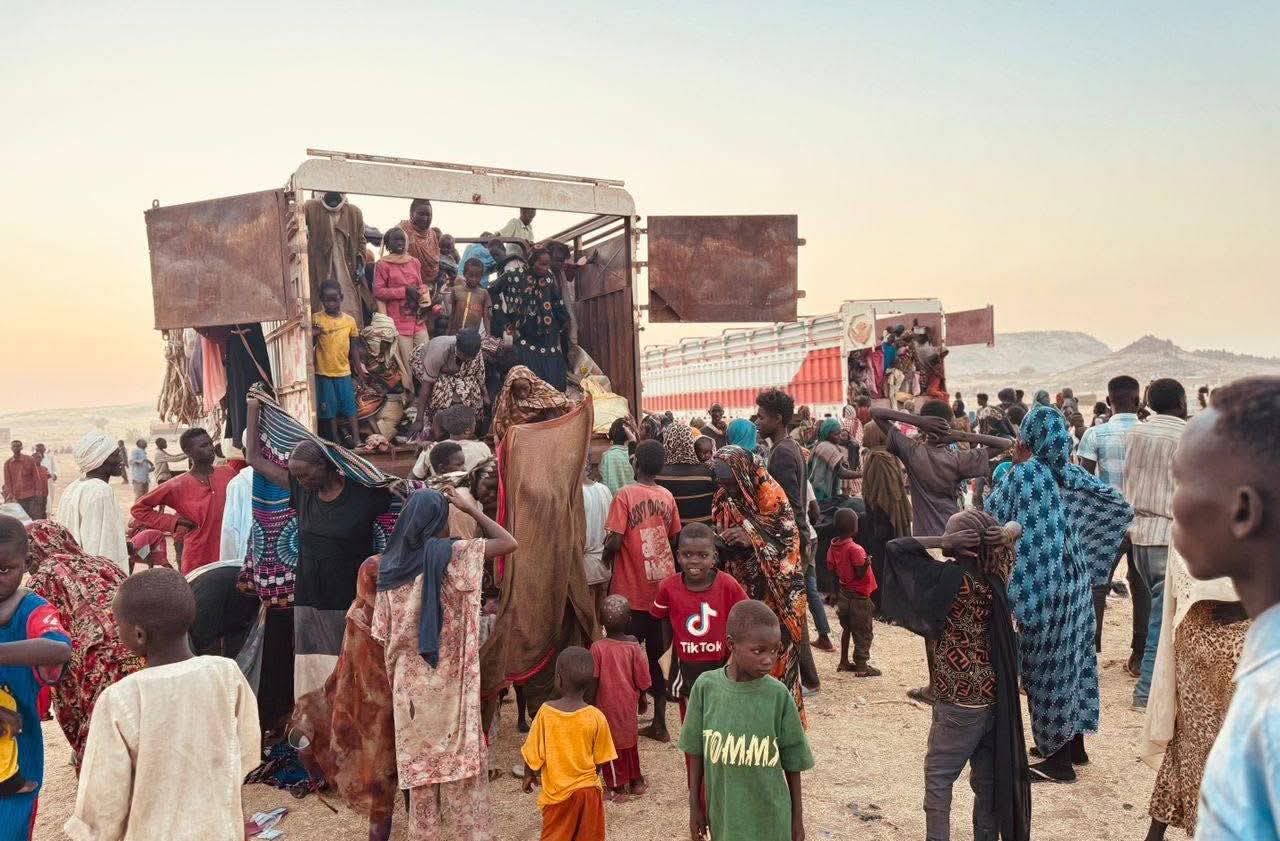
‘Unable to erase the sight of the dead from our minds’: Scenes from Fasher’s fall
Survivors of the RSF's massacres in Fasher recount the harrowing scenes of the city's capture.
Your support is the only way to ensure independent, progressive journalism survives.
You have a right to access accurate information, be stimulated by innovative and nuanced reporting, and be moved by compelling storytelling. Subscribe now to become part of the growing community of members who help us maintain our editorial independence.
Join us