
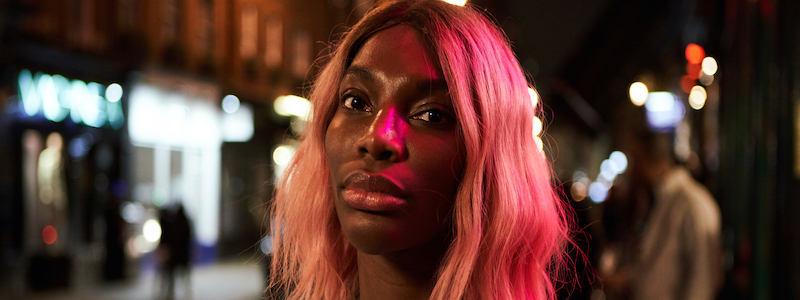
Double authorship: A conversation on I May Destroy You
Since the days of Mad Men and Breaking Bad, great television now mostly exists for me as a sort of mirage I delusionally think I’m moving toward as I scroll through Netflix, mindlessness and mediocre content feeding one another like a snowball. So I watched I May Destroy You, the acclaimed series created by and starring Michaela Coel, at the end of last summer with a sort of relieved euphoria of having arrived: it’s out there! (Although it’s not on Netflix; the show is a BBC and HBO coproduction, and is available in Egypt on OSN).
IMDY is about consent, and the center of its plot is the sexual assault and rape of Coel’s character Arabella, whose drink was spiked by her rapist and only remembers the violence in confused, flashing fragments. The show is shaped by Coel’s own experience of assault, which she spoke about publicly in 2018.
When we meet Arabella, she’s a London writer who’s been catapulted from social media stardom into the mainstream literary industry after the success of her first book “Confessions of a Fed-Up Millennial,” which, as she says, she “wrote for Twitter.” She is extroverted and warm and open with fans and strangers as well as her tight group of friends. She is assaulted after she takes a break from an all-nighter working on her new book to meet a friend at a bar.
The show takes us through Arabella’s realization of what happened to her, to her transformation from a scrappy, partying young person to a sexual justice warrior. She uses her social media platform and her anger to call out rapists and campaign against both racism and sexism using a buzzy language that we’re all familiar with: white men, patriarchy, speaking truth. The show takes on the complexities and ethical ambiguity that come up when a person’s life is overtaken with social media fame, in a way that manages to be critical without being moralizing or didactic. In its treatment of Arabella as a social media monster, as well as every other character, the show refuses to cast people as either good or bad; everybody is capable of both.
Ultimately, Arabella goes offline, and here we watch an author grappling with how to tell her own story. Can there be resolution to trauma like this? What does healing even mean, in a world where everyone around you is violated in some way or other?
This is what stunned me throughout and in between Coel’s tight, well-acted and multilayered 30-minute episodes: how did she do it? How has she, a young black writer and showrunner, made television that was both good to watch, but also made her viewers think about a kind of violation that most often engages audiences on a purely emotional or sensational level.
Part of the answer is that Coel opens up the storyline to an incredibly well-cast social world around her, showing how varied and complicated rape, survival and solidarity can be. But the other part of the answer, I think, lies in the fact that as much as this show is about consent — and that’s how it’s billed and blurbed — it’s also about making art under capitalism. We watch Arabella navigate a publishing industry whose motivations have become unapologetically whittled down to base numbers, in which she herself is not an artist but a commodity. On both consent and capitalism, IMDY investigates a double layer of authorship, with Arabella’s manuscript about her rape as a sort of stand-in for Coel’s show.
The outpouring of speech and organizing around sexual violence in Egypt was well underway when I watched IMDY the first time. I looked for an excuse to watch it again, and to find people to talk about it with, people who were here. So, a few months later, I had the pleasure of rewatching it with Salma El Tarzi and Rose Elbay. We watched together but apart, straddling different time zones, chatting on a group text as we went through the episodes. When we finished, we had a chat about it on Zoom, in which Salma had forgotten we were meeting with the aim of printing an article. It was worthwhile anyway, and I recommend that you watch this with people you like discussing TV and film with. There’s a lot to talk about.
Rosaline Elbay is an actress (Ramy, Qabeel) and writer. Salma El Tarzi is a film director (Underground On the Surface), artist and writer.

Yasmin El-Rifae: Well, I got so much out of watching this show a second time, and I think also watching it while in conversation with you guys made me pay more attention and be more thoughtful about what I was taking in. I haven’t really seen anything made about sexual violence that was quite so muscular or flexible — or both. Every thread and every idea is dealt with in a surprising way, or from multiple angles, or eventually turned on its head.
Rosaline Elbay: Yeah, I agree. There’s never a neat black-and-white that you can live in; you never get comfortable in going, ‘This is what’s right in this situation and this is what’s wrong.’ Sometimes you want to watch TV and you want to hate someone. But she almost doesn’t let you, which is very bold. And very impressive, because she wrote it about her own assault.
Salma El Tarzi: I also think that the depiction of the rape itself was really well-directed, we were really in her head but she was not objectified, or we were not looking at her. Even when she was in the shot, we were not watching her, we were with her. And it was a complete shift of gaze, which is so often not the case. Even when the most sympathetic, well-intentioned directors try to portray rape or sexual violence, it always tends to be overly sensationalized or over-victimized, overly melodramatized, overly sexualized — there’s an over-something, always. Usually when filmmakers think of shifting perspective to make it from the point of the view of the victim — automatically what they do is they have the camera in the POV position and you see the grunting faces of the horny men being all monstrous with the wide lens and to me, it just re-emphasizes the same thing: the focus is on the perpetrator’s desire, or whatever it is that drives rapists.
RB: All you were doing in that episode was looking at the rapist and being like, ‘What the fuck is wrong with you?’ But that didn’t mean that you lost her perspective. I don’t remember the last time people were going wild over a rape scene. In Orange Is the New Black, in season two or three, there was a rape scene where they zoomed into the victim’s face and that was all you saw. And, at the time, this was finally a rape scene that is not male-gazey, in that the victim wasn’t sexualized at all and we’re just seeing her experience of it. But what you missed was confronting the perpetrator. And I thought this was an ingenious way of getting both — like, you were forced to look at him, but you never lost Arabella.

YR: For me, the shift in perspective is part of a bigger project, where we’re in Arabella’s own shifts of consciousness throughout the show. It peaks in this ground-shaking moment of empathy, when she’s at the station with a fragmented memory of seeing someone get raped, and then one of the investigators demonstrates a posture that makes her realize it was her that was raped. That “Oh shit, it was me” moment — I don’t think television has ever made me feel that way, ever. And it was the same when I saw it the second and third time.
ST: Also, throughout the whole show, I am impressed by how inelegant she is, what a mess, what an inelegant, ungraceful mess she is. Because even when rape is not being sexualized intentionally in films, the victim is always over-feminized or very delicate — she’s still beautiful. Throughout the show, even in the moment when she’s sexually active, there isn’t this sensual hyperfemininity that’s usually there. It’s almost a slap in the face to someone who’s expecting a rape victim to be in a certain way.
RB: There was one thing about Arabella’s character — I always refer back to this when people talk about how women are portrayed in film, especially when you’re supposed to empathize with them: so, in Titanic, when Kate Winslet is supposed to be drowning, James Cameron said to put her in an oversized lifejacket so she looks more vulnerable. For him, to make sure that an audience sympathizes with a female character, he infantilizes her and makes her even more vulnerable and even smaller. And Arabella’s never small. We never get any of that — this is not the sort of woman who has to come out and say, “I am so weak,” for you to empathize with her. This happens to very strong, independent women—this happens to women who this “would never happen to.”

ST: It makes all the statements without the manifestos and the lectures. Except in the episode where she’s working for a vegan/eco politics startup, and her black friends all bash it. I mean, I know what they mean and I agree with it, but I’d like to talk about it more.
RB: I thought that it was a very good example — and she went into that with the rest of the social media thing, as well — of how women’s voices are commodified. They’re so excited that she’s a Black woman or a woman of color and she’s being exploited as a mouthpiece for their eco-friendly brand. And it felt like most of her experience with her publisher, or with social media in general, was that her real experiences were pushed aside in favor of packaging them for other people.
YR: This show came out in 2020 and she started working on it in 2018, conceiving it when #MeToo was happening, and you had this uptake of television needing or wanting to reflect woke culture and be more representative and wanting to deal with all these issues, etc. And it ended up giving us a lot of superficial crap TV that’s trying to go through a list and tick the boxes: Okay, we’ve given the audience the right kind of politics on these issues, and we’ve got a cast that looks like this, and so on. And the fact that she manages to sidestep all that ... I take the social media thing within that. She’s engaging critically with the way that our language around a lot of this stuff gets hollowed out so quickly, and we become machines ourselves as we speak about and tweet about this stuff, and are plugged into our likes. You need it because it’s a platform and a tool, and sometimes it’s the only one we have. But what does it do to us? I don’t know if you guys managed to watch the video of the speech Michaela made at the Edinburgh TV festival — essentially speaking to this audience of power players of the industry: producers and everyone who makes television — and she talks about race and about gender politics without using any of the language that we’re surrounded with all the time. She adopts a completely new vocabulary. She uses the word “misfits” instead of “minorities.”
RB: Which she does in the show, when she says “raper” instead of rapist. Her use of language is so deliberate. Even in conversations that I’m having now, all the time, in the industry, there are buzz words that have almost lost their meaning, like “diversity” and “inclusion” — it’s like, what are we talking about though when we say “diversity”? And when you take away the buzzwords and you actually talk about it, it jerks you into having to actually think about what you’re talking about, rather than assuming everyone is on the same page as you and moving on. I think that’s why the show is such an active watch. Because it doesn’t ever do the thing that you expect it to do. You can’t sit back and be like, I know what this episode is. Try. [Laughs.] It’s not going to work. Which I think is who she is as a filmmaker.
The first time we meet Arabella’s publishers — her agents are the two white people — and then you see this Black woman, Susy Henny, come in and you’re like, She’s going to be her ally, because she’s the other Black woman in the room. And she is not — instead, she’s the antagonist of the whole book publishing scenario.

YR: I was thinking back on that scene later in the show, when Arabella’s broke, and wants an advance — an advance on her advance — and you see her and you realize, every time she goes to see Susy Henny, she rides up and down this glass elevator and I think there’s something about that just made me think of like, ‘Oh, this is a straight look at how power ends up working under capitalism.’ And how could I watch that scene and not think of glass ceilings being shattered, you know? And then she gets up there, and it’s all this absurd invitation to eat out of a bowl of pomegranate, and stroke the office plants and whatever, and then suddenly Suzy cuts through the bullshit and is like, ‘Where is the draft?’ This draft that is happening because earlier, when Arabella tells them all that she’s raped, Susy Henny is there, and she doesn’t react on any sort of human level, just says, You should write about that.

RB: [About] the glass elevator thing: You see her go up and come down, and when she goes up, every time, she’s hopeful, and when she comes down, she’s broken. Shattered. And then the other thing about Susy is like — that scene with the plants was so fucking frustrating, because it was almost too on the nose, the metaphor of her talking about her plants and being like, “It’s been two years. You have to nurture them and grow them,” and then she just cuts Arabella off. [Laughs]. The actress is also just so good.
YR: What did you guys think of the episode that flips back and forth between her childhood and a present-day family lunch? The thing that stuck with me was that it ends after she’s told her mother about the rape. One of the final scenes is them sitting at the table and they’re all playing the roles, except the mother, who’s clearly stricken with this thing that she isn’t going to talk about, but she’s clearly being watched very closely by her son, and Arabella gets up and serves more food for her father.
RB: I mean, the family thing is just — the article that I wrote for Mada was very much about that, that relationship that mothers and daughters can have that is almost impossible to communicate to the male members of your family. Like, the weight of knowing that that happened to your child and the men are sitting at the table; how do you even...? Are they going to react the same way? Probably not. If you talk to them about it, their whole thing will be like retribution and “Let’s get the fucker!” and whatever. But their struggle is internal, within themselves and with each other, which I thought was really beautiful. And, for an episode that was so much about her dad, it really was about the women, and how he affected them and her mother’s relationship with her best friend and being like, “I’m fine.” But she’s not. Just his effect on all of them
ST: I think it was about the dad, but it wasn’t. It was really about her not seeing the mom as a woman before she was violated just for the fact that she’s a woman. And that’s when being a woman becomes a pressing issue, [one] that you had taken for granted until you get violated just for that, and then it’s as if you’re revisiting this idea of what it means to be a woman. I don’t think she had the intention to reveal the rape to the mother when she was going to lunch. The decision to share it came when she could make this connection, when she could finally see (that the mother had been cheated on by the father), and they each have each other’s secret, in a way — as two women, not only as mother and daughter.
Do we want to talk more about Kwame’s rape?
RB: That’s the one that really affected me, because his defense was almost self-punishment, and then seeing himself as an object; it’s so familiar, and [he's[ invisible to everyone around him, which is what happens to a lot of victims, especially men. He’s a man, at the end of the day; being attuned to his behavior isn’t going to be as obvious to his friends, who completely dismiss him for the first couple of episodes after he’s been raped. They’re even talking about the typical things that happen to rape victims — being withdrawn and all this kind of thing — and just completely ignoring that it happened to him, right in front of them.
ST: Kwame’s really is the story that puts a finger on the idea that privilege is not a pyramid, but more of a web, whereby the same person can have very little privilege and be abused because of it, but in another situation are in a position of power and they are abusing someone else, and so on. I think this was very interesting, particularly his encounter with the white woman, because she was a total asshole with all the privilege, but in this instance, she was violated by him, and he violated her and he was a perpetrator and he was a man, gay or not gay. And I thought this was very multilayered and very well-played.

RB: It also sits in that really uncomfortable area — when are you violating someone’s consent? And withholding information from someone, is that violating consent? And ultimately, in his healing or whatever he was trying to do, he wants to find someone to manifest that healing through, whether they had agreed to be part of it or not.
YR: I can’t help but link Kwame’s apology to her with Zain’s non-apology. Zain is contrite, and he’s not exactly redeemed, but he helps her when she’s stuck with her book. She takes the help. And if we look at it cynically, it’s like there’s something transactional here. He has this knowledge that he has acquired through going to Cambridge, and from his first appearance in the show, you can see how he doesn’t think that she should be in these same literary spaces as him, and it’s in those spaces where she calls him out. In the end, it is that position of advantage that he has that allows him to come back to her in this really neutral way without even discussing it head-on.
RB: A lot of the time, and it’s this really uncomfortable thing — the people that assault you are going to be in your life and in your work and you’re going to have to deal with them. Sometimes, you’ll be confronted by them. And she finds a way to kind of take advantage of that. It doesn’t make it comfortable and it doesn’t make it okay, but what else is she going to do? She does this thing where she got on stage and said that he’s a rapist. And he’s still being published. What else is she going to do about it?
YR: What did you think when you first saw that scene, when she calls him out at that event?
RB: It was very cathartic for me, in a way. I was like, I wish I’d gotten to do that. And also, I was so scared for her. It made me so tense. It wasn’t a straightforward triumph. I was genuinely frightened for her. And also that this is the type of rape where she has to discover that it’s a rape, which is horrible — and I love that that’s in there, because it happens, where there’s an interaction and it doesn’t feel right and it just takes someone telling you, “This is unacceptable,” for you to go, “This is unacceptable.” She didn’t get to say, “This guy dragged me into the bushes.” It’s harder to communicate it and getting into the minutiae of that — saying, “He took a condom off,” is so much more vulnerable and revealing than being able to say, “He raped me.”
ST: There is another thing that I felt when she called him out — in this moment, in the heat of the moment, you’d say, “Yeah, that’s badass. She did it, she called him out.” As a matter of fact, not only did she get raped by him, but her reaction is an act of survival. It was really hanging onto anything, and while hanging onto anything, this was her moment as a writer to read something of her book, and this got completely sabotaged. Everything that she works for takes the backseat and her identity is now the rape victim who called out someone else. Everyone is asking her to write about this, everyone is asking her to use this: use it to help other women. It’s like it’s the most important thing that’s happened to her.
RB: That’s maybe what a lot of people who haven’t gone through it don’t realize. It’s not just the act perpetrated on that person, it’s that you rob that person of the potential of what they could have been doing otherwise.
YR: Let’s talk about the role of the cops. Obviously, from where I’m sitting, that’s a dream, where you go to talk to two female investigators and they are so sensitive and professional. But then she’s still in a world where everyone around her has been violated, it’s the same police force that retraumatizes Kwame when he goes to them after his own rape, and she doesn’t get a solution from them.

RB: And that was Michaela’s experience as well; it’s never resolved. They don’t catch them and that’s it. So you get the one side of the coin of the cops who help her, but the system is only as good as the people implementing it. So when Kwame goes back, he gets a different policeman, who’s not that empathetic and is actually immediately judgmental, and that’s what happens. But also the tragedy of it is that even when the system is functioning as well as it’s supposed to, that doesn’t necessarily mean that you’re going to get the resolution that everyone wants you to get. And then how do you heal and move on?
YR: In the final episode, she puts together a series of alternative fantasy endings, and the first time I watched it, I had this feeling that it was too neat or even a little bit contrived. But then watching it again, paying more attention — and knowing a bit more about how much the show is really based on a quite similar experience that Michaela herself had — that whole last episode just seemed more valuable to me. I feel like it’s fundamentally about authorship, or where we are in terms of our own stories and owning them, but how much can we deal, or grapple, with our own aftermaths? In between each of the fantasized scenarios, we go back to the scene where she’s sitting in her garden with her roommate Ben, and you catch it for a glimpse of a second when she goes back to her wall, with all the different Post-its where she’s like storyboarding for her novel, and there’s a Post-it that says, “Garden scene with Ben.” I realized in that glimpse how much this show is authorship on two levels: Arabella’s and yours, as the showrunner.

Salma El Tarzi: I appreciated the ending. When there was the first fantasy ending, before we realized it was fantasy, when it was super violent, I was like, Oh, shit. I automatically felt sort of betrayed for a moment, because I felt that, well, I know so many people that would love this ending. And then it went really, really dark — but again, if she just leaves it there, it becomes too dark to celebrate, even for the people who were angry that this was not how I felt after my own rape. But you can’t just leave it so dark. And then there was the realization that it was a fantasy and I was like, Thank you, now I get it.
The one that I appreciated the most, personally, and was gratifying for me, was the one where they had sex and she was on top. This was very gratifying on several levels. One of them is that she made this scene to begin with and got away with it. I don’t know how it was received, but that she got away with it. And the second thing is how she played with this role-reversal thing, where she is on top but it’s not aggressive or ugly.
YR: Like there’s penetration, but it’s not like thrust-ey.
ST: [Laughs.]
RB: It’s not payback; it’s not like she’s raping him back.
ST: Yeah, sex is not a punishment here. I was grateful for this scene, because it’s rare that anyone acknowledges this side of how you process things.
RB: I think I had a similar thing to Yasmin in that, the first time I saw it, I was like, What’s happening? And coming at the end of having seen the whole thing as well; it was just a lot. And then watching it the second time, something clicked into place, where I completely understood what it was. There’s this neat societal expectation where it’s like, Okay, you’re raped or you’re assaulted, the justice is that they get put behind bars and that’s it, then you recover. But that’s now how it works. And the kinds of fantasy scenarios you play out in your head — which we’ve all done — it’s that thing where one of the ways you process your trauma is that you try to rewrite what happened. But then you also try to write the resolution of it.
And one of the ways that I think a lot of us have, and is difficult to square with this person is an aggressor and did something awful and unforgivable, is you also want to write a scenario in which you don’t hurt anymore and it wasn’t a bad encounter, especially if it’s someone you knew. I mean, in this case, it was someone that she didn’t know, so she wrote him into someone that she could empathize with, but also for people who have been in domestic situations, how nice would it be if you could go back and just re-write that hour and it was lovely. You just had sex and it was nice? It wasn’t aggressive sex, it was just a resolution and that at the end, she just tells him to leave and he leaves. He just gets up and goes.
YR: Well, it’s like the whole arrangement and context of sex in that third fantasy is stripped of the usual power dynamics. From the beginning, in the bar, we’re in this strange inverted scenario where it’s the guy who’s dancing for Terry, so you’re like, Are we in a matriarchal thing? Or what exactly is happening? It’s essentially some form of a one-night stand: this just happened, they’d liked each other, they had sex, and she told him to go. And so he just leaves, without even getting dressed.
ST: You know, actually, one aspect of this scene is that I wasn’t even sure if she was penetrating him. And I think that’s very smart. She wasn’t on top in like a cowgirl position, because this would definitely mean that he is penetrating her. But here, this was some sort of — is she really penetrating him? And I think this was really questioning this whole power that penetration gives, and was very interesting. And she could have made it much clearer if she had wanted to. But there was a conscious choice not to. She could have made it more of a statement, that she is penetrating him, that she is wearing a strap-on, that she is whatever. But we don’t know. This was a conscious choice not to make it anatomically conceivable. And I thought this was very interesting.
RB: For me, it was clear that she was penetrating him, but I also appreciated how it was shot and executed, the way that a lot of love scenes are, with the sheets kind of artfully draped exactly where they should be. It just read like a romantic sex scene, just reversed.
Then we realize none of it happened and she never went back to the bar at all, and it was always just her fantasizing in the garden. And that’s almost the best scenario, is that she’s finally like, I can’t keep going back there. She says that thing about the criminal always going back to the scene of the crime and asks, “Which of us is the criminal?” At what point is her trying to resolve this just perpetuating her trauma, by forcing herself to revisit it over and over again? It’s not a neat resolution for her, at all.

Yasmin El-Rifae
Yasmin El-Rifae joined Mada Masr’s editorial team in 2019, where she focuses on gender, among other areas. Her first book, Radius, a narrative history of the militant feminist group Operation…
تقارير ذات صلة

Egypt’s human rights strategy is finally out, but will bring few ‘major developments’ in criminal justice reform, says source
Mada unpacks the strategy and its delayed rollout and looks to what it means moving forward.
How do institutions respond to sexual violence?
While shaming institutions publicly appears to have pressured some into putting anti-harassment policies in place, policies alone are not enough, and experts tell Mada Masr there's a need for "collective responsibility" to enact justice for people who have been subjected to sexual violence.
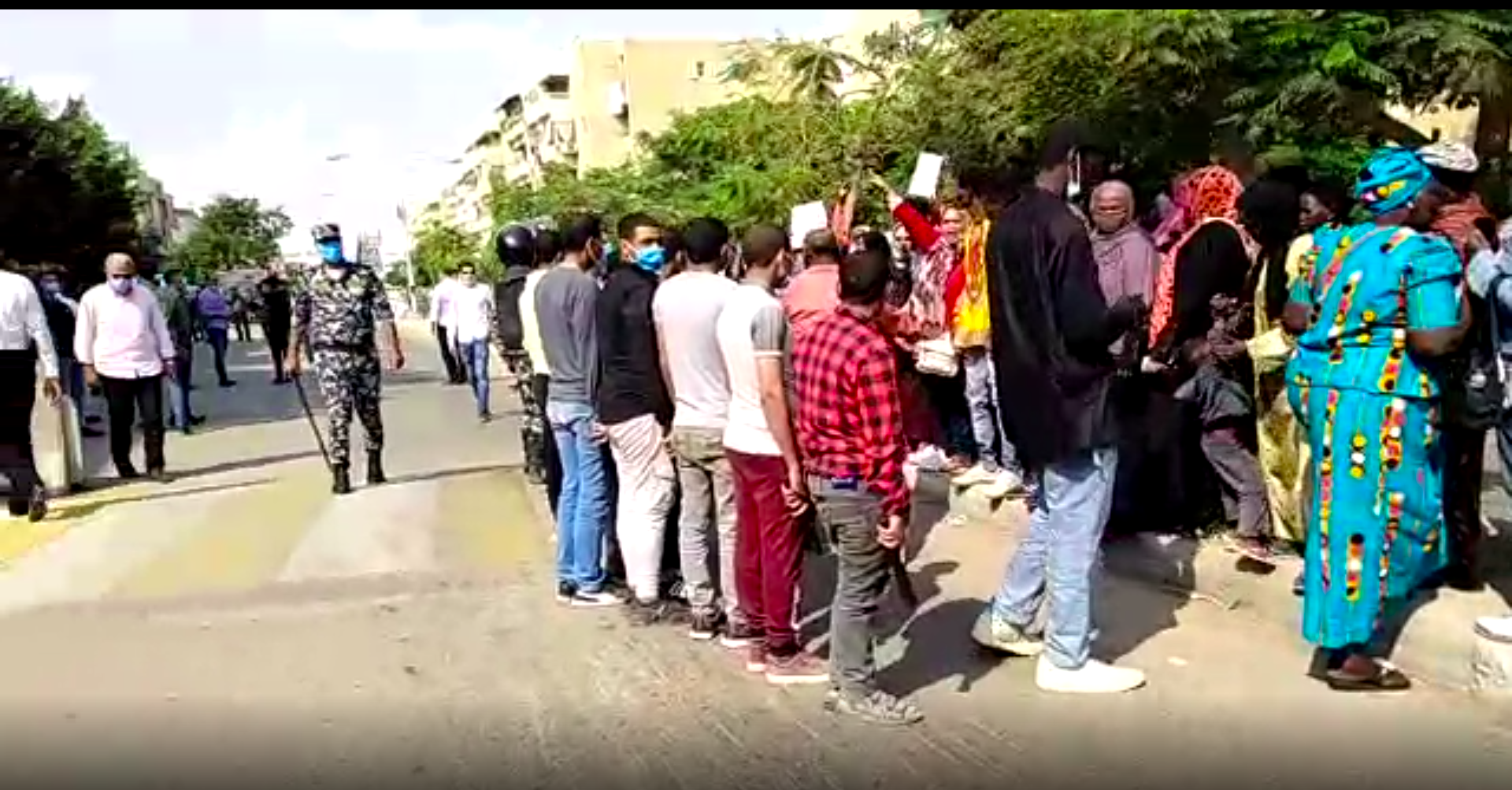
Security forces crack down on refugees protesting violence, harassment
Within 15 minutes, security forces began to use batons and water cannons to disperse the protest.
Your support is the only way to ensure independent, progressive journalism survives.
You have a right to access accurate information, be stimulated by innovative and nuanced reporting, and be moved by compelling storytelling. Subscribe now to become part of the growing community of members who help us maintain our editorial independence.
Join us