
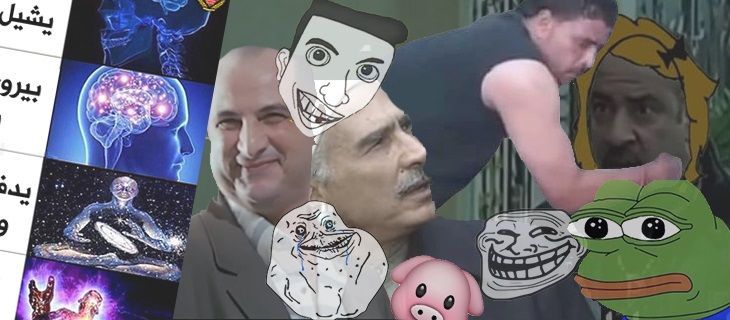
A brief history of memes
Over the current decade, “memes” have become ubiquitous among internet users, highlighting a phenomenon that is too elusive to be described by any of the synonyms that were available in the dictionaries of all common languages. And like any recent term, plagued by controversy and confusion, studies and reports attempting to find a comprehensive definition poured in. The confusion was a reflection of the nature of the meme’s rapid and unstoppable circulation: Does it refer to the comics exchanged by people on social media? Or to edited shots from films and ads? Or to any idea that goes viral on the World Wide Web?
We can start by excavating the history of one of the most common kinds of memes: pictures with captures of lines of dialogue. These modified images go through a vast cycle of circulation, reproduction and variation as an extension of its very first version (the reproduced original), be it by changing or adding to the text, which is often extracted from certain contexts within the public domain, be it pop culture or local in-jokes. Here, we will seek to familiarize ourselves with the features of these practices of repurposing and reproduction, inevitably delving into their cultural, social and political aspects, in an attempt to reach a more rounded understanding of memes. After all, what we’re trying to explore here is one of the strongest and clearest markers of the current internet culture.
The beginning
Memes can be traced back to the forums and newsgroups that dominated the internet in the beginning of the millenium, where cyber communities were taking shape for the very first time, with their own distinct language and humor, just like any communities in real life (or, shall we say, IRL).
I came across a thread started by the founder of Something Awful, a website and forum that was very present and influential among young people when I first started to discover the internet. In it, he recalled with a noticeable sense of nostalgia how “image macros” (a primitive form, of pictures with text superimposed on them), which had originated on that particular platform as a gradual development of “demotivational posters” — a trend that had started on newsgroups between work colleagues in the US as a riff on the motivational posters that often covered office walls at the time with the intention of raising employees’ morale — were the true starting point of this kind of meme as we know it today.
It is from that forum that internet entrepreneur Christopher Poole (username moot) would leave to found the website 4Chan, after forum members complained about his constant attempts to recreate the “imageboard” model, which was then very popular in Japan. Later, Poole would sell his website to the owner of 2channel, the Japanese website that had initially inspired him.
In his 1976 book The Selfish Gene, evolutionary biologist Richard Dawkins coins the term “meme” to express the proliferation of ideas and behaviors in cultures in a way that resembles how genes multiply and transform and respond to different factors inside the body. 4chan visitors adopted the term long before it became what it is today. That was upon the suggestion of Mike Godwin — one of the most influential participants in drafting laws pertaining to the exchange of information on the internet and founder of the Electronic Frontier Foundation in the early 90s — after he noticed the distinct sarcasm shared by visitors of Usenet newsgroups, manifested in how they mocked “normies,” for instance (back then there was still a delineation of some kind between internet users and the majority).
They described themselves as those who lived in the attics of their parents’ homes. They huddled in the dark corners of the internet, hiding from the normies and dreading the internet spreading to other people. Most of them worked in tech, and saw themselves in the stereotype of the nerd, who had often been mocked and bullied until the heroes of the digital age triumphed, their victory heralded by the media’s recognition of their value, as David Fincher demonstrates in The Social Network (2010), for instance.
4chan did not require any particular criteria for its users. It was a community where all members were anonymous, and where they reused and redeveloped the ideas and jokes that they shared, not just disseminated them.
I do not think that Dawkins knew, when he coined the term, that the features of the “meme” would crystallize in the collective consciousness so quickly and efficiently. All that was needed was the availability of a platform for expression and publication (it was the internet) and tools for (re)production (personal computers and editing programs).
The internet offered unprecedented freedoms when it came to expression and participation, and editing programs — such as Photoshop and Macromedia Flash (which would later be purchased by Adobe) — enabled anyone to edit pictures and also make their own images.
Japan and the meme generation
It seems memes first became common in Japan, particularly among video game fanatics, the most ardent of which were known as “weeaboos.” Influenced by cultural products like anime and certain Japanese games, the creations of that generation were focused on their childhood and the animated heroes they encountered while growing up.
4chan was divided into six sections, the most prolific of which was headlined “Japanese culture,” and it included subcategories for anime, manga (Japanese comics) and others. The very reason why Poole had founded the website was to create a space for discussing these topics beyond Something Awful, the platform where he’d first become active.
For example, one of the oldest memes in that period was based on a translation error in the Japanese video game Zero Wing (all your base are belong to us). This was way back in 1998, and it also coincided with the famous "It’s over 9000" meme (a captured still from the famous anime Dragon Ball Z), which marked the beginning of the trend in which shots from films or TV shows are adapted and reused in different contexts.
The nature of memes as a cultural product
Memes are an important part of the culture of the current, internet-immersed generation. They are open-source products that allow everyone to add their own touch. The meme is similar to a trend to some extent, but what sets it apart is that it requires more personal intervention and a larger degree of creativity. It is a way of engaging with the products of the world around us, implicitly acknowledging the effect of these products on us, but simultaneously questioning their power.
This is why memes don’t only belong to internet culture and its spider-like forms of expansion — they can also be identified within the larger context of this generation’s cultural production, which is often based on reimagining and repurposing existing products. For example, the TV show Rick and Morty (2013), which was a major source for memes in 2017, is itself an adaptation of a short film by show creator Justin Roiland, itself a parody inspired by the characters of the 1985 landmark film Back to the Future: Dr. Brown and Marty McFly become Doc and Mharti, and then Rick and Morty.
The nature of memes also resembles that of certain video game series, such as Minecraft, the second-best selling game in history, which was based on creating an open space for gamers to build and develop their own world rather than play according to specific instructions through a number of levels, as was the case in conventional video games. In this respect, the game shares the premise of the meme: reconstructing certain elements to create new ideas.
In Egypt
Throughout the past decade, memes grew to become the most popular social currency among users of social media. They became an indicator of what’s happening in the minds and the psyche of societies, particularly their youth. They created new languages and specialized modes of expression. In their performance, they became a force spreading specific ideas, affiliations and jargon, as demonstrated in the interactions between oldfags, the native inhabitants of 4chan, and its more recent visitors. 4chan was the birthplace of the hacktivist group Anonymous, for example. This inventiveness is also evident in certain Egyptian Facebook pages, such as 5anzeer, where users always replace the Arabic letter jeem (ج) with the letter ghein (غ). Here, the practice of reproduction extends to language itself, as is also the case with other memes such as Dolan, which was adapted in Egyptian memes like Sisi, where the main premise is the deconstruction and reinvention of language.
There were attempts to Egyptianize the 4chan experiment after the revolution, and internet users in Egypt began to be heavily exposed to memes, propagated by pages like Egypt’s Sarcasm Society, which started by recycling memes that had originally been created on 4chan but were then in turn repurposed by more mainstream websites (i.e., more accessible to normies) such as 9Gag.
The most common memes in Egypt are images or videos taken from popular cultural products, be they movies or TV shows or ads, that are reused to express a different idea or to tell a joke, assigning different roles to famous characters or cultural figures, such as the Mohamed Sobhy/moral police memes, for example, or those of Mealim Sardina from the show Lan Aeesh fi Gilbab Abi (I Will Not Live in My Father’s Shadow, 1995), who has officially become the internet’s foremost wise man.

The relationship between memes and the media was far from one sided, however. Advertising agencies attempted to adopt memes as a new method of viral marketing (it is worth mentioning that one of the first instances of ads as memes was the Egyptian "Never say no to Panda" campaign from 2010). Like countless other cultural phenomena, memes are being absorbed into the capitalist machine, and agencies are discussing "memetic marketing" in annual advertising conferences and summits. It will be intriguing to observe the methodology of meme creation in the future for many reasons, but mostly because memes are a clear enemy of guided and centralized media, chief amongst it branded ads directed to consumers. In 2018, for example, an internal video was leaked from Google’s research and development labs, examining this particular phenomenon. The video was titled The Selfish Ledger, a spin on Dawkins’s The Selfish Gene.
Memes and Situationist International
Memes also share a lot with the ideologized movement created by the progressives of the 1950s, particularly Situationist International and their artistic practice known as “détournement,” whereby members of the movement would transform works of art by disfiguring them, with the aim of resisting what Marx referred to as Entfremdung, or alienation. This is why it wasn’t strange when college students active on 4chan referred to themselves as neo-situationists, because the main premise behind what they did was to reproduce the products of dominant media as a form of reclaiming possession of one’s own ideas, which was indeed the seed that planted the most common types of memes we know today, in which scenes and images from famous ads and films are repurposed to sarcastically express the concerns of the current generation.

Gradually, different forms of memes dominated varying platforms. Image macros were the most-shared form on imageboard forums such as 4chan and social media platforms like Facebook and Twitter, while montage parodies took over YouTube, Vine (RIP), and Snapchat, as well as the latter’s successors: Instagram and Facebook stories.
Perhaps none of those forms shared unified political objectives of the systemic disfigurement applied by the situationists on the products of capitalism, but it seems that memes have succeeded where situationism has not — and that is empowering consumers to repossess their own ideas. Memes have become a new virtual medium of their own, independent of any particular language or affiliation, just like television, radio, or books. This calls to mind Marshall McLuhan’s famous declaration: “The medium is the message.” This is why, for example, the Dolan meme has manifestations across many languages, even though its main proposition is the deconstruction/disfigurement of language.
Memes, psychohistory and political campaigns
We can try to understand the way memes move in cyberspace by searching for explanations for the phenomenon in psychohistory, a fairly recent science established in the 1960s, specialized in studying the psychological motives behind major historical events.
In his 2002 book The Emotional Life of Nations, Lloyd DeMause, one of the discipline’s founders, attempts to explain how history has become a race between the slow improvement in raising children in advanced societies and destructive, rapidly developing technology. DeMause argues that humans are currently living between two psychological states of child development — herd culture versus individualism: pushing children to integrate within their societies (through official systems of education) versus encouraging their independence, be it a logical development in modes of parenting in advanced societies or simply a lack of control over technology that is now highly accessible for children, as a result of the massive advancement in communications and the internet.
This theory offers potential, if incomplete explanations for the global rise of the alt-right, fanaticism, actions driven by the desire to reclaim past glories, or general nostalgia, all apparent in political speeches but also in social media campaigns that explode in sudden bursts and are forgotten in mere days or weeks.
What distinguishes memes, however, from the wider systems whereby ideas are propagated in culture (be it through centralized media or viral campaigns), is the inherent dynamic in their modes of dissemination, because by definition they involve elements of recreation and reproduction, so the prevalence of a certain idea or cultural product online does not necessarily make it a meme; you need to alter it, to infuse it with your own personal vision before it becomes one. At the end of the day, what is shared as a meme is produced by the users of those platforms, not by advertising agencies or production studios or chambers of state propaganda. Once an idea is adopted and reproduced by the general public, such as the Kiki Challenge or the Ice Bucket Challenge, for instance, it becomes a meme.
In 2009, Christopher Poole was named the World’s Most Influential Person by Time magazine, though he would not become a household name until 2011, the year his website became acknowledged as an influential platform where the meme phenomenon had thrived and multiplied. Back then, Internet trolls had manipulated Time’s open poll only for the sake of fun (i.e., for the lols), but it happened and Poole beat political leaders like Barack Obama and Vladimir Putin.
Things are definitely different now; the internet has so much influence it is capable of determining the fates of nations. Users have more agency on the web, perhaps their strongest — and sometimes only — tool for empowerment. Revolutions have started online, and in turn have become memes themselves.
But while memes are indicators, they can also be tools that serve certain purposes. If you ask Google “How memes helped Donald Trump win the election,” you will find hundreds of newspapers and periodicals attempting to answer the same question. Memes are like a self-propelled machine that’s constantly producing ideas, ones that influence the masses with much more effectiveness than controlled propaganda ever could.
Memes have become a powerful social currency, and — like any economic system has its Gods and subjects — it has its own heroes. Small communities have formed on those many platforms, founding their ideas and affiliations on fleeting feelings of belonging and self-accomplishment based on the number of followers or interactions. The influence of this phenomenon will likely grow as new generations who spent their childhoods on computer and smartphone screens come of age. Memes have become reminiscent of the fly in the famous Islamic allegory: on one wing it carries the ailment, on the other it carries the cure.
تقارير ذات صلة
17-yr-old convicted of ‘prostitution’ based on social media content used to convict ‘human trafficker’ of sexually exploiting her
On May 31, the appeals circuit of the juvenile court rejected an appeal against the conviction
Witnesses arrested and intimidated: How the Fairmont rape case fell apart
Something shifted after the arrest of Ahmed Bassam Zaki
Clubhouse: What’s the story?
The live and direct engagement on Clubhouse makes it fertile ground for the unexpected.
Your support is the only way to ensure independent, progressive journalism survives.
You have a right to access accurate information, be stimulated by innovative and nuanced reporting, and be moved by compelling storytelling. Subscribe now to become part of the growing community of members who help us maintain our editorial independence.
Join us