
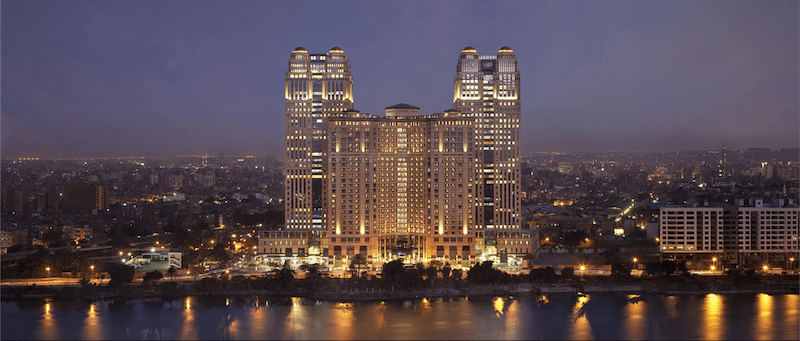
Witnesses arrested and intimidated: How the Fairmont rape case fell apart
On May 11, the Public Prosecution announced it was suspending criminal proceedings in the high profile Fairmont rape case, citing insufficient evidence.
Allegations of a violent gang rape at the Fairmont Nile City Hotel in 2014 first appeared on social media in the summer of 2020. According to the anonymous Instagram account Gang Rapists of Cairo, at least six men drugged a young women with the date-rape drug GHB, took her to a room at the Fairmont hotel, took turns raping her and wrote their initials on the victim’s body. According to the account, the rapists filmed the assault and circulated the video among their acquaintances. The allegations accused some of the country’s elite and powerfully connected young men, and the story quickly made waves.
After nine months of investigations, the public prosecutor suspended the case.“We have done everything possible to seek out the truth. We have concluded that the accused had intercourse with the victim without her consent while she was unconscious in a hotel room, during a private party she attended in 2014. But the evidence was not sufficient to refer the accused to criminal trial, he said in a statement.”
The prosecutor’s office then ordered the release of defendants Amr Hussein, Ahmed Helmy Toulan and Amr Hafez. Another defendant, Khaled Hussein, had previously been released, while the last defendant detained in the case, Amir Zayed, is being held in connection with another rape case that took place on the North Coast in 2015. Two other men implicated in the Fairmont case but never detained, Sherif al-Komy and Youssef Korra, are also accused in the North Coast case and remain at large. (The North Coast case was referred to trial in April.)
Several months earlier, in January, the Public Prosecution had ordered the release of three witnesses who were also detained in the case: Seif Budour, Nazli Karim, and Ahmed al-Ganzouri. The three witnesses were arrested in August 2020 and had been detained for four months.
The arrest of the witnesses marked a turning point in the Fairmont rape case, one that appears to have paved the way for the case to ultimately be shelved.
Mada Masr spoke to a number of sources about the circumstances of the witness detentions. They spoke on condition of anonymity out of fear of reprisal.
****
Details of the Fairmont rape case first began to emerge at the end of July 2020, on the Instagram account Assault Police, a social media account that reported dozens of accusations of sexual assault, harassment and blackmail by Ahmed Bassam Zaki, a 21-year-old university student at the time. Zaki was subsequently arrested and tried and is currently serving an 11-year prison sentence on charges of harassment and sexual assault.
Assault Police account administrators put out a call for further information and testimonies about the Fairmont case but soon suspended activity on the account and deleted their posts after they reportedly began to receive death threats. The case was quickly taken up by other pages, such as Mughtasiboon (Rapists), Cat Calls of Cairo and Gang Rapists of Cairo, which tried to publish whatever information they could find. These accounts urged anyone who had information or video recordings of the crime to submit them to the Public Prosecution and to stop circulating them in order to protect the survivor’s rights. They also indicated that the Fairmont rape might not be an isolated incident.
According to a source closely connected to the Fairmont case, something shifted after the arrest of Ahmed Bassam Zaki.
“People began to say, ‘this Bassam Zaki thing is nothing compared to what happened at the Fairmont, and we’ve known about that for years.’ The victim’s friends began to ask [the survivor]: ‘Aren’t you going to do anything?’ They encouraged her to file a report,” the source says.
According to the source, the survivor got in contact with Assault Police and several other women who had allegedly experienced sexual violence by the same men in order to file reports together. Ultimately however, the Fairmont survivor filed her report alone, with the others serving as witnesses to the case. The complaint was initially submitted to the National Council for Women in August 2020, which then referred it to the Public Prosecution.
When Assault Police and Gang Rapists of Cairo began to publish details of the Fairmont case in July 2020, nine men were implicated in the gang rape. The Public Prosecution later announced that seven of them had fled the country. Ultimately, five of them were taken into custody: Amir Zayed and Amr Hafez were arrested in Egypt, while three others — Ahmed Toulan, Amr Hussein and Khaled Hussein — were arrested in Lebanon and extradited to Egypt, in accordance with an Interpol notice issued by Cairo.
Yet the case was turned on its head at the end of August 2020, when witnesses, campaigners and a bystander suddenly found themselves targeted by authorities. Three — Budour, Karim, and Ganzouri — were ordered into remand detention by the Public Prosecution, while three others were released on bail of LE100,000 each. Another witness was released without bail.
The arrests were accompanied by a smear campaign by media websites affiliated with Egyptian security agencies that published information attributed to the case file, saying that the Fairmont case was “not what it appeared to be” and was in fact a revenge campaign orchestrated by two individuals, one of whom is among the women arrested. The articles framed the party at the Fairmont as a “group sex party” and used homophobic slurs to depict what they called a group of “perverts.”
The arrests sent shockwaves through the community of campaigners and advocates seeking justice in the case.
A second source closely connected to the case believes there was an intention to “sabotage the case” from the outset, pointing to the fact that most of the witnesses were arrested simultaneously from their homes at dawn on August 28. The source also says the witnesses were most likely targeted as a result of pressure from the families of the men accused in the rape.
According to the first source, before they were arrested, the witnesses were questioned in regard to the rape case and then were contacted again to arrange a second appointment to continue the investigation. One day before the second appointment, however, they were taken into custody.
The first source says that when the witnesses arrived at a security directorate, a “script was already in place.” They were asked why they tried to escape, even though they hadn’t tried to flee, and were accused of “deviant behavior.” The officers had sexually explicit videos of some of the witnesses, especially the women, and used the videos to threaten them.
All the witnesses were subjected to rectal examinations at the police station, the first source says.. “They made the female witnesses take off their clothes. A female prisoner was brought in and the officer said to her: ‘Search them inside and out — put your finger inside.’ They made them take their clothes off behind a screen, but the officers were taller than the screen. They stood there watching them,” the source says, adding that they were told this was standard procedure for new detainees.
“The witnesses’ lifestyles were used against them, to undermine their credibility,” the source says. “‘Are we going to accept witness statements from people who do drugs, from this slut?’ Of course not.”
According to a legal expert who had access to the details of the investigation, the prosecution treated both the accused rapists and the witnesses with extreme contempt. Contrary to the norm of arresting and interrogating a suspect on a specific charge, the prosecution dealt with both the defendants and the witnesses in a harsh manner, the legal expert says: they performed drug tests on everybody and deleted all the data from their personal cell phones. They then filed reports against the witnesses, listing charges ranging from drug use to sexual deviance and prostitution.
Mohammad al-Sebai, a lawyer who at the same time represents one of the accused rapists as well as two of the witnesses (Zayed, who is accused in the Fairmont rape and the North Coast rape, and Budour and Ganzouri), claims that the details around the Fairmont incident revealed to the prosecutor a general deviant lifestyle of everyone involved and that one of the prosecutor’s duties is to protect Egyptian “family values.”
“The public prosecutor rounded up everyone with a connection to the case, and was verifying the truth of their testimonies. One aspect of that is that this person can’t be a junkie or behave in immoral ways. They were also trying to verify the victim’s general state of consent.” According to Sebai, a wrench was thrown in case when the witnesses were charged with incitement of homosexuality and sexual deviance since witness statements by those charged with felonies cannot be accepted by the court.
According to the first and second sources, the witnesses spent two days in the security directorate, where they faced threats and pressure to change their testimonies.
“They would go to one witness, for example, and tell him: ‘The party was in April, but you said it was in February.’ He would get confused and say he wasn’t sure. They did that with several people until the statements contradicted each other,” the first source says. “They also threatened other witnesses with rape charges if they didn’t say what they wanted.”
According to the second source, several different security agencies were involved in the investigation. “There was a lot of pressure on the witnesses to change their statements. They were threatened with more serious charges if they didn’t change their testimonies or make specific statements. Some of them succumbed to the pressure and changed some details and dates. That’s why the public prosecutor’s statement indicates that there were contradictions in the witness reports and different claims about the date of the incident,” the second source says. The Public Prosecution’s statement in May announcing the suspension of the case had indeed described the statements of the 39 witnesses as contradictory.
One of the ways that the case was sabotaged, according to the sources, was the authorities’ insistence that the video of the crime constituted the only conclusive evidence, despite the existence of other evidence that was not properly investigated. According to a source who has known the rape suspects for a long time, the video was not presented to the prosecutor’s office because the witnesses received serious threats that were spearheaded by the family of Amr and Sherif al-Komy, two brothers connected to the case. (Amr was among the accused in the original testimonies that circulated though he was never arrested, while Sherif is a suspect in the North Coast rape case.) The first source closely connected to the case also said the Komy family threatened the witnesses.
The legal expert pointed out that one of the witnesses told the prosecution that the full video of the rape was in the possession of someone who lives in western Europe and who sent it to a journalist in Egypt, but the journalist’s name was not specified.
During the investigation, according to the legal expert, the witnesses presented photographs and short, seconds-long fragments of the original video. However, the prosecution did not consider this conclusive evidence, especially in light of investigations by the National Security Agency that found consensual sex parties are often held at the Fairmont hotel. The prosecution claimed that there was no evidence that the victim was in the hotel room against her will. “The only material evidence in the case is the rape video, and the National Security Agency said that it does not exist,” the legal expert says.
The second source close to the case says that the survivor and witnesses had been receiving threats since the case began. The survivor was also offered large sums of money — up to LE50 million — to drop the case, the source says. Sebai, the attorney, confirmed that some of the suspects’ families offered the survivor a huge sum of money to try to convince her to drop the case, though she refused.
However, Sebai believes the prosecution did a thorough job on the case. He says the process took place on two levels: first, the case was investigated by the local public prosecutor’s office, then it was investigated a second time by the technical office of the public prosecutor, who interrogated the survivor and the witnesses once again. It was important for the public prosecution to firstly verify whether the survivor went up to the room, and secondly whether she took the drug willingly or by force, and the conclusion it reached was that neither of these two points could be verified.
As it stands, unless the survivor presents new evidence within three months, the public prosecution’s temporary suspension of the case will become permanent. “As soon as the three months are over, we’ll submit a request to the public prosecutor to make the decision permanent,” Sebai says. He adds that, according to the Criminal Procedures Code, the public prosecution has the right to reopen the case within ten years of its filing if new evidence emerges.
However, the Public Prosecution did not just decide to shelve the Fairmont rape case. According to the second source, it also filed a new case against some of the witnesses, accusing them of drug use and allegedly banning them from travel. The witnesses have no further information about the new case. They were all subjected to drug testing after they were arrested, and neither they nor their lawyers have had access to the results.
“It’s just surreal,” says the source. “Everyone was arrested, and a case that had witnesses and recordings of the crime was shelved because of insufficient evidence. The witnesses were banned from travel, and instead of being protected, they were accused of other crimes.”
When the Fairmont case first came to light and some of the accused rapists were taken into custody, it was hailed as a step forward for a revitalized women’s movement combatting sexual violence in Egypt. It has since become a story about the repercussions of reporting crimes of sexual violence — for the survivors, the witnesses, and their supporters.

تقارير ذات صلة
Egypt’s new rights image met with skepticism in DC
'We did not come to whitewash the face of the Egyptian government'

Jailed Fairmont witness in danger, family and lawyer say, as remand detention drags on
Prosecutors renewed Karim’s remand detention for 45 days on Saturday.
Friend of witness in Fairmont case swept up in backlash arrests, ordered detained
The prosecutor’s statement did not specify the charges that the detainees are being investigated for
Your support is the only way to ensure independent, progressive journalism survives.
You have a right to access accurate information, be stimulated by innovative and nuanced reporting, and be moved by compelling storytelling. Subscribe now to become part of the growing community of members who help us maintain our editorial independence.
Join us