
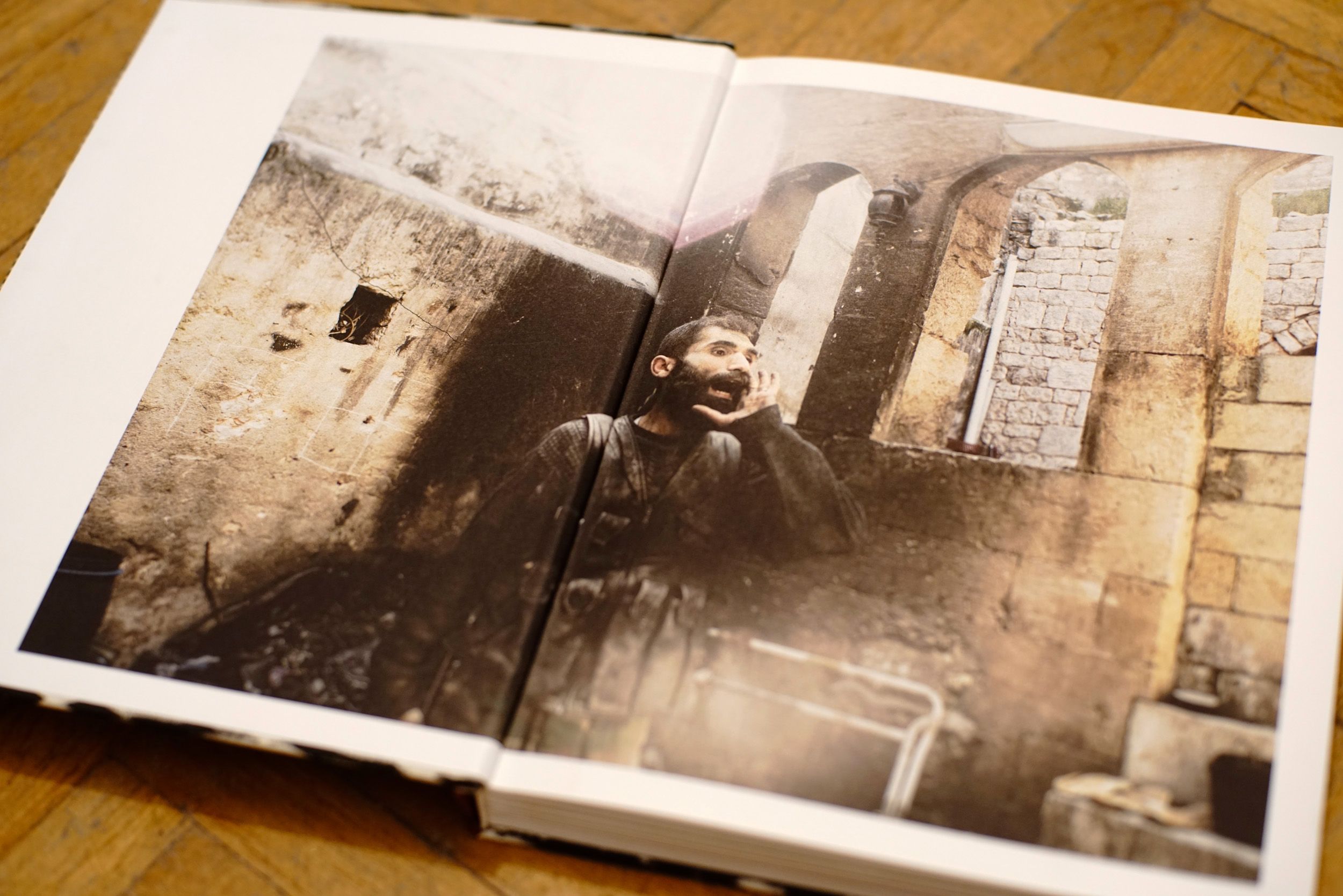
Review: Discordia by Moises Saman
Discordia, a new photography book by Magnum photographer Moises Saman, offers a unique personal perspective on working as a photojournalist in areas of the Middle East between 2011 and 2014. Saman is an experienced conflict zone photographer, whose work has been published in TIME Magazine and The New York Times Magazine, among other international publications.
Saman took numerous images in Egypt, Syria and Libya over a four-year period that were used by conventional media outlets to feed the demand for photographs of war and violence during the ‘Arab Spring’. In Discordia, however, Saman opens up a less sensationalist window into conflicts in these countries.

Born in Lima, Peru in 1974, Saman was in Libya during the NATO bombing campaign in 2011, and was smuggled into Syria carrying nothing but a change of clothes and two cameras in a grocery bag.
The title Discordia is a reference to the Roman Goddess of chaos, with the hardback book containing on the ground impressions of historic warzones and moments. Aside from Saman’s short essay at the back, a more playful approach is taken to the traditional layout of a photo book, with the inclusion of collage pieces of Saman’s photographs by Dutch-Iranian artist Daria Birang. These images are juxtaposed in thought-provoking ways; pages fold out, and provocative sequences are curated.

Such juxtapositions, for example a Cairo tanning factory beside a fake scene of carnage in a Libyan hospital by Qaddafi’s regime, introduce interesting questions of violent equivalences, without captions next to the images to lend them any authenticity or context. An index at the back of the book lists the time and place each image was taken, with a brief description. The deliberate absence of a clear narrative structure serves to amplify the subjective experience and lures the viewer into the everyday banality of conflict through depopulated streets and moments of calm, belying the danger often lurking beyond the frame.
There are several striking short sequences of images, for instance the placing of Eid ritual sacrifice opposite human casualties in Cairo. This plays into a common critique of photojournalism — the exploitative nature of witnessing and reproducing others’ suffering. The use of aesthetics only amplifies this, as Allan Sekula insightfully says: “Documentary photography has amounted mountains of evidence. And yet the genre has simultaneously contributed much to the spectacle, to retinal excitation, to voyeurism, to terror, envy and nostalgia and only a little to the critical understanding of the world.”

Although many of the images in Discordia are emotionally loaded, the photographer takes care to position himself as a participant observer in these conflicts over four years. The book is not a comprehensive view of violence during this period, but rather a mediated amalgamation of Saman’s experiences.
In keeping with a tradition of art photography, such as Telex Iran by Gilles Perees or even Bertolt Brecht’s image adventure in War Primer, Discordia is a compelling visual meta-narrative. A short, vignette-like text by Saman provides minimal context, suspending the viewer in a dissonant world of shattered lives. Some images are particularly haunting, as though Saman himself is caught in a memorial loop, trying to make sense of places, faces and time.

“Discordia is an exercise in trying to make sense of what my immersion in this period of history meant to me,” Saman has said in interviews about the publication. Although photojournalism attempts to document moments, art and distance add an ability to bear witness on another level.
Saman complicates the role of the photographer in conflict, without appealing to simplistic notions of the image industry, or archaic positivist traditions, avoiding the clichés of many before him, like Don McCullin’s rhetorical critique of media.

In a fragmented moment, Saman’s book reminds us of the importance of long-term witnessing and the complex role of the photographic imprint on society. The book offers the viewer space to visit and consider the lives of others outside the media bubble of the moment.
In one image, a boy from Shubra poses with a goat’s head during Eid; in another a man plays a trumpet outside the hospital where former President Hosni Mubarak was being treated. The book feels like discovering an archive from street observers of their divergent memories.
To citizens of these countries and eyewitnesses of violence, Saman’s images may trigger personal responses. In some of them, citizen photographers can be seen taking pictures on camera phones, pointing to layered histories that have been and have yet to be written.
Discordia
By Moises Saman
Edited by Daria Birang
Collages by Daria Birang with photographs by Moises Saman
Texts by Moises Saman
Design by Daria Birang and Moises Saman
Post production by Marco Zanella
Hardback: 240x320mm (portrait)
127 photographs / 4 collages / 1 composite
Printed in Italy by Grafiche Antiga – February 2016
بانوراما أخرى
Noor Naga, metafiction and the limits of self-knowledge
Sometimes a story needs three acts
‘Nothing moved but the mirage’: Movement and its absence in Adania Shibli’s Minor Detail
The novel is a contender for the 2020 National Book Awards
What I didn’t tell the officer: a review of Randa Shaath’s The Sand Mountain
"The Sand Mountain? Hmmm … Is this a political novel, Mr. Shady?”
Your support is the only way to ensure independent, progressive journalism survives.
You have a right to access accurate information, be stimulated by innovative and nuanced reporting, and be moved by compelling storytelling. Subscribe now to become part of the growing community of members who help us maintain our editorial independence.
Join us