
With nowhere safe in the south, displaced Palestinians double back to Gaza City
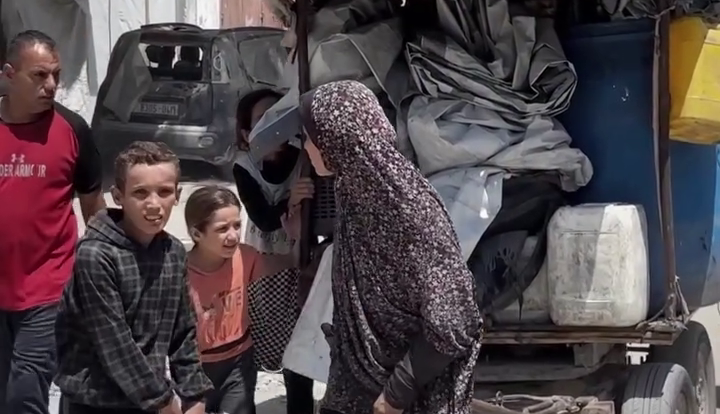
In the northern Gaza City neighborhood of Saftawy, quadcopters dominate the skies and the ground shakes as each remote-controlled demolition brings yet another building down.
These have become hallmarks of the Israeli invasion of Gaza City, which for the past month has rapidly expanded from the southeastern neighborhoods of Zeitoun and Sabra to the northwest.
For Israel, these demolitions and attacks are meant to clear the ground for an offensive to seize Gaza City they say is yet to unfold, with Israeli politicians and military figures holding its launch up as a threat in negotiations over the release of those held by Hamas. But for those living in Gaza City, the invasion is already unfolding and its intent is clear: to force the million-plus people living in the city to “evacuate.”
The Israeli military spokesperson underscored this point in a Wednesday tweet, describing the evacuation of Gaza City as “inevitable” and indicating a series of designated areas – many of which in Mawasi and Deir al-Balah – across the strip to which people could move.

Commentators online pointed to the fact that many of the areas designated safe are garbage dumps, while others are located within closed Israeli military zones.
“The map is a deception. There is no safety at all. Our colleague, journalist Hassan Dohan, was killed in his tent inside a ‘safe zone,’” wrote Sami Abu Salem on Facebook. “Most of these areas are wastelands of destruction, or garbage dumps [...] or they are far from water sources, without sanitation systems or civil life services or space.”
If those in and around Gaza City aren’t checking the Israeli spokesperson’s X account for the latest Israeli expulsion notice, the Israeli military is making sure the message reaches them. Occupation drones flying overhead are constantly broadcasting audio messages around Gaza City calling on residents to flee certain areas.
For Hassan Matar, it wasn’t the evacuation orders but the violence that made him decide to leave.
Matar lives near Saftawy’s main intersection, where Israel has been conducting flash raids in recent days.
The raids are conducted by teams in tanks, bulldozers and jeeps, flanked by quadcopters, that advance from eastern Jabalia. They place remote-controlled robotic explosives among the homes, withdraw, then detonate the explosives.
Eyewitness Alaa Abu al-Reesh told Mada Masr that the Israeli military intensified bombing late Wednesday in the Abu Eskandar area and the surrounding Jabalia al-Balad, burning multiple homes.
Overhead, quadcopter drones dropped explosives near the Saad ibn Abi Waqqas School, close to the Saftawy intersection, sparking a major fire, Abu al-Reesh said. “The situation in the area is extremely dangerous. No one dares to step into the street, because quadcopters target any moving object,” Abu al-Reesh said, describing a continuous, heavy presence of Israeli drones in northern Gaza City’s skies.
But Matar did decide to step into the street.
In fact, Matar is one of about 19,000 people who have been displaced from the areas around and inside Gaza City between August 24 and 27, according to the Global Camp Coordination and Camp Management Cluster, which monitors internally displaced people around the world and tracks displacement in Gaza via field interviews.

Though most people have been displaced into western Gaza City, Matar and his family decided to move directly south given the likelihood of further displacement when Israel launched its offensive.
“I rented a vehicle at a high price and we fled to Khan Younis’s Mawasi neighborhood,” Matar said.
But in Khan Younis, the family had no luck finding a place.
“I searched everywhere for a place to set up my tent, but I couldn’t find one,” Matar told Mada Masr.
The family then moved to Deir al-Balah in central Gaza, only to face the same predicament.
In the end, that meant the family was forced to return to Gaza City, to the same neighborhood they had fled days earlier.
“I would rather die in my city, next to my home,” Matar told Mada Masr, after he had returned.
Matar’s story resonates with countless others who have been forced to flee to safety only to return to the frontlines. Mada Masr’s correspondent in Gaza City has seen several families leave their tents only to return days later.
And while Saftawy continues to be pummeled by Israeli forces, thousands of others are facing the same choice as Matar in Sabra and even western Gaza City.
In Sabra, robotic explosives were deployed on Wednesday night in the Asqoula al-Dahshan area and along Basatin Street, said Nadim al-Sarsak, an eyewitness who lives close to the area. He described near-total destruction after the attacks.

The bombing also reached the heart of Gaza City, he said, and hit several homes in the western neighborhoods, including Tal al-Hawa and Remal.
For Sarsak, it is clear what the Israelis want: “People all over the city are living in a state of terror.”
أخبار ذات صلة

Hundreds of Gaza students demonstrate for right to study abroad
Hundreds of university students trapped in the besieged Gaza Strip gathered on Monday outside the Journalists Syndicate’s headquarters in western Gaza City…

In meeting with Board of Peace director-general, Hamas refuses UN disarmament plans until Israel commits to withdrawal
Hamas has refused to commit to the plans proposed by the United Nations for its disarmament, citing lack of advancement in Israel’s…

Israel agrees to limited reopening of Rafah border crossing — details pending
Israeli Prime Minister Benjamin Netanyahu’s office announced on Monday that it has agreed to a “limited reopening” of the Rafah border crossing…

Sisi touts ‘stabilization’ agenda at first Davos appearance in over 10 years
President Abdel Fattah al-Sisi advertised Egypt’s “stabilization” agenda in Davos on Wednesday, saying the country’s focus on steering away from regional conflicts…
Your support is the only way to ensure independent, progressive journalism survives.
You have a right to access accurate information, be stimulated by innovative and nuanced reporting, and be moved by compelling storytelling. Subscribe now to become part of the growing community of members who help us maintain our editorial independence.
Join us