
What is Egypt asking to ‘review’ with the IMF?
Egypt is in talks with the International Monetary Fund to request a number of concessions related to its debt payments scheduled for the end of the year, in addition to extending the timeframe to implement several fund-mandated proscriptions and tax regulations on certain commodities, three sources informed on the negotiations tell Mada Masr on condition of anonymity.
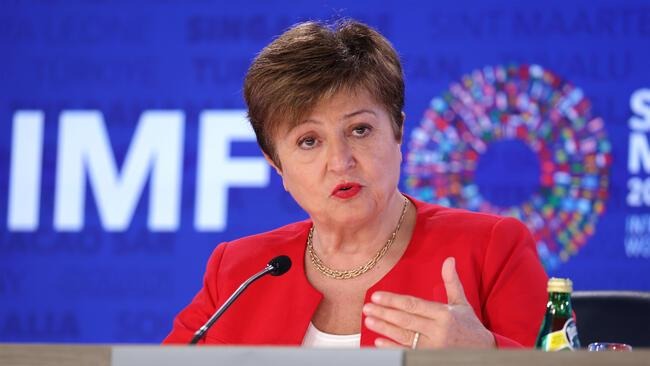
However, the fund’s message to Egypt was clear on the need for both parties to adhere to and implement the agreement of the $8 billion loan program, the three sources add, which the fund’s director, Kristalina Georgieva, stressed last week in public comments where she said that delays need to be avoided.
Georgieva, however, added at the time that some flexibility can be shown in reviewing the loan program with Egypt “to better serve the circumstances.”
Her statements came a few days after President Abdel Fattah al-Sisi made rare comments about the IMF deal in which he said that “the situation with the fund must be reviewed” if its terms place “unbearable” pressure on the public.
Sisi added at the time that the previous reform program implemented in agreement with the IMF in 2016 was successful not only through Egypt’s efforts but because of the stability in the region, referring as well to talk of a “global economic recession” in the coming years.
Egypt is facing foreign currency pressures due to its debt obligations, estimated at nearly US$11 billion, an Egyptian investor close to the negotiations tells Mada Masr on condition of anonymity, adding that this sum is scheduled for repayment within 2 months.
In his comments last week, Sisi added that foreign debt obligations come at a time of decline in dollar inflows, namely a drop in Suez Canal revenues, with the war on Gaza and the subsequent Houthi attacks on commercial vessels sailing through the Red Sea restricting movement and proceeds from the canal.
Suez Canal annual revenues dropped by nearly a quarter in the previous fiscal year 2023/24, falling to $7.2 billion from $9.4 billion the year before.
Foreign debts owed by the government for the current fiscal year are estimated at $33 billion, according to the IMF report on third loan review. The Central Bank of Egypt announced in February that Egypt owes $34.9 billion in debt repayments, including $15 billion scheduled for the second half of the year.
In order to ease these pressures, Egypt is asking the fund to reconsider the timing and scale of the disbursal of the loan, by combining several tranches into one, or by pushing the payment period out further into the future, the three sources say.
The country also aspires, at the very least, to restore the balance of inflows and outflows to the fund, they add.
While Egypt will receive nearly $3 billion in loan tranches during 2024, assuming the coming tranche is disbursed, the government needs to pay the fund $4.6 billion during the same year, as per the fund’s data.
During the negotiations, Egypt hinted at the need to increase the loan’s value, currently estimated at $8 billion, the Egyptian investor says.
The fund, however, suggested a different resort to increase dollar inflows, one of the sources informed on the negotiations say, adding that it suggested to slightly devalue the Egyptian pound to attract greater foreign investments in treasury bills and bonds or other investments, a reference to the expected inflows from Saudi Arabia.
Egypt and the fund formally agreed to augment the value of the 2022 loan to $8 billion in March, after the IMF waived Egypt’s non-compliance to the policies mandated in the 2022 deal, namely in relation to the liberalization of the pound’s exchange rate.
Following the landmark Ras al-Hikma deal Egypt signed with the UAE in February, the central bank allowed the Egyptian pound to float, causing the national currency’s value to drop around 60 percent against the dollar, and raised interest rates by an unprecedented 6 percent.
The government then renewed the pledges it must adhere to in forthcoming reviews, specifically addressing spending on national projects, containing fuel subsidies and creating a competitive climate for the private sector.
An economic advisor close to the negotiations tells Mada Masr that global lending markets are anxiously anticipating a decision on the exchange rate, adding that any indications of a fixed exchange and lack of its flexibility could affect markets’ desire to invest hot money in Egypt.
Even as Egypt is pursuing a pressure release mechanism, the sources close to talks between the two sides say that Egypt can still repay its debts in the coming two months, but the government is trying to avoid resorting to its foreign currency reserves and disrupting the banking sector’s foreign assets — the difference between the banks’ total assets and their liabilities — especially since they saw an uptick with the Ras al-Hikma deal.
The IMF’s suggested scenario to float the pound comes up against the government’s standing concerns about inflation rates, which rocket up with each devaluation.
Egyptians have weathered high inflation for the past two years amid an economic crisis, with rates reaching a record high of 38 percent in September 2023 and spiking again in recent months after the government hiked the prices of energy, electricity, bread and transportation in line with austerity measures recommended by the IMF.
The government also fears that another flotation of the pound could affect fuel prices even further, the sources informed on the talks say.
The Egyptian investor says that the current cost of supplying fuel exceeds the selling price for the consumer by 25 to 27 percent.
In the scenario of a devaluation, the gap between fuel cost and its selling price will widen, the investor adds, pushing the government to increase fuel prices, thus exacerbating inflation and the pressure it puts on all other goods.
The fund was taken aback by Sisi’s comments on the loan program, especially since they came after the government raised fuel prices at a level higher than the rates mandated by the Automatic Fuel Pricing Committee, which should not increase or decrease by more than 10 percent, and exceeded even the rates agreed upon with the IMF, the source who is informed of the talks adds.
The government raised fuel prices a third time this year only weeks ahead of the IMF’s fourth loan review. Prime Minister Mostafa Madbuly also stressed last week that the state is committed to gradually phasing out fuel subsidies by the end of 2025 as per IMF recommendations.
Electricity prices were also raised two times since the beginning of the year, once in January and the other in August, pushing prices up by nearly 74 percent. Prices of cooking gas cylinders were also raised by about 50 percent in September.
On another note, the IMF is discontented with the government’s slow divestment from state-held assets, a Parliamentary source tells Mada Masr
When the time comes to sell, they add, “you find the institutions and entities that own assets saying: ‘No, I paid a lot of money and I want it back,’ and then the investor says: ‘No, that’s too high of a valuation.’”
While the Parliamentary source does not identify the concerned entities, another government official informed on the negotiations notes that the real obstacle lies in offering companies owned by the military.
According to the official, the IMF requires “at least a step in this direction,” while Egypt requested a longer period to address this file.
The sale of stakes in companies owned by the Armed Forces has long been a top priority for the IMF and a difficult step for the government. The military has consistently refrained from publishing the accounts of their companies that operate in the civil sector due to concerns that it will threaten their interests, along with those of retired officers who manage these institutions.
The sources close to the talks also say that Egypt asked to withdraw from the commitment it adhered to in the third loan review, regarding applying the value-added tax on 19 of the list of 58 commodities and services that are tax-exempt.
According to the fund, the value-added tax on the 19 commodities will increase tax revenues and therefore the budget’s primary surplus as well.
Two of the informed sources say that Egypt argued during last week’s discussion with the IMF that tax reforms, announced by Finance Minister Ahmed Kojouk last month, would raise tax revenues by a percentage similar to the case of withdrawing the tax exemption of 19 commodities.
“Therefore, there is no need to reverse their tax exemption,” one of them adds.
During the third review, the IMF predicted for the government to complete the exemption process in November this year, allowing a 0.2 percent increase in tax revenue for the current fiscal year.
The executive regulations for the value-added tax law issued in 2016 stipulates the exemption of several goods and services from the 14 percent tax, mostly food products, such as baby milk and food, bread, pasta and sugar among other essential commodities.
The list also includes a number of agricultural products, such as seeds, seedlings and fodder, as well as educational services, such as books, notebooks and newspapers, along with healthcare services and a number of raw materials such as oil, natural gas, gold and silver.
The House of Representatives is supposed to discuss the draft law amending the value-added-tax law, including the exemption on the 19 commodities, but no discussions have been held yet as there is a desire to postpone the implementation altogether, the parliamentary source tells Mada Masr.
Egypt also requested flexibility in the IMF’s recommendation for the government to set a schedule for gradually raising fuel prices to the level of cost recovery or the complete phasing out of energy subsidies by December 2025, according to two of the informed sources.
They explain that the lifting of energy subsidies, which will translate into rapid price increase, will make it difficult to control inflation rates, leading Egypt to request a longer deadline for the complete removal.
أخبار ذات صلة
Egypt passes 5th, 6th IMF loan reviews, with fund easing tone of govt criticism
In a Tuesday statement, the International Monetary Fund announced that Egypt passed the fifth and sixth reviews as part of its ongoing…
IMF in Cairo to discuss privatization, over-reliance on short-term borrowing
A delegation from the International Monetary Fund touched down in Cairo on Monday to begin its final review of the US$8 billion…
Former employees sue to block sale of Eastern Company workers’ shares to Fidelity
Two hundred former workers at Eastern Company have filed a lawsuit to halt the payout of proceeds from the sale of the…
Unnamed investor buys out workers’ stake in tobacco giant Eastern Company after monthslong conflict
Share-holding workers at partially state-owned tobacco firm Eastern Company were bought out on Thursday following months of conflict over the sale. The…
Your support is the only way to ensure independent, progressive journalism survives.
You have a right to access accurate information, be stimulated by innovative and nuanced reporting, and be moved by compelling storytelling. Subscribe now to become part of the growing community of members who help us maintain our editorial independence.
Join us