
UN launches campaign to vaccinate Palestinian children in Gaza against polio

Parents and carers brought children under the age of 10 sheltering in sites across central Gaza’s Deir al-Balah Governorate to medical centers and other temporary structures for vaccination against polio on Sunday.
Children queued to receive a few drops of the liquid vaccine in their mouths, before staff administering the vaccine marked one of their fingers with dark blue ink to show they had been treated.
Doctor Moussa Abed, director general of primary care at Gaza’s Health Ministry, told Mada Masr that he believes the campaign is enough to reach as many children as possible, provided that “there are no obstacles from the Israeli side and no strikes here and there.”
The first polio case in Gaza in 25 years was confirmed in August, as the strip suffers an outbreak of the life-threatening virus amid an ongoing public health crisis which has spread in the wake of the war.
Many parents attending the campaign launch on Saturday and at a vaccination site operating on Sunday at a health center in Deir al-Balah told Mada Masr that they were worried about disease spreading amid deteriorating living conditions caused by the war.
Israel agreed to facilitate “humanitarian corridors” for the passage of medical teams and to halt fighting for a number of hours each day. The resistance factions also agreed to halt fighting.
Medics and humanitarian workers held a press conference in the Nasser Medical Complex in Khan Younis on Saturday to launch the campaign, which will seek to immunize all children in the strip under the age of ten, given the age group is particularly vulnerable to the disease which can cause lifelong paralysis.
Head of the campaign’s technical committee Majdi Duheir explained to Mada Masr that the campaign targets around 640,000 children in the age group who will be vaccinated in two rounds.
Staff from the Palestinian Health Ministry in Gaza are working alongside UNICEF and other humanitarian agencies aiming to reach as many of the hundreds of thousands of children under the age of ten in the Gaza Strip as possible.
A first round of the campaign which began on Sunday is to continue until September 12, administering the vaccine to children over a four-day period allocated for each zone of the strip, starting in central Gaza, followed by four days in Khan Younis and Rafah, and finally four days in Gaza City and the north, according to Duheir.
Abed told Mada Masr that about 770 medical teams have already spread across most of central Gaza, with each team able to vaccinate 50 to 70 children each day. He noted that medical teams will continue to provide the vaccine between the rounds at the primary centers affiliated with UNRWA, government centers and medical points.
Duheir said the second round of the campaign is due to start on September 17, and will follow the same pattern. He added that medics in Gaza are “working with our partners like UNICEF on security issues for our team working on the ground, in safe zones and unsafe zones.”
Both Israel and Hamas agreed to halt fighting for at least eight hours a day over three days during each phase, a senior World Health Organization official said on Thursday.
UNRWA Communications Officer Louise Wateridge told the media that the pause in fighting lasted through the morning, although some gunfire was heard shortly after 6 am when it was due to start.
The Health Ministry has called for a ceasefire to ensure the success of the polio vaccination campaign during the past two months, following the arrival of about 1.2 million doses of the polio vaccine from UNICEF, days after the WHO announced the first confirmed case in the strip.
Gaza's Health Ministry and the WHO reported in July that the virus had been identified in sewage samples collected by UNICEF from Khan Younis and Deir al-Balah, noting that people living in overcrowded conditions without adequate water and sanitation were at risk of contracting the disease.
Polio can cause death or permanent disability for infected children, primary care official in Khan Younis Najwa Abu Moustafa told Mada Masr. She noted that the Health Ministry, in cooperation with UNICEF, eradicated the disease from 1988 to 2014, with no cases of the disease recorded during that period.
But public health has declined in the strip amid Israel’s aggression on the strip, which is nearing its eleventh month. The war has destroyed a majority of Gaza’s civilian infrastructure with all five waste treatment plants offline, making clean water scarce and complicating access to sanitation.
Meanwhile a majority of the 2.3 million Palestinians in the strip have been displaced multiple times, with over a million taking shelter in an increasingly small area of the coast, contributing to overcrowding.
Hanaa al-Sheikh Eid, whose child suffers from kidney failure, told Mada Masr that “the campaign came at the right time,” as she spent months in fear that her son might become paralyzed amid the disease-causing pollution in the displacement camps and with the lack of food compromising health conditions for everyone. Her anxiety worsened when the first polio case in Gaza was confirmed.
Another mother, Amal Shaheen, was encouraged to vaccinate her child when she learned the vaccine is administered orally, not by injection, which reduced her fears of contamination and disease transmission, she explained to Mada Masr.
Head of the Pediatric Department at Nasser Complex Ahmed al-Farra told Mada Masr that the vaccinations offered in this campaign cover type 2 polio virus, which was detected in sewage water in Deir al-Balah, unlike the routine vaccination against polio, which covers the type 1 and type 3 polio.
But parents are still concerned about the spread of disease. The Health Ministry, too, has stressed that the vaccination campaign will not be effective alone against polio, given the lack of clean water, personal hygiene supplies, the spread of sewage among the tents of the displaced and the lack of a healthy environment.
Four people who came to vaccinate their children pointed out to Mada Masr that routine childhood vaccinations for other diseases are not available in health centers in the Gaza Strip at present, adding that medications are not available for the skin diseases and allergies many are suffering due to environmental pollution and high temperatures.
Maysaa Elwan’s two children received their polio shots. “Vaccination is better than no vaccination,” she told Mada Masr, but stressed the spread of other diseases such as smallpox and scabies. “One wants to get rid of war and disease.”
Elwan noted that many children around where she is staying have developed a rash due to bacteria in the water. “All the children have spots,” she said.
أخبار ذات صلة
‘Resistance will persist’: Q&A with Hamas leader Mohamed Nazzal
Hamas leader discusses Qatar strike, snags in ceasefire, steps for technocratic govt
‘The ruins of our homes and lives:’ Return to north Gaza fraught with loss for tens of thousands
“I wish I hadn’t come back” was the first thing Emad Azzam, one of hundreds of thousands of people who returned to…
‘Isn’t there a truce?’ Residents face Israel’s continued assault on Gaza City
Despite a declared “halt” in Israel’s military operation in Gaza City on Saturday, the hundreds of thousands of people still in the…
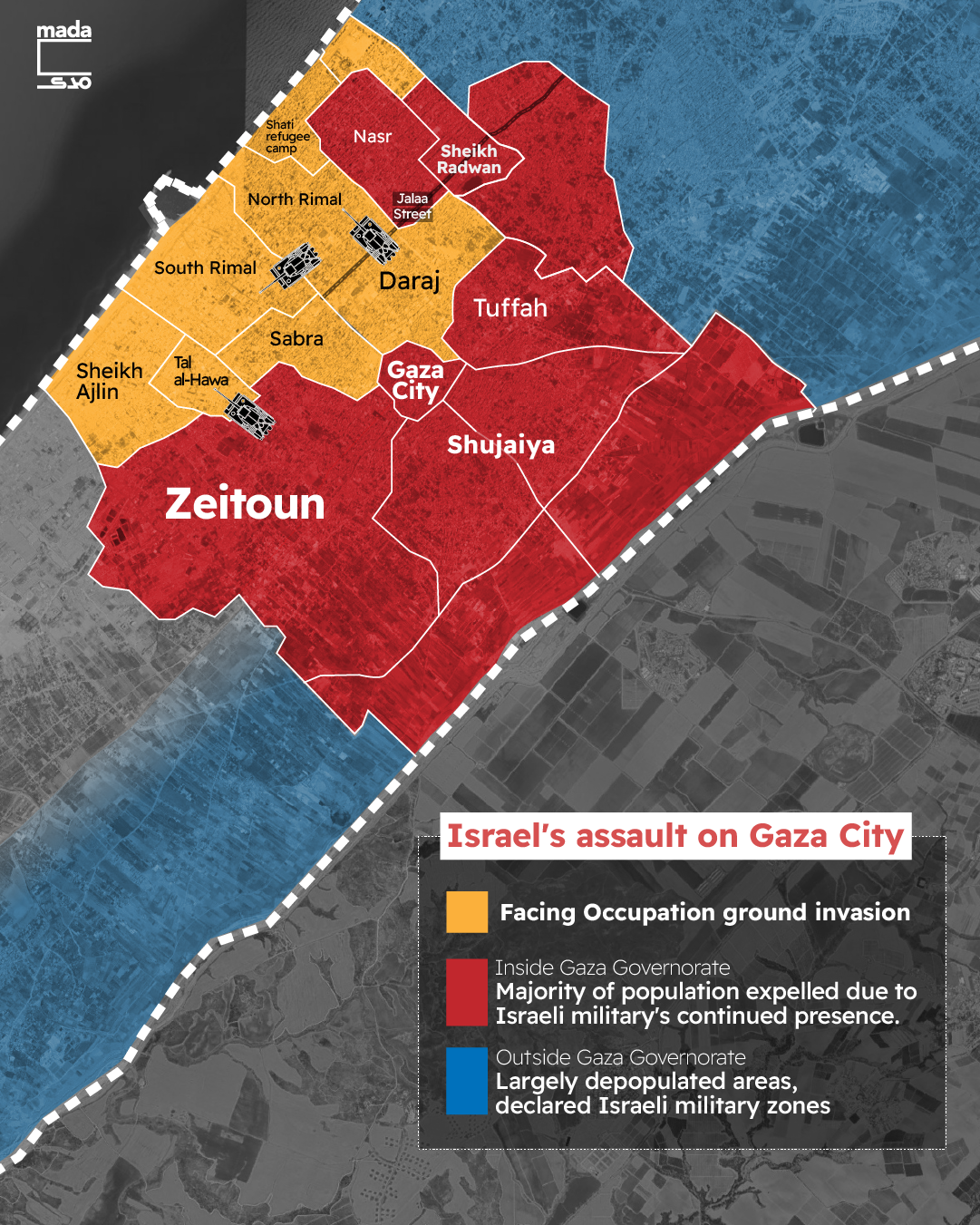
Families isolated in coastal neighborhoods with ‘no means to endure’ as Israel advances into central Gaza City
Hundreds of thousands of people living in central Gaza City are being forced to flee as advancing Israeli forces push with the…
Your support is the only way to ensure independent, progressive journalism survives.
You have a right to access accurate information, be stimulated by innovative and nuanced reporting, and be moved by compelling storytelling. Subscribe now to become part of the growing community of members who help us maintain our editorial independence.
Join us