
Families isolated in coastal neighborhoods with ‘no means to endure’ as Israel advances into central Gaza City

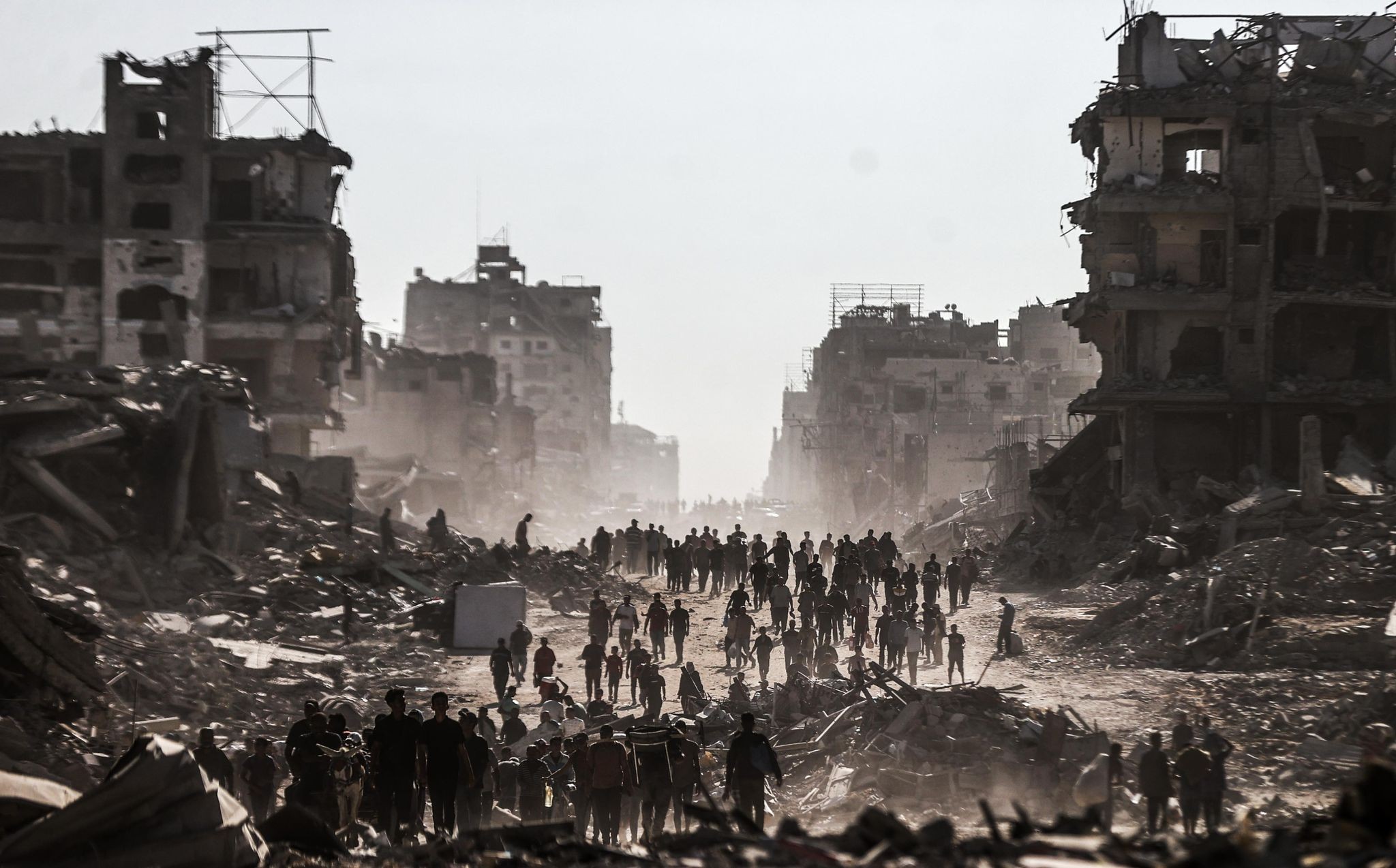
Hundreds of thousands of people living in central Gaza City are being forced to flee as advancing Israeli forces push with the operation to capture the entire metropolis.
People who fled attacks over recent days in the city’s central neighborhoods of Tal al-Hawa and Daraj described to Mada Masr the progress in Israel’s operation to occupy the city, while those unable to escape crowded western neighborhoods voiced rising panic as the remainder of the city becomes increasingly uninhabitable.
Ground forces advance into central neighborhoods of Tal al-Hawa, Nasr, Daraj
Israeli tanks reached the neighborhood of Tal al-Hawa on Monday, eyewitness Mohannad al-Sindawy who lived in the area told Mada Masr.
The advance came under the cover of aerial bombardment that struck homes, leaving massacres in its wake and hundreds recorded injured each day by the Gaza Health Ministry.
The vehicles pushed past the Palestinian Red Crescent’s Quds Hospital in the south-central neighborhood and, Sindawy anticipated, may by now have reached the universities’ area. Al-Araby TV correspondent Islam Badr said that tanks also pushed into western Gaza City’s Nasr neighborhood, coming close to the Shifa hospital before withdrawing.
Various accounts shared online show that Israel has now reached the Industrial Zone and Universities Junction in Tal al-Hawa, bringing its forces to the southern perimeter of the Rimal neighborhood: once the heart of the city.

Sindawy described Tal al-Hawa now as one of the most dangerous areas in Gaza City, with many families still trapped in their homes as they weren’t able to evacuate in time. He said that stepping outside their homes means certain death — just as staying does, as the military detonates homes and buildings.
Israeli forces have closed in on Tal al-Hawa from the southeastern direction in a weeks long operation that began in August in Zeitoun, and progressed to Sabra, pushing tens of thousands to flee as their homes came under threat.

With Tal al-Hawa under constant artillery and quadcopter fire, and with drones swarming overhead firing at anyone moving on the street, Sindawy and his family barely managed to escape.
“The situation is terrifying in the extreme,” he said. “We left Tal al-Hawa in the early morning hours, without luggage, bedding or blankets. We walked until we reached Nabulsy in western Gaza City, and from there continued to the south.”
“We hurried through the ruins of homes to stay hidden so the drones wouldn’t spot us and target us. We evaded their field of surveillance with great difficulty.”
Israel’s military is also pressing into the city’s central neighborhood of Daraj from the north, after closing in on the area from multiple fronts.
To the east, Shujaaya and eastern Tuffah fell under Israeli control months ago. Troops have since closed in from the northeast into the neighborhoods of Saftawy, Sheikh Radwan, Tawam and Abu Eskandar. From the northwest, forces have pressed into the Amn al-Aam region and into Nasr.
The advance has brought troops as far as the Ghafry area near central Jalaa Street, the artery that runs down the middle of the city.

Mohamed Mansour, who was also displaced from Gaza City in recent days, recounted how he and his ill parents fled their home in Daraj, central Gaza City, after bombardment escalated.
An Israeli quadcopter entered their neighborhood and began to fire at their house.
“After it left,” he told Mada Masr, “I decided that we had to leave immediately under the cover of night.”
Mansour and his family moved west toward Rimal, then along the coastal road south to Deir al-Balah.
Families increasingly isolated in western Gaza City
Many have been unable to leave Gaza City and are stranded in neighborhoods under attack or isolated in the crowded coastal areas in the city’s west, awaiting the oncoming invasion.
Large areas in the northern neighborhoods of Nasr, Karama and Sheikh Radwan have been emptied of their residents, and with accommodation in southern parts of the strip expensive and hard to come by, people described the struggle to remain.
Khalil Atef, who lives in Shati camp in western Gaza City, said he cannot leave due to the soaring cost of transport for his family and their luggage. Truck drivers are constantly changing their rates, he told Mada Masr, and the lowest fares are already prohibitively expensive, ranging between 3,000 and 4,000 shekels (US$897-$1196)
“Whoever can pay more gets taken,” he said. “You agree with a truck driver on a time and price, but suddenly they stop answering.”
Staying in Shati is equally hard, with “no means to endure.” Food prices in the north have soared as mass displacement means traders and vendors moved south, while water sources and internet services are scarce.
Eman Salha is also stuck with her husband and four children in the Nasr neighborhood. She told Mada Masr that they cannot find shelter in the already overcrowded south, she told Mada Masr, nor can they cover the cost of transporting their furniture and belongings, nor even buying a tent and renting a plot to pitch it on. “The minimum price for a truck to move our belongings is 3,000 shekels. Transport fare has reached 300 shekels per person,” she said.
In the western areas of Sheikh Radwan, Nour Sokkar has spent weeks searching for an apartment in the south to relocate with her sick mother, who can’t endure another round of displacement in a tent as she did in the early months of the Israeli aggression.
But Sokkar could only find what she described as an inhabitable “ruin,” in exchange for around 3,000 shekels per month.
Meanwhile, she is stuck in Sheikh Radwan, which has borne the brunt of weeks of concentrated Israeli assault. Around her, “martyrs are lying in the streets and no one is able to bury them,” she said. “We wish we could all die rather than live through all this torment.”
Sokkar’s family is relying on canned food in the absence of meat and poultry, while the prices of vegetables and rice have surged. “A kilo of tomato costs 90 shekels ($27),” she said. “We’d have to go to heaven to have them. We haven’t known their taste for six months.”
Israeli military aims for comprehensive displacement
To expand operations and establish full security control in the city, the Israeli military has aimed to displace as many people as possible since it began its attack in mid-August.
It estimates around 700,000 residents to have been displaced so far, as per military correspondent Doron Kadosh, who attributed the estimate to the Israeli military’s southern command on Wednesday evening.
Kadosh said that the figure would leave approximately 200-300,000 people in the city, describing the scope of evacuation as “relatively satisfactory,” adding that it would give the invading forces greater “freedom of action.”
Monitoring conducted by the Global Camp Coordination and Camp Management Cluster (CCCM), meanwhile, puts the displacement figures lower. The group’s latest report monitored around 340,000 displacement movements from Gaza City between mid-August, when Israel began its operation to control the city, and September 23.
For those remaining, huge parts of the city are extremely dangerous. Israel’s military rendered the whole of the metropolis a dangerous combat zone earlier this month.
Around half of the city is directly occupied by troops, tanks and armored vehicles while other areas are controlled by what residents call “explosive robots:” moving units loaded with large amounts of highly explosive material which are driven into residential blocs and detonated remotely. Each such vehicle can level a neighborhood of 30 to 40 homes. The use of this tactic has spread terror among Gaza City’s residents and has played a major role in forcing many to flee westward within the city or to the south of the strip.
Many homes in the northern neighborhood of Sheikh Radwan are currently exposed to similar demolitions. The Israeli military reported on Thursday that resistance fighters killed one of its personnel in the neighborhood.
Atef said that while the northern neighborhoods of Nasr, Karama and Sheikh Radwan are mostly emptied of their residents, some families remain hiding in their homes from Israeli quadcopters and snipers targeting individuals in areas that are not yet fully occupied.
The few coastal neighborhoods that are yet to face ground invasion, Rimal and the Shati camp, are controlled from the air, with residents facing constant fire by surveillance drones and warplanes around the clock.
The areas have become the last shelter for hundreds of thousands of displaced residents who haven’t yet left the city. Armed quadcopters and artillery fire is also increasingly reaching these neighborhoods from where troops are stationed as far as areas deep into the city.
At the same time, the Israeli military has stepped up issuing evacuation orders and leaflets in recent days, directing residents to evacuate for the south.
Other tactics, beyond the relentless bombardment of homes and buildings, have included the targeting of residential towers. Nearly 20 of Gaza City’s towers, each more than ten stories tall, have been destroyed after residents were ordered to evacuate, with strikes following only minutes later.
أخبار ذات صلة

‘Resistance will persist’: Q&A with Hamas leader Mohamed Nazzal
Hamas leader discusses Qatar strike, snags in ceasefire, steps for technocratic govt
‘The ruins of our homes and lives:’ Return to north Gaza fraught with loss for tens of thousands
“I wish I hadn’t come back” was the first thing Emad Azzam, one of hundreds of thousands of people who returned to…

‘Isn’t there a truce?’ Residents face Israel’s continued assault on Gaza City
Despite a declared “halt” in Israel’s military operation in Gaza City on Saturday, the hundreds of thousands of people still in the…

World leaders recognize Palestinian statehood at New York summit
“The time has come. That is why, true to my country's historic commitment in the Near East to peace between the Israeli…
Your support is the only way to ensure independent, progressive journalism survives.
You have a right to access accurate information, be stimulated by innovative and nuanced reporting, and be moved by compelling storytelling. Subscribe now to become part of the growing community of members who help us maintain our editorial independence.
Join us