
The ‘bus incident’: Proving harassment in public view
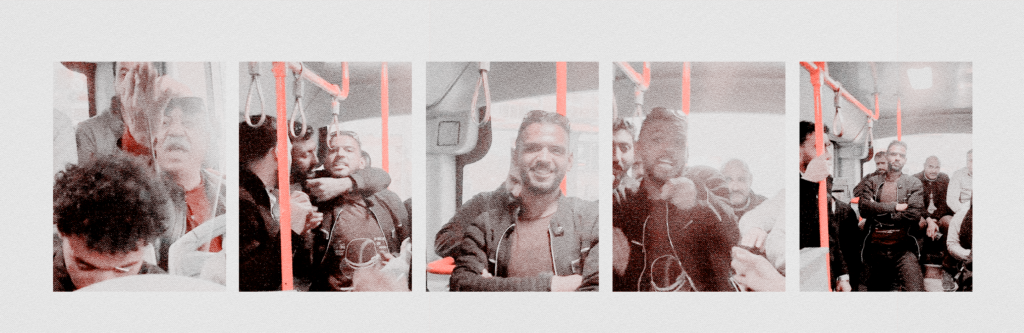
Mariam Shawky used to commute to her place of work each day from Suez to Maadi. In the course of one week alone, she said in a video she published on her social media accounts, she faced three incidents of verbal harassment and assault on the road she takes to work, all by the same stranger.
According to the testimony she recorded and published on TikTok and Instagram on February 8, Shawky said the man had first cat-called at her. Then he became more aggressive in trying to get her attention by throwing rocks and a metal object at her. On both occasions she confronted him and called for help from people in the street, but to no avail. No one stopped to help her.
So, when she saw him for a third time in a public bus, speaking on the phone and threatening to harm her once she got off, Shawky recognized him and decided to take matters into her own hands.
She took her phone out and started filming the man.
In the videos she later published, we can hear Shawky confronting the man, yelling at him to look at the camera. He turns away from her, and then turns back to try to take the phone by force. Later, in other videos, we see him from Shawky’s viewpoint, as he stands at the far end of the bus, smiling and looking at her while other passengers seated or standing around him shout back at Shawky, telling her to stop accusing him and judging her appearance.

“This is what women are subjected to every day,” she says in her video testimony.
The attacks and assault Shawky faced on the bus were a drop in the ocean of the online pressure she would face over the following weeks. Social media users questioned her story and criticized her appearance. She has since published social media posts saying she has received death threats and that crowds of people have surrounded her place of residence. A wave of media coverage took up the perpetrator’s protestation of his innocence.
As well as the video, however, Shawky had filed police reports on the incident and has sought to prosecute the perpetrator. To better understand her chances of securing justice through the courts, Mada Masr spoke with the lawyers supporting her claim, both of whom have sought to prosecute similar cases of gender-based violence.
They described the burden that falls on survivors in securing legally viable proof, especially with the compounding worry of fielding media coverage and victim-blaming narratives, such as those blaming women for inviting harassment and assault based on their appearance — an account echoed by a Journalists Syndicate council member who explained to Mada Masr the additional difficulty of pursuing such cases for survivors and the impact of media coverage on legal proceedings.
The pressure drives many women away from reporting the incidents in the first place, they said.
But the sources also noted the way in which media coverage can support prosecution in the case that some survivors, such as Shawky, film and publish their testimony, noting that in these instances the influence could tip the balance in their favor.
***
On the bus, Shawky said that she first shouted that the man was a thief, in hopes that people on the bus would take action against him. But this did not happen, she added during a televised interview with ON TV channel on February 10.
When she then accused him of harassing her, other passengers on the bus offered to protect him, some even forming a human shield around him when she asked the bus driver to stop near traffic police officers. She called the scene “absurd.”

Later that day, and after officers at the police station where she got off the bus failed to intervene immediately, Shawky filed a report against the accused at Khalifa and Moqattam Partial Prosecution Office, according to a statement on the incident issued by the Egyptian Initiative for Personal Rights.
She accused the man of verbally harassing her and endangering her by throwing stones and a metal object at her, as well as threatening her and targeting her more than once, over the course of several days along her daily route to and from her workplace, according to EIPR.
One day later, authorities arrested the man, whose name was later revealed to be Osama Mohamed — a blacksmith working at the shuttle bus station near Baron City compound in Katameya.
Following initial investigations in which Mohamed denied Shawky’s accusations, the defendant was released on LE1,000 bail.
In seeking legal recourse for the incidents, Shawky faces a set of challenges that often complicate prosecution.
EIPR lawyer Aziza al-Taweel, who attended initial investigations with Shawky, told Mada Masr that it can be complex to secure legally viable proof that sexual harassment incidents have occured — whether in public spaces or private settings.
The problem lies in the “burden of proof” bestowed upon survivors, said Taweel, underlining that “this process is very challenging and exhausting for the victims.”
Alongside eyewitness testimony, videos or recordings, there are various types of evidence that could be sought and gathered, including circumstantial evidence that Taweel argues authorities should take into consideration.
But the people harmed in such incidents often have to provide testimony to authorities themselves, with this testimony forming the key basis of evidence in these cases. Taweel notes that they have to provide this at a moment when they are in a particularly vulnerable state and struggling emotionally.
“In other words, it is the victim who has to prove [to prosecuting authorities] that they were subjected to sexual assault,” the lawyer added.
In Shawky’s case, the prosecution is set to pursue two charges, her lawyer, Mohamed Helmy, told Mada Masr. The case is yet to be referred to court.
“The first charge is assaulting the victim by using indecent language in a public place with the intent of obtaining sexual gratification,” the lawyer said, and the second is attempted theft of the victim’s phone, which he explained was clear in the video Shawky took on the bus.
Although it can be difficult to collate evidence to support charges of verbal harassment, Helmy explained that the charge in Shawky’s case is built on victim testimony and corroborating police inquiries that confirm a pattern of harassment, even though physical evidence like surveillance footage was absent from the spaces where the incidents took place.
He noted that investigative findings from testimonies must serve as circumstantial evidence, and that they corroborate the victim’s account even if they do not constitute conclusive proof.
“Since the victim testifies under oath as a witness, her statements are considered evidence in their own right,” he added.
He added that the police reports she filed helped verify that the defendant had assaulted her a week ahead of the bus incident, and that the reports themselves act as circumstantial evidence that may confirm the victim’s testimony, even though in Shawky’s case there was no other documentary footage to verify the earlier incidents due to the absence of cameras.
Taweel echoed the importance of victims’ filing police reports in similar incidents. “In such cases, prompt reporting and timely documentation are crucial to allow authorities to act and investigate effectively,” Taweel said.
While she argued that many survivors prefer not to document the incidents fearing the social stigma entailed, documentation can often lead to more rapid attention by investigating authorities.
But Taweel also noted that the difficulty in proving harassment cases could be mitigated if state institutions were to do their work and support victims seeking prosecution, adding that otherwise, many victims may be too afraid to seek justice because of the complexities of legal procedures.
At present, however, the final say on conviction in cases of gender-based harassment rests on the discretionary opinion of the presiding judge, she added.
In a number of prominent sexual violence cases that have broken into the media in recent years, judicial discretion has granted leniency to the perpetrators, including in cases of sexual violence and “honor” killings.
It’s unclear so far how Shawky’s case will go in court, with she and her lawyer still awaiting a trial date to be determined.
But in securing such a quick investigation process, both lawyers involved in her case note the role of the media coverage surrounding the incident.
“Ideally, the process shouldn’t be influenced,” Taweel stressed. “Investigations should proceed normally, allowing victims to obtain their rights without unnecessary delays or prolonged hardship.”
But both lawyers said that the uproar around Shawky’s case, in both traditional and social media, has played a role in her pursuit of justice through the law.
Shawky’s videos on the incident, which she published on February 8, immediately went viral.
While some responses were supportive, there was also a wave of backlash against her and her character, her clothing and her decision to film the defendant, including a deluge of insults and death threats.
Shawky published a story on her social media account last week saying that people were arriving at her place of residence and asking about her, claiming that they were journalists.

After Mohamed was released on bail, the voices proclaiming his innocence in comments on Shawky’s social media platforms continued to sound their views.
Several popular public figures — including a sheikh, a musician and an actor — publicly defended the accused and insisted that he was innocent. Several news platforms also adopted the same narrative. Local news outlets such a s Al-Masry-al-Youm and Al-Bawaba news called Mohamed a “hero” and gave space to his version of the story at the expense of Shawky’s in their coverage.
So extreme was the wave of criticism that Journalists Syndicate head Khaled al-Balshy also released a statement in its aftermath, calling on journalists to prioritize protecting victims’ privacy and dignity, avoid blaming them and focus coverage on holding perpetrators accountable.
But the cycle of coverage would not reach its peak until February 15, when Mohamed, in the company of his father, appeared on a TV program on the privately owned Al-Hadath Al-Youm channel. In the television segment, the host asks Mohamed to reenact the way he was standing in the bus when Shawky confronted him.
“You stood with emotional steadiness and a precise gaze… Could you replay that scene for us?,” the host asks. While the defendant initially displays confusion at the request, the host insists.
“Show me how you stood; beautiful. I swear I said bravo [when I saw it in the video,]” the host, Sarah Hady, says.
Both Mohamed and his father accuse Shawky of being “sick” during the live broadcast, while the father accuses her of wanting to “make a trend.”
From her side, the program’s host stated that Shawky had the right to respond, but that she refused a telephone interview with the show when she found out that the accused would also be appearing.

The Al-Hadath Al-Youm appearance was so egregious that the pendulum began to swing back in Shawky’s favor. People on social media accused the host and the TV channel of supporting the defendant, both by granting him airtime and by expressing admiration for his behavior.
Women commenting on social media argued that the show’s tone was harmful for the survivors of harassment and sexual violence and makes it harder for perpetrators to be held to account.
One day after the TV program aired, the Supreme Council for Media Regulation issued a decision taking Hady’s program off air, and banning her and the defendant from appearing on TV until the conclusion of the prosecution’s investigations into Shawky’s case.
“The right of reply does not extend to insulting the victim or survivor,” said Eman Ouf, a member of the Journalists Syndicate Council and the general rapporteur of its Women’s Committee, commenting on the media council’s intervention.
The insults to Shawky’s character that were aired on Al-Hadath Al-Youm therefore go beyond the standard media practice of hosting defendants and allowing the right of reply, Ouf explained to Mada Masr.
Helmy said that the television appearance could potentially obstruct justice or improperly influence the legal proceedings.
“The accused is supposed to be released on the condition that they are not permitted to do anything that could affect the course of the investigation,” Helmy said. He continued, "Of course, appearing in the media impacts the investigation, so that’s wrong and could be considered a criminal offense. However, the [media council] took action — the program was stopped, and he was banned from appearing — which is a good step.”
Ouf added that media standards on reporting during ongoing investigations strictly protect citizens’ privacy and prohibits media outlets from invading private lives, defamation or the violation of personal freedom, under the Press and Media Law, the Constitution, the Penal Code, the Telecommunications Law and the Cybercrime Law.
Ouf noted that coverage of Shawky’s case could have transgressed these standards from the outset, pointing to news outlets which quoted the defendant’s lawyer to report his release on bail, without explaining that investigations were still ongoing at the time, that Mohamed had not been acquitted, and that prosecutors’ investigations concluded that Mohamed was implicated in verbally harassing Shawky a week before the bus confrontation.
She explained to Mada Masr the fact that several outlets could be legally liable for publishing false news, since she pointed to their quoting the defendant’s lawyer telling “half truths” that she said should merit interventions from the prosecution and the Bar Association to regulate press appearances and statements by defense lawyers.
The pattern of coverage in Shawky’s case and other similar ones, said Ouf, describing media outlets publishing sensational material at the expense of those harmed in such incidents, is akin to “building a trend on women’s corpses.”
As much as the virality of Shawky’s video has left her exposed to a wave of online abuse, both lawyers also acknowledged that the recording and its publication may also have influenced the course of investigations in her favor.
According to Taweel, media coverage when the video of an incident goes viral also draws institutional attention, leading to faster case resolution, justice for the victim. She noted that in other instances, a litigation process can take years.
It can even act as a deterrent for future cases, said the EIPR lawyer.
Shawky’s lawyer echoed the point of view, saying that while media coverage of the case should not, in theory, affect the process of investigations, when the case receives media attention, procedures tend to move faster.
Shawky published her testimony and filed her police reports on February 8, Helmy noted, and Mohamed was arrested within 24 hours and the investigation fast-tracked.
Though the outcome of Shawky’s case still awaits trial, the fact that she took out her phone on the bus and decided to document the incident has undoubtedly, according to Helmy, expedited the process.
أخبار ذات صلة

Front states over 1,000 detained in recent demonstrations in Egypt
The Front to Defend Egyptian Protesters published a report on Thursday, documenting 1,277 arrests and detentions between April 15 and 27, the…
Class-based provision for judicial recruitment stirs discontent
A presidential decree ratifying the appointment of new comers to the general prosecution in September was met with accusations of discrimination and…
Navigating digital consent violations: Speak Up’s founder talks partnering with Pornhub
In February, Speak Up partnered with Aylo — parent company of Pornhub and other adult websites
Uber in the rear-view mirror: The story of the rise and fall of the ride-hailing company’s reputation
Habiba al-Shamaa booked an Uber ride in February to drive her the 25-kilometer trip from Fifth Settlement to Heliopolis. The cab and driver arrived, and Shamaa set off to her…
Your support is the only way to ensure independent, progressive journalism survives.
You have a right to access accurate information, be stimulated by innovative and nuanced reporting, and be moved by compelling storytelling. Subscribe now to become part of the growing community of members who help us maintain our editorial independence.
Join us