
Starvation threatens Jabalia camp, US gives Israel 30 days to improve humanitarian conditions in northern Gaza
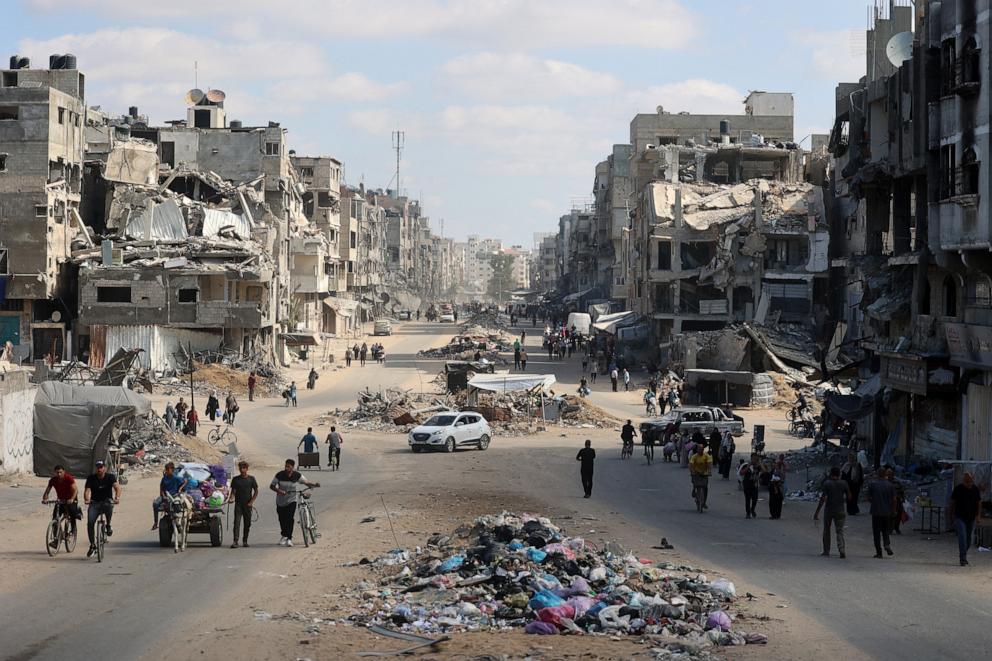
Israel launched constant fire on Jabalia camp yet again on Wednesday, prolonging a siege on the area that has lasted for 12 consecutive days.
Ali al-Bayed, a resident from the northern Gaza Strip, said that Occupation forces have stationed vehicles west of Jabalia and Saftawi, which lies to the southwest of Jabalia, where Bayed lived before he was displaced from the area, and are currently shelling the camp from there.
Israel’s incursion into northern Gaza which began at the end of September has seen its forces emerge from the Netsarim axis, a zone several kilometers wide which Israel cleared with bulldozers and fortified with military presence over recent months to impose a separation between the northern and southern parts of the strip.
Troops and military vehicles have since advanced into northern Gaza, closing into Jabalia camp and other neighborhoods in the north such as Beit Hanoun and Beit Lahia.
At the same time, Israel has blocked the delivery of aid to northern Gaza for over two weeks, with reports emerging on Wednesday that the United States has given Israel 30 days to ameliorate the humanitarian situation or risk cuts to US military support.
Bayed, whose family took up residence in a small shop in Gaza City, near Jalaa Street, after they were displaced from Saftawi, said that the street is now being targeted daily by Israeli tanks as well.
Tanks opened fire on a gathering of civilians at the Ghafry intersection on Jalaa Street on Tuesday injuring many, Bayed said.
He added that movement along the street is extremely difficult, as Israeli vehicles and snipers have positioned themselves at the Saftawi intersection, north of Gaza City.
Gunfire from vehicles, drones and helicopters continues to pound the camp and nearby areas like Nazla and Bir al-Naaja, according to Mohamed Badr, an eyewitness in the area. Badr told Mada Masr that “every day we hear of new martyrs in our area,” adding that they can’t even say their farewells, and many of the dead remain trapped under the rubble.
At the same time as the military advances, Israeli troops have imposed a siege on the entirety of the strip’s north. No food aid has entered northern Gaza since October 2 due to the closure of the crossings between the strip’s northern border with Israel.
The US told Israel that if it does not take concrete measures, within 30 days, to address the worsening humanitarian situation it would face restrictions to US military aid, American officials told Reuters on Wednesday.
In the meantime, food security is rapidly deteriorating, with at least three-quarters of the population relying on food assistance to survive, according to a report released on Tuesday by the UN Office for the Coordination of Humanitarian Affairs (OCHA) in the occupied Palestinian territories.
“Essential goods are missing from northern Gaza’s markets, and the prices of what remains available are exorbitantly high,” the report said. In the absence of other coping mechanisms, families are selling whatever belongings they have left and searching through the rubble for money or food.
Nour Abu Matar, one of the residents trapped inside the camp, told Mada Masr that the Occupation has surrounded the camp from all sides, preventing residents from leaving, while also blocking the entry of provisions for days.
Abu Matar’s family are confined to their homes, unable to go out and search for food. If conditions remain unchanged, Abu Matar said that he and his family would perish from hunger.
“We only have a few cans of food and a small amount of water. We eat as little as possible each day, to save what’s left. We have three children with us, and we try to save the food for them for as long as possible," he said, adding that their bodies have become weak and they can barely move due to the lack of nourishment.
Abu Matar said that the sounds of shelling intensify after dark. At night, the family sleeps together in one room so that if their house is targeted, they would all die together rather than leave anyone behind.
He has tried several times to venture outside in search of food, but Israeli quadcopters — constantly hovering above — immediately open fire, forcing him back inside. "My family and I have sent many pleas to civil defense teams and international organizations to rescue us, but no one can reach our area," he said.
Mohamed Badr, an eyewitness, described the heavy siege on Jabalia camp, which has prevented residents from leaving their homes to search for food for days. “The strikes intensified on Tuesday night in our area, hitting the center of the camp so severely that my family and I thought we would be killed at any moment.”
The situation is dire, he said, with severe shortages of food and water, leaving his family starving, yet unable to leave the house to find provisions.
Ahmed Abu Sharar’s family, among those trapped in Jabalia, is surviving primarily on flour — their last remaining food supply after running out of canned food two days ago, on the tenth day of the siege, he told Mada Masr.
Food aid deliveries have been cut off due to the Israeli military incursion into Abu Sharar’s area, and no one in the family can leave. Bodies lie in the streets, Abu Sharar said, as Israeli quadcopters and aircraft fire at anyone attempting to move.
As Israeli forces continue to block the entry of food, fuel and medical supplies to northern Gaza, the area’s three hospitals — Awda, Indonesian and Kamal Adwan — are operating at minimal capacity. Fuel supplies are depleted, with the hospitals currently treating a total of about 285 patients, including eight children and five adults on ventilators in the intensive care unit, and 161 patients in the emergency department, according to OCHA.
Only five out of 15 medical points in North Gaza that were functioning in the last few months are now considered functional, OCHA reported.
UN spokesperson Stephane Dujarric called the situation in the north “catastrophic” on Tuesday, and said that Israel’s military escalation is “severely compromising people’s access to means of survival.”
أخبار ذات صلة
Prices surge in Gaza redoubling food insecurity after Israel shuts borders citing attack on Iran
For the first week of Ramadan, Reem al-Masdar was cooking vegetables, salad and bread to prepare iftar and sohour meals for her…
Gaza, the Board of Peace and the active cancellation of the past
The future By the time we get to the speech of Cypriot-Israeli real estate businessman and billionaire Yakir Gabay at the Board…
Only 12 Palestinians permitted to return to Gaza Strip since Rafah crossing opened
Sabah al-Raqab is one of only 12 Palestinians who have been able to return to the Gaza Strip via the Rafah crossing…

Israel agrees to limited reopening of Rafah border crossing — details pending
Israeli Prime Minister Benjamin Netanyahu’s office announced on Monday that it has agreed to a “limited reopening” of the Rafah border crossing…
Your support is the only way to ensure independent, progressive journalism survives.
You have a right to access accurate information, be stimulated by innovative and nuanced reporting, and be moved by compelling storytelling. Subscribe now to become part of the growing community of members who help us maintain our editorial independence.
Join us