
Sisi’s first TV interview (part 2): We have to move, to sprint
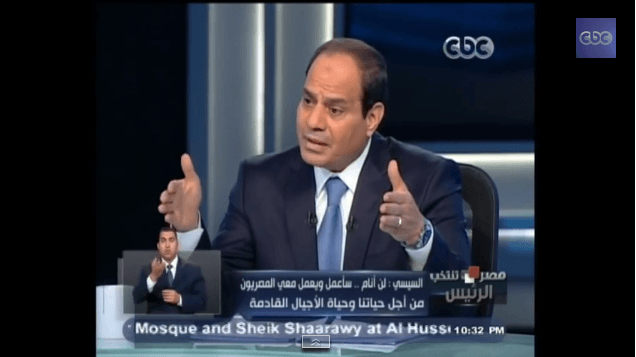
In Monday night’s opening to his first televised interview, presidential hopeful Abdel Fattah al-Sisi was firm, warning against “irresponsible protests and chaos,” which he said would “eventually bring down the state.” However, he was vague when it came to his actual presidential program, saying that his priorities are stability and security.
During the second part of the interview, conducted by Lamis al-Hadidi and Ibrahim Eissa and aired on privately owned CBC and ONTV satellite channels, the former defense minister continued to hold the upper hand, firmly and repeatedly demanding that Eissa and Hadidi stop interrupting him whenever they tried to press him on a point he was making.
Sisi’s responses were also more detailed this time. He quoted figures and used precise examples to explain his campaign ideas for solving some of Egypt’s biggest problems, including national debt and the energy crisis.
According to Sisi, national debt has reached LE1.7 trillion, incurring LE200 billion a year in interest, while subsidies cost the nation LE200 billion, and salaries LE280 billion. “So, what’s left for the government to spend on the country?” he asked.
“That’s why I don’t understand protests. I mean, even the fuel used in the vehicles police use to protect a protest are a financial burden,” he added.
Sisi expressed disdain regarding the possibility of leaving the debt to future generations, saying, “We have to move, we have to sprint; I will not sleep and I will not let you sleep. Why is this? It’s not because I want to torture you. I told you the magic wand is Egyptians; they’re capable of achieving everything.”
To prove his point, he spoke about “proud and strong” citizens of Upper Egypt that he has met, who he says are accountable and trustworthy. “You’d see them working day and night and barely finding anything to eat, but after 10 years, making something out of themselves, with a shop and a secure future.”
“So, we can do it, like Upper Egyptians?” Eissa enquired. “Yes, we can do it, and we will do it,” Sisi replied.
He also said that, since he doesn’t have the luxury of tackling one issue at a time, Egypt’s main problem now is money.
Using a map showing a new division of governorates in Egypt, Sisi discussed the changes in land distribution as part of his political program. This includes dividing Egypt into 33 governorates, providing each one with access to desert land and a water source, which according to him allows for the development of a mining industry, tourism, fishing, and consequently job opportunities. The plan, which makes four million feddans of land habitable, is a long term one that will need tens of years to implement and a lot of money and effort to build the necessary infrastructure.
Throughout the interview, Sisi constantly insisted that his words were all based on research and expert opinion. “I’m talking to you in scientific and not layman’s terms,” he said.
Sisi’s land development plan is estimated to cost LE1 trillion. He maintained the money would come from three sources, the first of which is the eight or nine million Egyptians living abroad, who he addressed, saying, “Are you going to leave your country like this?”
However, when Eissa doubted the idea, which he claimed has been tried before and failed, Sisi objected, asserting that the problem in the past was the lack of trust and credibility of the people running the campaigns.
The second source of finance he said is foreign investment, which he asked the media to help with by reassuring people and helping to attract investors.
The third and final source includes donations from those he referred to as “friends and brothers” in Arab countries. Sisi took this chance to praise Saudi King Abdallah for assisting Egypt by donating over LE12 billion, as well as Emirati rulers, while praying — twice — that God protect them from “evil people.”
Back to the recurring topic of labor protests, Sisi angrily said: “If you don’t wait for things to get better, I will not tell you what I’ll do to you, but I have one question — Why are you doing this? I have nothing to give to you now! Are you going to eat Egypt? Are you going to kill it?” Eissa argued that some might say that the “rich are the ones eating Egypt,” to which Sisi replied, “That’s not true.”
Onto the actual implementation of his plans, Sisi praised the private sector, welcoming their assistance in his proposed projects. However, he said, since he is on a tight schedule, he would give them no option but to “finish in three months what they want to finish in a year and half.” He also said the Armed Forces would step in to join the task force if needed.
To help with unemployment, he explained a scheme whereby young people would receive loans to buy vehicles to deliver reasonable priced vegetables from the Obour market.
Regarding energy, Sisi said Egypt could no longer rely on traditional methods to solve its energy crisis, blaming homes for almost half of Egypt’s energy consumption. He said people should be encouraged to save energy in their homes by turning off the lights and air conditioning and replacing light bulbs with energy preserving ones that he suggested the government would provide. This prompted a host of jokes on social media about Sisi oil lamps powered by the "light of his eyes."
When asked about the role of factories in the energy crisis, he asserted that decreasing energy consumption in the home would solve the issue of power cuts and provide more energy for factories at a lower cost. He also mentioned establishing solar energy plants as an alternative power source that doesn’t require coal or fuel.
Continuing to speak about public austerity measures, Sisi suggested, “If every family saved one loaf of bread, we’d save 25 million loaves. And if people aren’t patient now, things will never get better. I have nothing else to give you.”
The former military chief acknowledged that pensions are generally too low, and some citizens receive hardly any money, which is why he said he wants to implement a minimum wage. “I appreciate your resilience now, but I have no other options, I have to improve the overall economic situation of the country first,” he added.
In spite of this, he made a promise that citizens would start feeling the difference in their everyday lives within two years of his presidency. When Eissa asked if he would follow the international tradition of making a 100-day promise, he shrugged. “100 days? Provide me with international standards and I’ll provide you with something within a 100 days.”
Sisi said he has been selecting his presidential team for the past month, “among highly competent people.” He warned there is no room for trial and error and therefore he would need people who are highly professional, efficient, loyal, honest and willing to work. “They can’t be looking for money or positions, and those who can’t live with this should step away,” he said. “Egypt needs brilliant men now, lions.”
He also said he wouldn’t rely on military personnel. However, “for national security reasons,” he acknowledged that they would have to be appointed in some areas, but said it is too early to discuss details.
He told the presenters to “leave the military alone,” when they tried to question him about his current relationship with the Armed Forces’ new Commander-in-Chief. He said that he wishes all institutions in Egypt would be more like the military when questioned about his intentions to monitor the military’s budget as president. “The Armed Forces is in my heart and will always be in my heart,” he said.
“I love Egyptian women, but don’t misunderstand me, all the women in my extended family are like daughters to me and if I’m president, all Egyptian girls will be my daughters. It pains me when anyone does them wrong and it pains me because this is not the manly thing to do,” he said.
He admitted that society has been quiet regarding the suffering of women, especially when it comes to sexual harassment, yet, said he believes that justice can be restored through the law and awareness, which he suggested the media could help with.
“I could sense danger back in October. I felt that we were headed towards catastrophe in January when Morsi canceled the meeting with political forces because he lacked political experience,” he said. “I realized that Brotherhood rule was over in March 2013, but things could’ve gotten much worse and we could’ve gone through a civil war had I not decided that it was better to let the military receive the blow, rather than let Egyptians fight Egyptians.”
He claimed that in March, an American official came to him. “I told him it was over.” He then swore that it was not a conspiracy, but said, “The crisis was huge and there was no way out. Morsi could’ve spared us all this if he’d admitted that we had differences and accepted to hold a referendum over continuing his presidency, which he refused to do until 4 pm in the afternoon on July 3.”
Regarding foreign policy, Sisi refused to talk about the arms deal with Russia, adding that a lot of the military’s equipment already comes from Russia.
He also denied speaking with American officials, but said that Europe and the US are interested in the stability of the region and the Suez Canal. “They are concerned with the reality and the future because they have administrations, intelligence services, and recommendations. Our role is to work on this and assert that we will defend our country till the end.”
On the Palestinian-Israeli front, he asked Egyptians to separate their position towards Hamas from their historical position towards Palestine. “Egyptians will never forget those who stood beside them and those who stood against them,” he said.
When asked if he would visit Israel or receive their Prime Minister, Sisi said, “They can help us with something to cheer us up, letting us see Jerusalem as the capital of Palestine.”
He asserted that Egypt would always respect its treaties, including the peace treaty. “But, I tell Israel that this is a real chance to give Palestinians hope, which will open a lot of doors in the region."
"Powers of former regimes were not dependent on public opinion, but they are now,” he acknowledged.

أخبار ذات صلة
Abdel Moneim Abouel Fotouh: A man apart
His political journey has been a winding one.
COVID-19 drive-thru testing rollout blurs lines between public, private sectors
The prime minister visited the company’s first drive-through site the day it opened, on June 15.
A presidential race, anyone?
Plans for Sisi’s campaign take shape as other political figures weigh up running in the 2018 presidential elections
A disintegrating coalition: Rifts re-emerge after Dostour Party’s default leadership election
Rifts have re-emerged within the Dostour Party days after the default election of Khaled Dawoud as party president
Your support is the only way to ensure independent, progressive journalism survives.
You have a right to access accurate information, be stimulated by innovative and nuanced reporting, and be moved by compelling storytelling. Subscribe now to become part of the growing community of members who help us maintain our editorial independence.
Join us