
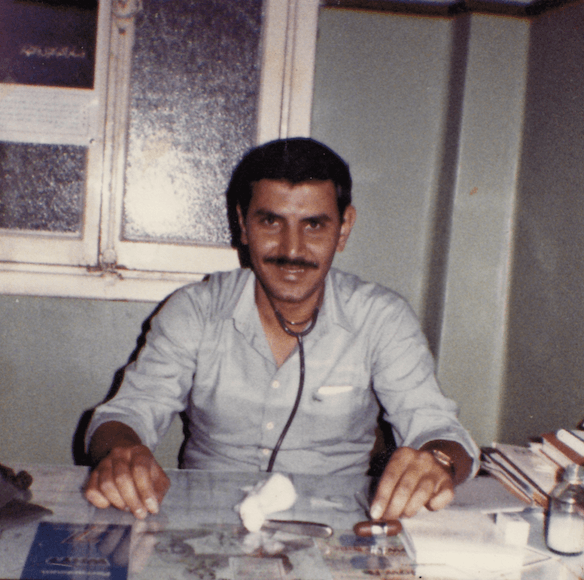
Abdel Moneim Abouel Fotouh: A man apart
The evening of May 10, 2012, may have been the apex of Abdel Moneim Abouel Fotouh’s unique political career. That night, the physician and former leading Muslim Brotherhood figure stood beside former diplomat Amr Moussa in a television studio for the Arab world’s first televised presidential debate.
In the run-up to the debate, opinion polls had Abouel Fotouh and Moussa as the two front-runners in the presidential race. However, in the first round of the elections, they came in fourth and fifth respectively. It is difficult to gauge whether the debate played any role in the final outcome or if the polls themselves — which also had Mohamed Morsi coming in fourth place — were wildly off.
Nevertheless, at that point, many believed that within a few short weeks, either Abouel Fotouh or Moussa would be Egypt’s next president.
During the debate, which was watched by tens of millions of people in Egypt and across the Arab world, Abouel Fotouh presented himself as the representative of the January 25 revolution, albeit one with specific, pragmatic solutions to various issues as outlined in his platform. By contrast, Moussa also presented himself as part of the revolution but stressed the need for a statesman with executive experience, capable of fulfilling its promise. Abouel Fotouh homed in on Moussa’s decade of service to the Mubarak regime as foreign minister, while Moussa attacked his competitor for his former membership in the Muslim Brotherhood, accusing him of supporting violent Islamist groups.
By then, Abouel Fotouh had built himself into a distinct figure in Egyptian politics, a maverick who presented himself as more than just another Islamist candidate. In the 12 years prior to the presidential election, he had gained significant experience trying to break free of the constraints imposed on him by the Brotherhood’s conservative leadership as well as the confines of political work in Egypt in general.
His political journey has been a winding one. As a student in the 1970s, he helped to found Jama'a al-Islamiya before renouncing political violence and joining the Muslim Brotherhood, where he helped revive the group’s political influence. He eventually rose within the ranks of the Brotherhood to a leadership position and was sentenced to five years in prison in the 1990s. An open-minded figure in the group, he was eventually marginalized by the Brotherhood’s more conservative wing and was expelled for good after the 2011 revolution. Then he ran for president as an independent, backed by a uniquely diverse political coalition. We use accounts from one of Abouel Fotouh’s sons, his closest Muslim Brotherhood colleagues, a politician from the leftist Bread and Freedom Party, and researchers to chart a journey that has led the politician back to prison, where he languishes behind bars, an outcast once more.
***
By the time Abouel Fotouh was released from prison in 2000 after serving a five-year sentence alongside most of the members of the Brotherhood’s Shura Council, the group’s more conservative wing was ascendant. This was partly due to the series of security blows the Mubarak regime dealt the Brotherhood throughout the 1990s, which led the organization to turn inward and prioritize the protection of the group at the expense of public politics.
Abouel Fotouh found himself sidelined within the organization, according to Arafa,* a leading member of the Brotherhood’s student organization at the time. He was a member of the Guidance Bureau but without any real responsibilities, despite the fact that he had won his seat in the 1994 internal elections with the highest single vote share. By contrast, Khairat al-Shater lost in that same election but was appointed to the bureau, according to Arafa, by Mustafa Mashhour, who was the deputy guide of the Brotherhood at the time. From 1996 to 2002, Mashhour served as the general guide of the group, kicking off an era in which the conservative voices within the organization became increasingly empowered.
According to Arafa, who was among the closest young politicians to Abouel Fotouh from before the 2011 revolution until his last arrest, Abouel Fotouh provoked the leadership during this period, reaching out directly to rank and file members despite efforts to keep him isolated. It was in this period too that he started to give media interviews, voicing political ideas at odds with those held by the Brotherhood’s conservative wing.
Some of those ideas would later become a point of controversy during discussions of the Brotherhood’s political platform in 2007. For example, Abouel Fotouh rejected the notion that a Coptic Christian or a woman was not qualified for the presidency, saying the matter should be left up to voters.
Arafa says that when he graduated from Cairo University in 2003, Abouel Fotouh was the one Brotherhood leader he wanted to meet. Like others of his generation, Arafa joined the Brotherhood drawn more by its political activities than its religious outreach. Arafa eventually met Abouel Fotouh as part of a series of meetings organized by the Brotherhood student leadership between 2004 to 2006. The students invited influential Brotherhood leaders like Mohamed Habib, Mohamed Morsi, Essam al-Erian, and Abouel Fotouh, as well as figures from other political currents, including Nasserists from the Karama Party and the Revolutionary Socialists.
One meeting brought the students together with Essam al-Erian and Abouel Fotouh. It was the only meeting that occasioned a harsh reprimand from the Brotherhood leadership. When the organizers asked why the leadership objected specifically to Abouel Fotouh and Erian, they were told it was because neither of the men toed the Guidance Bureau line.
During this period, Abouel Fotouh continued to face occasional attacks from the Brotherhood leadership.
Arafa recalls when Abouel Fotouh went to visit Naguib Mahfouz in his home in December 2004 (he had not had the opportunity to do so since the attempt on Mahfouz’s life in October 1995). The visit ignited a controversy among the Brotherhood youth at the time, leading to a senior figure of the group, who was a professor at al-Azhar University, to devote an entire Friday sermon to attacking Abouel Fotouh.
What Arafa remembers from the student meetings with Abouel Fotouh was that, compared to what he usually heard from leading Brotherhood members, Abouel Fotouh was provocative. He said that no Brotherhood opinion was self-evidently true; everything was up for debate. He didn’t disagree with the current formation of the state and did not believe the Brotherhood needed to invent a new kind of Islamic state — he simply aspired to reform it. Abouel Fotouh also underscored the importance of coordinated political action with other parties — Arafa pointed to Abouel Fotouh’s signature on Kefaya’s founding statement as evidence of his openness to cooperation.
The young Brotherhood members who arranged the meetings had forged friendships with other young people in Nasserist and Revolutionary Socialist circles during periods of joint action at university. For example, Islam Lutfi, one of the Brotherhood student leaders at the time, would go on to help create the Revolutionary Youth Coalition in January 2011 and the Egyptian Current Party after that. Another student leader, Mohammed al-Qassas, would later become Abouel Fotouh’s deputy in the Strong Egypt Party.
This group of young Brotherhood members were flexible when it came to political cooperation with other political factions during this period — something which was not always welcomed by the Brotherhood’s conservative leadership, as documented by researcher Ahmed Abd al-Hamid Hussein in his book, Parties of the January Revolution: Context of Emergence and Shifts 2011–2013. According to Hussein, the security crackdown on the Brotherhood at universities in the early 1990s came when student activities were controlled by a conservative cohort, known as the ‘Campus Brotherhood,’ with the support of the central Brotherhood leadership. This was the generation before al-Qassas and his colleagues. The Campus Brotherhood focused on religious outreach and avoided contact with other political groups, until Qassas’s generation came along and assumed leadership of student activities. But the organization’s central leadership began to intervene in the early part of the new millennium, sidelining Qassas and his comrades in favor of a more conservative, insular student leadership.
Arafa met Abouel Fotouh in the mid-2000s, when he had begun to emerge as a politician who stood with the pro-democracy movement against the Mubarak regime, according to Amr Abdel Rahman, a leader of the leftist Bread and Freedom Party. In line with the movement’s position, Abouel Fotouh publicly rejected Mubarak’s continued hold on power and the inheritance of power by his son, and he supported the judiciary in their standoff with Mubarak in 2006, when the authorities sanctioned judges Hisham al-Bastawisi and Mohammed Makki for making statements to the media about the rigged parliamentary elections in 2005.
Abd al-Rahman believes it instructive to compare Abouel Fotouh’s performance during this period with that of other Brotherhood leaders like Khairat al-Shater, the deputy guide at the time who was the leading conservtaive figure in the group. Abouel Fotouh became the face of the Brotherhood aligned with the democratic agenda that was growing in the political sphere. By contrast, al-Shater was emblematic of the parochial nature of the organization, his name associated with the group’s “plan for empowerment.” Found on CDs in the office of his company, Salsabil, in 1992, the plan expressed a vision of the Brotherhood in extremely reactionary terms, Abd al-Rahman says.
Just as Abouel Fotouh stood in for the Brotherhood in the broader political movement, he also stood for a more open political discourse within the organization.
When the Brotherhood won 88 seats in the 2005 parliamentary election, making them the largest opposition bloc in the assembly, it became even more urgent for the organization to craft a detailed political platform. The group released its platform in 2007, setting off a debate both within and outside the organization about its controversial aspects, such as the ban on non-Muslims or women from the presidency and the formation of an Islamic scholars’ council that would be responsible for vetting laws to ensure compliance with Islamic law.
Abouel Fotouh, alongside other Brotherhood members like Gamal Hishmat and Essam al-Erian, publicly rejected these two planks. They also criticized the way the platform was drafted, accusing a small faction within the Brotherhood of controlling the decision-making process and excluding dissenting opinions.
Arafa says that more open-minded young Brotherhood members strengthened their ties to Abouel Fotouh during this period, often visiting him for discussions. To them, there was clearly an enormous problem within the organization: There was a reformist wing facing off against another faction that they saw as having an unworkable vision.
Following the dispute over the political platform, Abouel Fotouh lost his seat in the Guidance Council in the 2009 elections, which saw the continued rise of more conservative voices. Arafa says that Abouel Fotouh’s defeat in the struggle over the platform and the outcome of the 2009 internal elections brought him to the realization that the problem within the organization went beyond just the Guidance Bureau. It extended to most of the group’s leadership, and there was no hope of trying to reach out to them.
The question for both Abouel Fotouh and a group of young Brotherhood supporters became whether to remain in the organization. Abouel Fotouh saw little utility in breaking with the massive Brotherhood organizational machine and attempting to create something new, wary of jumping alone into the political fray at that time. The experience of Abul Ela Mady in particular loomed large. Mady had left the Brotherhood in the mid-1990s to form the Wasat Party, but in the intervening 15 years the party had still not secured a permit or built up a popular base. For Abouel Fotouh, the only solution was to wait and see. As it happened, he did not have long to wait.
***
The January 2011 revolution was a singularly decisive factor in determining Abouel Fotouh’s relationship to the Muslim Brotherhood.
After a meeting on February 6, 2011, between the group’s leadership and Mubarak’s newly appointed Vice President Omar Suleiman, senior Brotherhood figure Saad al-Katatni spoke positively about the encounter, despite the fact that Suleiman had offered nothing more than promises of reform if the demonstrators left the streets. In response, Abouel Fotouh told the press that the Brotherhood “continues to operate with the mindset of an underground organization.”
That was not the only meeting between Suleiman and the Brotherhood leadership. Katatni and Mohammed Morsi had attended another meeting — this one in secret — with Suleiman just before the publicized February 6 encounter. At a gathering of the Brotherhood’s Shura Council on February 10, Morsi began giving a report about the February 6 meeting before Abouel Fotouh interrupted him to say that he had learned that Brotherhood leaders had attended a secret meeting with Suleiman and demanded that Shura Council members be briefed on it.
It was a pivotal moment — the rest of the Shura Council was also unaware of the meeting. Morsi said that they had already briefed General Guide Mohammed Badie, but Abouel Fotouh was furious. He said it was an insult to the history of the organization and to the members of the Shura Council and that secret meetings were unacceptable, especially at such a time. He stormed out and did not return, according to Arafa.
It was at that moment that Abouel Fotouh broke with the Brotherhood, Arafa believes, although it was not made public. In the months following Mubarak’s ouster, Arafa, who did leave the Muslim Brotherhood, took part in frequent meetings between Abouel Fotouh and a group of youth who would become the core of his presidential campaign operation.
Abouel Fotouh began exploring his political options outside the Brotherhood. Should he run for president? Should he form a new political party or join an existing one? Arafa says that the group around Abouel Fotouh suggested running for office and they discussed it at length to persuade him. He agreed in principle, but by April he was still moving cautiously, trying to feel out the opportunities available to him and his competitors.
Arafa says that in one conversation with Abouel Fotouh in 2011, he told him he needed to completely separate himself from the Muslim Brotherhood in his media discourse. Acknowledging that he had “definitively split from the organization,” Abouel Fotouh nevertheless did not want to clash with the Brotherhood at this early stage. He also hoped to bring over as many like-minded Brotherhood supporters as possible.
Abouel Fotouh’s official declaration of his candidacy came in June and the Muslim Brotherhood announced his expulsion, ostensibly because he had violated the group’s decision not to field a presidential candidate.
Abouel Fotouh did not know he had been expelled, Arafa said, because he’d been in London. Arafa and dozens of Abouel Fotouh’s campaign workers decided to meet him at the airport. Arafa informed him of the Brotherhood’s decision in the arrivals hall. Abouel Fotouh initially did not say anything. After a while, he said, “Alright, God has chosen the better option for us,” then he came out to greet the press and announced his candidacy for presidency.
After his expulsion, Abouel Fotouh was more at ease to freely voice his opinions and more defiant of those who opposed his candidacy.
At the time, a journalist asked him how confident he was of winning over Egyptian voters. “I’m confident I’ll win the votes of a majority of Egyptians,” he said. “I’ll get votes from liberals, leftists, Islamists, and even the Brotherhood.” Laughing, he added that he would even win the vote of the Brotherhood guide himself, Mohammed Badie.
The Brotherhood’s decision to expel Abouel Fotouh freed him from any caution or hesitation. It also made him more determined and better able to present himself to other political currents as he sought to create a broad political coalition beyond just Islamists. Arafa says that the campaign truly began that day at the airport and Abouel Fotouh went on to hold campaign rallies in nearly every governorate in Egypt.
In his book Parties of the January Revolution, researcher Abd al-Hamid Hussein writes that Abouel Fotouh’s base was diverse: “Most of them were newcomers to politics after the revolution … In addition to Islamists and former Brotherhood supporters, his campaign brought together party leaders and groups like the Justice Party, the National Front for Justice and Democracy, the Our Egypt Party, and even some people with the April 6 Youth Movement and unaffiliated leftists or former members of leftist movements.”
Describing the campaign office, Arafa says it was constantly abuzz throughout the second half of 2011, as the campaign worked to define its political platform. He added that there was a conservative faction that leaned heavily toward “stability” while another faction rejected the ongoing abuses by the security forces and the way the Supreme Council of the Armed Forces was managing the country. Abouel Fotouh was more sympathetic to the latter, Arafa says.
The biggest turn in the popularity of the campaign came after Abouel Fotouh took a firm stance during the November 2011 clashes on Mohamed Mahmoud Street in Downtown Cairo. After releasing a political statement in support of the demonstrators, Abouel Fotouh decided to go to Tahrir himself and called his campaign advisors to inform them of the move. “He was politically flexible and skilled enough to make such spur-of-the-moment decisions,” Arafa says.
After the 2011 parliamentary elections, Abouel Fotouh reached out to various parties, including the Freedom and Justice Party, the Free Egyptians, the Popular Socialist Alliance, and the Egyptian Social Democratic Party. Although he didn’t agree with all of their political views, he worked to forge the broadest consensus possible between his campaign and these parties, Arafa said.
Amr Abd al-Rahman believes that as a democrat and a conservative, Abouel Fotouh was well poised to bridge the secular-Islamist divide by addressing both camps, but he was ultimately thwarted by political circumstances, particularly amid the stark political polarization that emerged in the summer of 2013.
Distancing himself from Jama'a al-Islamiya — an organization that Abouel Fotouh had played a key role in founding as a student in the 1970s and which had engaged in violence against non-Islamist political factions — was not an easy task. But Abd al-Rahman believes it is “ridiculous” to hold a politician to account for positions he held in his early 20s, especially if he later disavowed them.
In his book, Abdel Moneim Abouel Fotouh: A Witness to the History of the Islamist Movement in Egypt, researcher Hossam Tammam observes how Abouel Fotouh came to change his views on violent Islamist groups. He, along with Brotherhood members Essam al-Erian, Helmy al-Gazzar, and Ibrahim al-Zaafarani, followed then-Brotherhood General Guide Omar Telmesani in renouncing violence as a tool for change, and they pushed for the Brotherhood to become involved in politics through parliamentary elections and professional syndicates.
From the outset of his presidential campaign, Abouel Fotouh also faced attacks from Islamists for including non-Islamists on his team, most prominently his political advisor, leftist Rabab al-Mahdi.
Abouel Fotouh’s attempts to speak to two very different political blocs opened him up to accusations of equivocation and a lack of principles from both sides. During the 2012 presidential debate, Amr Moussa accused Abouel Fotouh of tailoring his discourse depending on which camp he was addressing. In the wake of Mohammed Morsi’s presidential victory, Abouel Fotouh’s position and the work of his Strong Egypt Party — established after the election — became even more difficult, as the party’s stances would invariably invite attacks from one or both sides.
For instance, the Strong Egypt Party rejected Morsi’s November 2012 constitutional declaration and urged citizens to vote against the constitution the Brotherhood put to a referendum in December 2012. The party listed 10 reasons for its opposition to the proposed constitution in a statement, including the control over the state given to the military through the National Defense Council, the hollowing out of rights and liberties by leaving their interpretation open to statutes, al-Azhar’s religious custodianship of Islamic law and the state’s cultural tutelage of society.
The Strong Egypt Party also advocated for the June 30, 2013 demonstrations to demand that Morsi call early presidential elections. This move spurred the resignation of several party members, who declared that their Islamist ideas were incompatible with the party’s vision, including its attempt to bridge the Islamist-secular divide, Abd al-Hamid Hussein writes.
At the same time, Abouel Fotouh’s objection to the July 3 removal of Morsi and the suspension of the constitution — which he described as a coup — sparked attacks from the other side, which accused him of Brotherhood sympathies.
Abouel Fotouh’s positions regarding the National Salvation Front and the June 30 demonstrations, followed by the massacre at Rabea al-Adawiya Square, were the most controversial and usually spurred attacks from both sides. Islamists accused him of colluding to get rid of Morsi and his government and isolating the Brotherhood while June 30 supporters said he was not clear enough in his hostility to the Brotherhood because of his former affiliation with the group.
Abouel Fotouh did not join the National Salvation Front, which he believed was “created to whitewash figures of the old regime.” He believed that some members of the front cared little about democracy or the gains of the January revolution, and he was uncomfortable with “the machinations of the security apparatus,” according to Arafa. Abouel Fotouh instead chose to oppose the Brotherhood from outside the National Salvation Front.
Although Abouel Fotouh did harbor reservations about June 30, he nevertheless advocated joining the demonstrations because he came to believe it was impossible for the Muslim Brotherhood to remain in power, Arafa said. Still, he held to his demand for early presidential elections until the end. In an interview with a private Egyptian satellite channel in September 2013, he said he believed that it was the only way to prevent “a military coup or a descent into anarchy.” As he pointed out in the interview, even after Morsi’s removal, he called for a popular referendum on the roadmap.
According to Arafa, Abouel Fotouh intervened to try to stop the situation from deteriorating more than once during the bloody summer of 2013. On July 2, he called a Brotherhood leader in an attempt to persuade him of the need to end the Rabaa sit-in and start negotiating, in the hope of ensuring a peaceful transfer of power without grave violence. But the Brotherhood leader was certain that the military was acting under pressure from Saudi Arabia, the United Arab Emirates, and the United States and that the steadfastness of the Rabea protesters would shift the balance of power.
When Abouel Fotouh was invited to meet with interim President Adly Mansour for talks after Morsi’s ouster, he reluctantly agreed based on the advice of advisors, who believed that it was better to participate in dialogue to support civil forces within the June 30 coalition with the goal of reaching a political resolution with as little violence as possible.
As the forced dispersal of the 2013 Rabea al-Adaweya sit-in began, Abouel Fotouh contacted civil leaders in the transitional political authority in an attempt to find a way out of the crisis. One said he was “deceived by both sides,” while another told him he was “not in control of things now,” according to Arafa, who learned the details of both calls from Abouel Fotouh.
Throughout this period, Abouel Fotouh’s statements provoked both sides. According to Arafa he received a flood of angry messages from Brotherhood members who believed that by participating in June 30, he had helped pave the way for a military coup. Meanwhile, calling what happened a coup and demanding a referendum on the roadmap opened him up to heavy criticism from the June 30 camp.
***
Beginning in 2014, Abouel Fotouh was increasingly shunned by the media until eventually the only platforms open to him were non-Egyptian satellite channels or the party’s own Facebook page. He began to focus on trips to governorates outside the capital to maintain party cohesion, even as the political landscape became ever more forbidding amid the heightened conflict between the authorities and the Brotherhood.
Arafa says that in early 2018, Abouel Fotouh was hopeful that the forthcoming presidential elections would bring some openness to the political scene. He believed the Tiran and Sanafir crisis had weakened the regime’s control slightly and that elections naturally bring about some loosening of restrictions.
Ahmed Shafiq’s declaration of candidacy, followed by Sami Anan’s, further reinforced his sense that the current regime was not in full control. But these hopes were violently dashed with Shafiq’s deportation from the UAE to Cairo, the arrest of Anan from his home and the assault on his deputy, Judge Hisham Geneina, followed by the arrest of Mohamed al-Qassas, the vice president of the Strong Egypt Party, all of which took place in quick succession in late January and early February. Abouel Fotouh visited Geneina in the hospital.
Angry that it no longer seemed possible for him to even talk to the press, he traveled to London, where he conducted a television interviews with Al Jazeera and then Al-Arabi, during which he stridently attacked the Egyptian regime. He returned to Cairo to do a third interview with the BBC on February 14, the day after his arrival. That same evening, he was arrested at home along with six members of the special office of the Strong Egypt Party. They were taken to the Fifth Settlement police station, where the special office members were eventually released.
Hudheifa, Abouel Fotouh’s son, says that the risk of arrest became real the moment the Al Jazeera interview was aired. But Abouel Fotouh told his family that if he were arrested, it would not be at the airport or the first night of his arrival.
Everyone was expecting the arrest after the televised interviews. The Al Jazeera interviewer in London asked if he would return to Egypt. “There’s no place on earth for me but Egypt,” he responded. “I’ll go back. I can’t live outside Egypt.”
It harkened back to his experience 37 years earlier, in September 1981, when he learned that his name was on the last list of arrests ordered by President Anwar al-Sadat. As the president of Cairo University’s student union, Abouel Fotouh had a public argument with President Sadat in February 1977 over the removal of preacher Mohammed al-Ghazali from Amr Ibn al-As Mosque. Abouel Fotouh was in a student program in Rome when the arrest lists came out and he was advised not to return to Egypt, but he insisted. He was imprisoned for two years.
By doing the interviews, it almost seemed as if Abouel Fotouh was trying to get himself imprisoned. But Hudheifa says his father has always believed that in politics nothing is inevitable; possibilities always exist even in the most restrictive circumstances. Ultimately, he believed a message needed to be sent, to the regime and the public, that the political horizon should not be narrowed in this way and that silence was impossible in the current fragile political situation. Before his arrest, Hudheifa says that his father was wondering aloud what would happen if he tried to meet someone from the president’s office to talk.
Again refusing to accept the rules imposed on him, he was trying to forge an alternative path forward.
***
Arafa and Hudheifa agree that it was his time in prison between 1995 to 2000 that Abouel Fotouh revised many of his ideas about the Muslim Brotherhood and began to distinguish himself politically from the group’s conservative leadership. According to Hudheifa, being locked up for five years with dozens of other Brotherhood leaders gave him ample time to discover the depth of their intellectual and political differences.
His current prison stint is different, primarily because of its solitary nature. Since his arrest on February 14, 2018, the authorities have kept Abouel Fotouh isolated from other prisoners in a solitary cell in the Mazraa wing of the Tora prison complex. In the first months of his confinement, he was housed in a cell block that had other prisoners in it. Although they were prohibited from speaking to him, he could at least hear their voices through the walls as they talked amongst themselves.
The prison administration later moved him to an empty cellblock. He was allowed out of his cell for exercise in the corridor just once a day. After a year, he was allowed outside in the prison yard, but only when no other prisoners were there. Abouel Fotouh is not allowed to join other inmates for the Friday prayer or to go anywhere else in the prison except the family visiting area.
These visits initially took place in a private room in the prison, away from the area designated for regular visits. Later, he began to be taken to the high security wing in the prison complex during visiting hours, where visits took place behind a glass barrier via telephone. The visit never exceeded the allotted half hour, Hudheifa said, during which time the family would try to give him as much family news as possible, to make him feel less isolated. With the spread of the coronavirus, visits in all prisons were banned on March 10, effectively turning the institutions into black holes with the fate of the prisoners swallowed up inside unknown.
At the beginning of his imprisonment, Abouel Fotouh still had a small window to the outside world. Although he was denied letters, magazines, and newspapers, the prison administration allowed some books in. Hudheifa says they tried to pick things he would like and that authorities would permit. Abouel Fotouh reread Shaarawi’s Quranic exegesis and the works of Mutanabbi, Gibran Khalil Gibran, Abbas al-Aqqad, Taha Hussein, and Naguib Mahfouz before the prison administration reconsidered its book policy, leaving the cell empty save for Abouel Fotouh’s copy of the Quran.
What worries Hudheifa most is the decline in his father’s health. Abouel Fotouh, now 69, was diagnosed with sleep apnea in 2006 and, in addition to treatment, he needs a respirator while sleeping to ensure enough oxygen flows to his brain and body. Although the equipment was permitted entry, it no longer works because of the extreme heat in the cell and the machine’s need for maintenance and recalibration. Without the respirator, Abouel Fotouh’s sleep is fitful and intermittent. Lack of treatment may lead to serious medical complications. Abouel Fotouh has a history of high blood pressure and diabetes. He has lost 30 kilograms and has suffered repeated heart attacks in prison.
But Abouel Fotouh, a medical doctor by training, has treated himself as best he can given his solitary confinement: every time he has chest pains, he gathers what strength he can muster and begins beating on the cell door, taking the medication he has on hand to save himself. So far, he has managed to cope with the heart attacks, Hudheifa says, “with God’s help,” but they fear the strain of recurrent attacks on his heart. Hudheifa adds that there is a doctor who monitors his condition periodically, but his father needs tests and care that are not available in the prison hospital. At his remand hearings, Abouel Fotouh and his lawyer have repeatedly requested that he be transferred to a private hospital at his own expense for prostate surgery, but the request has been consistently denied.
His current isolation appears to be the exact opposite of what Abouel Fotouh was struggling for after his release from prison in 2000. He spent the first years of the millennium trying to break free of the organizational straitjacket imposed on him and his ideas by the conservative wing of the Brotherhood. In the years after the January revolution, he sought to escape the confines of the Islamist-secular divide, and later, he worked to break the isolation of the Strong Egypt party. He has now been cast out again, this time into a more enduring and bleaker solitude.
* Pseudonym
تقارير ذات صلة
Court renews detention of 700 in single ‘unprecedented’ session
“Who is the judge supposed to listen to? And which case file is he meant to look at?”
Without evidence or trial: Remand detention is authorities’ tool of choice to imprison political opponents
Many activists have been subjected to the revolving door of prison
Strong Egypt Party’s dissolution? Explaining the legal procedures required to dissolve political parties
With the Strong Egypt Party's expected dissolution, we delve into the requisite legal procedures
Your support is the only way to ensure independent, progressive journalism survives.
You have a right to access accurate information, be stimulated by innovative and nuanced reporting, and be moved by compelling storytelling. Subscribe now to become part of the growing community of members who help us maintain our editorial independence.
Join us