
Sisi links political unrest to population growth in public address calling for birth control

Population growth is a “national security issue,” President Abdel Fattah al-Sisi said in a public address on Tuesday.
Sisi gave the Tuesday public address on population increase during the inauguration ceremony for the new Integrated Medical Complex in Ismailia to mark the launch of the Comprehensive Health Insurance system in three new governorates: Ismailia, Luxor and Suez.
During the televised speech, Sisi said that political unrest in Egypt is tied to population increase, adding that the country’s resources cannot keep up economically with the current rates, stifling economic conditions for the people. However, analysts who spoke to Mada Masr criticized the current approach towards population control, describing it as an extension of an approach supported by the government and international organizations that addresses the issue in exclusive economic terms and as a national security issue.
“Did you not start a revolution in 2011 to improve your conditions?” Sisi asked. “Conditions will not improve unless the population growth rate is commensurate with our economic capacity, our ability to operate, and the state’s general budget.”
“You are burdening yourself, your children, and the country with a matter too great for its capacity,” the president continued. “And then you revolt, and go out on the streets, and destroy your country? And the series plays again: destruction on top of destruction,” continued the president.
However, dealing with the issue as a national security threat is “a problem,” according to Nana Abuelsoud, a reproductive rights researcher at the Egyptian Initiative for Personal Rights.
According to Abuelsoud, this approach has become increasingly widespread in Egypt over the last two years, with programs shifting to treating reproduction as a “developmental issue.” There’s an economic imperative to put the brakes on population increase, added Abuelsoud, making the matter one of “birth control” rather than of families being entitled to steady access to reproductive rights services and planning that suit their needs.
“In the last two years, we have seen the idea of birth control completely normalized. The government is telling [people] that if you have more than two children, we will deprive you of subsidies,” Abuelsoud said. Current programming targets lower-income women exclusively, Abuelsoud said, referring to the “Two is Enough” program that the government launched in 2018. Such an approach “lacks any perspective on social justice and is very classist,” she added.
The “Two is Enough” campaign targets low-income women registered in the Takaful and Karama welfare programs for support to access family planning services. Two Is Enough was originally funded by a LE75 million allocation from the Social Solidarity Ministry and a further LE10 million from the UN, targeting over 1.1 million lower-income families with up to three children. The government aims to reduce the current fertility rate of 3.5 to 2.4 by 2030.
In 2020, the government moved to incorporate birth control disincentives in its subsidy card system. In November 2020, the Supply Ministry announced it will not allow beneficiaries to register a third child on subsidy cards. The move did not include families that had already more than two children before the announcement, yet barred any future additions.
Plans were also floated last year to add new criteria to the Takaful and Karama cash subsidy program that would limit cash transfer benefits for families who have three or more children. Yet, they have not been implemented to date.
Speaking about family planning and population control on Tuesday, Sisi said he rejected “strict” planning, adding that the issue should be tackled by “programming … that provides the required services without costs.” Instead, Sisi said the issue “requires will: married youth should have the will and know that this issue is very important so that [their] children have a good living standard.”
Sisi added that Egypt needs to rein in the current annual population increase — just under 2 million people were born last year — down to 400,000 births per year, warning that the state’s budget cannot accommodate a higher annual figure. “A population of 100 million needs an annual budget of around US$1 trillion, or LE16 trillion,” said the president.
For Abuelsoud, the use of incentives and disincentives to achieve population growth targets fails to address critical obstacles in the access of reproductive health services. “There is significant funding from international and local organizations. Yet, we do not know why this money is not translated into permanent real services” that are accessible, said Abuelsoud, adding that the government does not address problems such as women who cannot seek services from family planning centers because they cannot afford the cost of transportation.
USAID disbursed over $400,000 million to Egypt to fund family planning programs between 1977 and 2009, when the USAID program withdrew. From the 1990s to the 2000s, fertility rates in Egypt fell from 5.2 to 3 children per household, according to government data.
USAID has begun to allocate money to Egypt again, with over US$19 million allocated for family planning initiatives through a five-year program slated to end in 2022, targeting the governorates of Aswan, Assiut, Beni Suef, Fayoum, Giza, Luxor, Minya, Qena, Sohag and marginalized areas of Cairo and Alexandria. A further $4 million from USAID aimed to “raise awareness of best practices and increasing access to voluntary family planning services” from 2016 to 2020 among male and female factory workers and young people with secondary or university education in urban areas in Port Said and Sohag.

أخبار ذات صلة

Infographic: Facts and figures from CAPMAS’ 2017 census
CAPMAS announced results from Egypt’s national census for population, housing and facilities on Sunday
Overpopulation, religion and fatwas on demand in Egypt
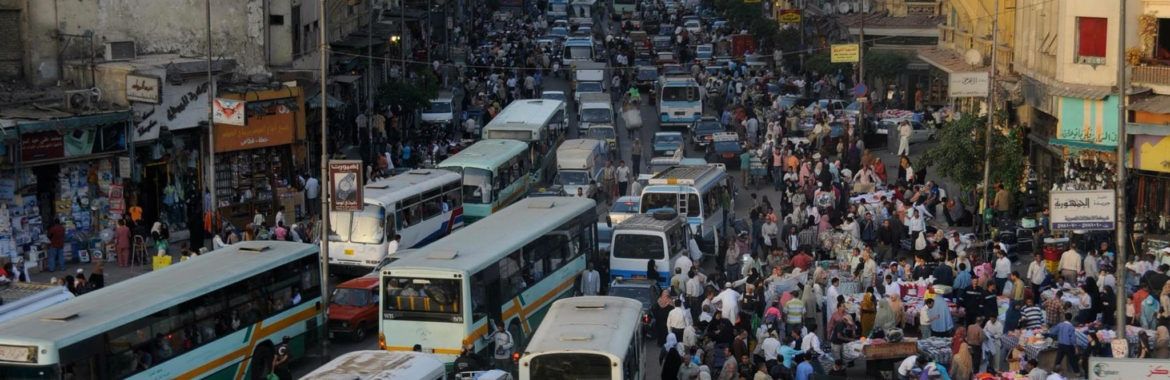
The state blames overpopulation for the continuing economic crisis and awkwardly courts the support of religious institutions in its battle
Analysts: Population control will not solve Egypt’s increasing poverty rate
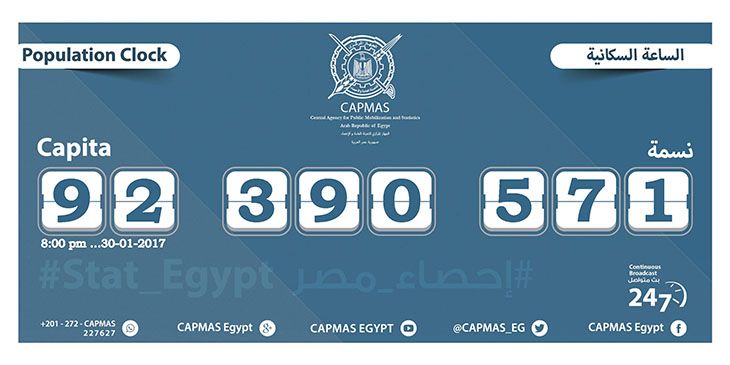
In a speech at the Police Academy last week on the 6th anniversary of the 2011 revolution, President Abdel Fattah al-Sisi pointed to Egypt’s overpopulation crisis as one of the major challenges confronting…
How will Egypt rein in its explosive population growth?
Egypt’s population is growing at a rate five times higher than that of developed countries, and twice as high as developing countries, according to the state-run Central Agency for Public…
Your support is the only way to ensure independent, progressive journalism survives.
You have a right to access accurate information, be stimulated by innovative and nuanced reporting, and be moved by compelling storytelling. Subscribe now to become part of the growing community of members who help us maintain our editorial independence.
Join us