
Selling the Suez? New fund to capitalize canal’s assets stirs concerns over sovereignty
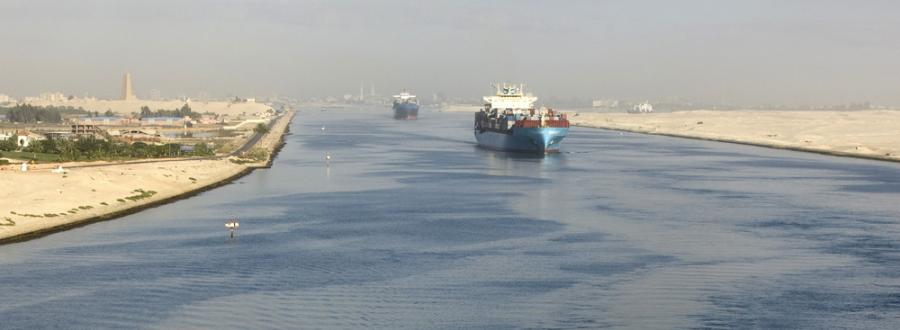
“Why is the government doing this to us?” Even the government of an enemy country wouldn’t do this to us,” said MP Hany Khader on Monday, calling for the government to resign if it intends to continue on its current track and prompting an interjection by the House speaker who requested the comment be struck from the record.
Khader’s outcry crests a rare wave of outspoken opposition that has swept the country this week — much of which has likewise been retroactively erased from public record — in response to a government proposal to create a fund under the Suez Canal Authority to “establish companies, invest, buy, sell, lease, rent, and utilize” the assets entrusted to it.
Arising from a lack of clarity over what these assets will consist of and how, precisely, they will be managed, fears the fund is a vehicle for “selling the Suez Canal” were voiced this week in quarters across the political spectrum: from Khader, an independent MP for Monufiya, who spoke out alongside a number of other MPs; to a former Suez Canal Authority official who retains a position as a presidential advisor; a former minister; and a coalition of opposition parties, all of whom have made public statements to condemn the proposal and voice concerns that the fund will compromise national sovereignty and control over the global shipping channel.
The canal’s status as a shared public asset is cemented not only through its historic nationalization in the 1950s, but also via the public investment project launched in the early years of President Abdel Fattah al-Sisi’s government. In 2014, citizens nationwide paid up LE54 billion (around $7 billion at the time) through special-issue national savings certificates that were mobilized to raise capital for a new, secondary channel to expand the canal’s capacity in a novel financing structure akin to crowdfunding.
The channel is also one of the few areas of Egypt’s economy to have benefitted from a succession of shocks to the global economy since 2020, beginning with the coronavirus pandemic and rounded off with Russia’s invasion of Ukraine. The Suez Canal Authority, the economic body responsible for managing the canal, has hiked shipping fees in multiple increments to benefit from its centrality to otherwise compromised world supply chains, bringing in revenue worth nearly LE197 billion, or around US$8 billion, this year.
With the state in dire need of foreign currency income to soothe a distressed balance of payments and a program of privatization via the national stock exchange proving a non-starter, the idea of maximizing revenues from the Suez Canal has been on the agenda for some time.
In February, Lieutenant General Osama Rabia, head of the Suez Canal Authority said that up to 20 percent’s worth of three of the authority’s seven subsidiary companies, all of which deal in shipbuilding, mooring, maintenance and other aspects of the canal’s economic ecosystem, would be offered to investors on the Egyptian Exchange.
The idea had evolved by the October convention of the National Economic Conference, a forum billed as a chance for the government and business actors to come together, when the president himself expressed support for establishing a fund under the Suez Canal Authority.
Revenues from the Suez Canal Authority, said President Abdel Fattah al-Sisi on October 25, return directly to the state budget via the Finance Ministry, leaving nothing for the authority itself. He asked Rabie and the finance minister to establish a fund to be fed with “the extra money that comes to the authority after it pays back LE68 million," in returns due on the 2014 investment certificates.
“Now the fund has LE70 billion or LE80 billion, and we are still at the beginning, in two-three years they will be LE200 billion or LE300 billion,” Sisi added.
But when amendments to the law regulating the Suez Canal Authority were discussed in the House of Representatives at the beginning of this week, though they gained preliminary approval, they were met with substantial dismay.
The bill was reported to lay out the framework for the creation of a new investment fund responsible for all economic and investment activity undertaken, with resources set to include the income from investing its assets as well as "a percentage of the Suez Canal Authority’s revenues, or the allocation of part of the authority’s surplus for the fund's benefit after agreement with the finance minister."
It would have its own budget, an authorized capital of LE100 billion and a paid-up capital of LE10 billion, according to the bill, and would be empowered to “establish companies, invest, buy, sell, lease, rent, and utilize” the assets entrusted to it.
Lawmakers were prompt to flag questions around the repurposing of the Suez Canal Authority’s revenues, which currently feed back into the national budget.
With a budget deficit of LE560 million, said Planning and Budgeting Committee secretary Abdel Moneim Imam, why would Egypt divert revenues from its most valuable source of foreign currency to create a new fund? “We are talking about the main source of foreign currency in Egypt, the Suez Canal, which has achieved nearly US$7 billion.”
“There are great fears among the public,” said MP Ahmed Farghaly, about the authority’s assets being sold off, while the move to siphon off some of the Suez Canal Authority’s revenues for investment via the fund looks “suspicious.”
Others raised concerns around the transparency of the financing structure, with economic funds enjoying independence from the state budget, which has in the past facilitated widespread corruption and been exposed as a conduit for the misspending of US$9.4 billion in 2012/13. The Suez Canal Authority itself is already an economic body, “with gross capital of LE 1 billion and 8,000 workers,” according to the authority’s website. It receives a small budget allocation and subsidization from the government each year, managing its economic activities independently and paying back its surplus revenues, taxes and royalties to the treasury.
“We have more than 7,000 funds and we are increasing them with a new fund that will be deducted from the general budget,” said Egyptian Social Democratic MP Ehab Mansour. Fellow party member MP Maha Abdel Nasser also opposed the draft law, saying that it contradicts the state’s efforts to provide greater transparency through the unified budget law issued earlier this year. “The Suez Canal is an economic body,” she said, “so why do we need to make a fund for it, or is this to appoint people in new places?”
The lawmakers’ objections were followed by the rarer statements of dissent by senior figures adjacent to the state, normally remarkable for consistently toeing the government line.
Former SCA head and current Presidential Advisor for Sea Ports Mohab Mamish claimed in Tuesday comments to the privately owned Al-Masry Al-Youm newspaper, removed from the site by Wednesday morning, that changes to the fund allowing foreign nationals a say in the canal’s management and changing the current system whereby the canal achieves sky-high profits would be impossible and would provoke a state of public panic given the level of emotional attachment to the canal, which he described as “dug twice” by Egyptians in reference to its creation and 2014 reinvention. Mada Masr was unable to reach Mamish for further comment.
Meanwhile, former Information Minister Osama Heikal wrote in a now-deleted post on his personal Facebook page that it is “very dangerous” that the Suez Canal Authority Fund will be permitted to establish companies, invest in securities and to “buy, sell and lease” assets. It’s unthinkable that any part of the Suez Canal be bought, sold or “neglected,” he continued, hoping that “national security services” would look into the bill before it reaches the president.
In response both SAC head and the Cabinet have come out with public statements to quell the public backlash.
In a statement published by the Cabinet’s Information and Decision Support Center on Tuesday, the Suez Canal Authority said, "The canal and its management will remain wholly owned by the Egyptian state and subject to its sovereignty, and the entire staff of the canal authority, including employees, technicians, and administrators, will remain Egyptian citizens."
The statement stressed that the aim of establishing the fund is "to increase the authority's ability to contribute to the sustainable economic development canal facilities through the optimal utilization of its funds."
In a long presser held on Thursday and broadcast on state TV, SAC head Osama Rabie said that, “revenues from the canal will not be deducted in favor of the [new] fund's resources, but rather the fund will depend on the surplus of the budget allocated to the authority, which is approved by the Finance Ministry,” though he evaded questions regarding the precise value of the fund’s budget. Rabie also assured that the fund would be subject to monitoring by the Central Auditing Organization.
It’s the absence of clarity around how much capital the fund will be steering that could be problematic, according to Mohamed Badrawy, a member of the House Planning and Budgeting Committee. Speaking to Mada Masr, Badrawy said that the idea of deducting part of the canal’s revenues and keeping them in the fund in order to reinvest it and generate higher returns is good and well-intentioned.
“But the devil is in the details,” he said, noting that the terms in the draft law are flexible and do not specify the percentage to be deducted from the canal’s surplus and paid into the new fund.
Under the current draft law, the basic system of feeding finances into the fund would be issued via presidential decree, based on a proposal put forward by the chairman of the Suez Canal Authority and the approval of the Cabinet, said Badrawy. Hisham Ibrahim, a Business Administration and Finance professor at Cairo University, likewise said that the government should specify the amount of money that will be dedicated to the fund instead of the state budget and should provide an alternative to compensate the public treasury.
Both commentators also agreed that the law should clearly stipulate that foreigners are not allowed a role in determining the fund’s investments, though foreign investors could be permitted a role in new projects like dredging plants or green hydrogen stations on lands surrounding the Suez Canal.
Assets that could currently come under the fund’s gift, according to Hisham Ibrahim, a professor of Business Administration and Finance at Cairo University, include any of the Suez Canal Authority’s assets, including its companies, arsenals, buildings, lands and resources. Under the new law, said Ibrahim, the authority could conclude cooperation agreements with sea port operators around the world and expand its shipping lanes, pointing out that the UAE, for example, is currently participating in a national project to develop Egyptian ports, led by the Ain Sokhna port, by expanding the lanes. Partners such as the UAE could enter into agreements with the fund to build new docks inside the canal and expand the existing ones to accommodate cargo from a greater number of vessels, Ibrahim added.
But there’s nothing currently in the law to prohibit foreign ownership of any of the canal’s assets, said Badrawy, pointing as an example to the law that bans foreign ownership of land in Sinai. Given that the law would allow for the fund to engage in various business interactions, including selling stock in its assets, this could allow for foreign nationals to purchase assets owned by the authority, the MP continued.
Final approval of the bill was postponed until the coming parliamentary session.

أخبار ذات صلة

How Iran may have found a new deterrence mechanism in its war with Israel
Over the course of two years of regional war, Al Jazeera’s Doha studio has been the epicenter of television coverage on the turbulent events that have touched nearly every country.…
Proposed formulas for new US military Red Sea foothold not acceptable to Egypt
Since March 15, the US has carried out nearly daily strikes on targets in Yemen
Leaked: US expects ‘return’ from Egypt after bombing Yemen to secure Suez shipping
The United States aims to extract compensation from Egypt in exchange for restoring Red Sea shipping
Ambitious dollar revenue growth targets dominate govt’s economic strategy for next 6 years
Govt-commissioned study suggests Egypt should raise US$300 bn in foreign currency revenues by 2030.
Your support is the only way to ensure independent, progressive journalism survives.
You have a right to access accurate information, be stimulated by innovative and nuanced reporting, and be moved by compelling storytelling. Subscribe now to become part of the growing community of members who help us maintain our editorial independence.
Join us