
Roof collapse at Qalyubiya construction site kills 4 workers, including 3 minors

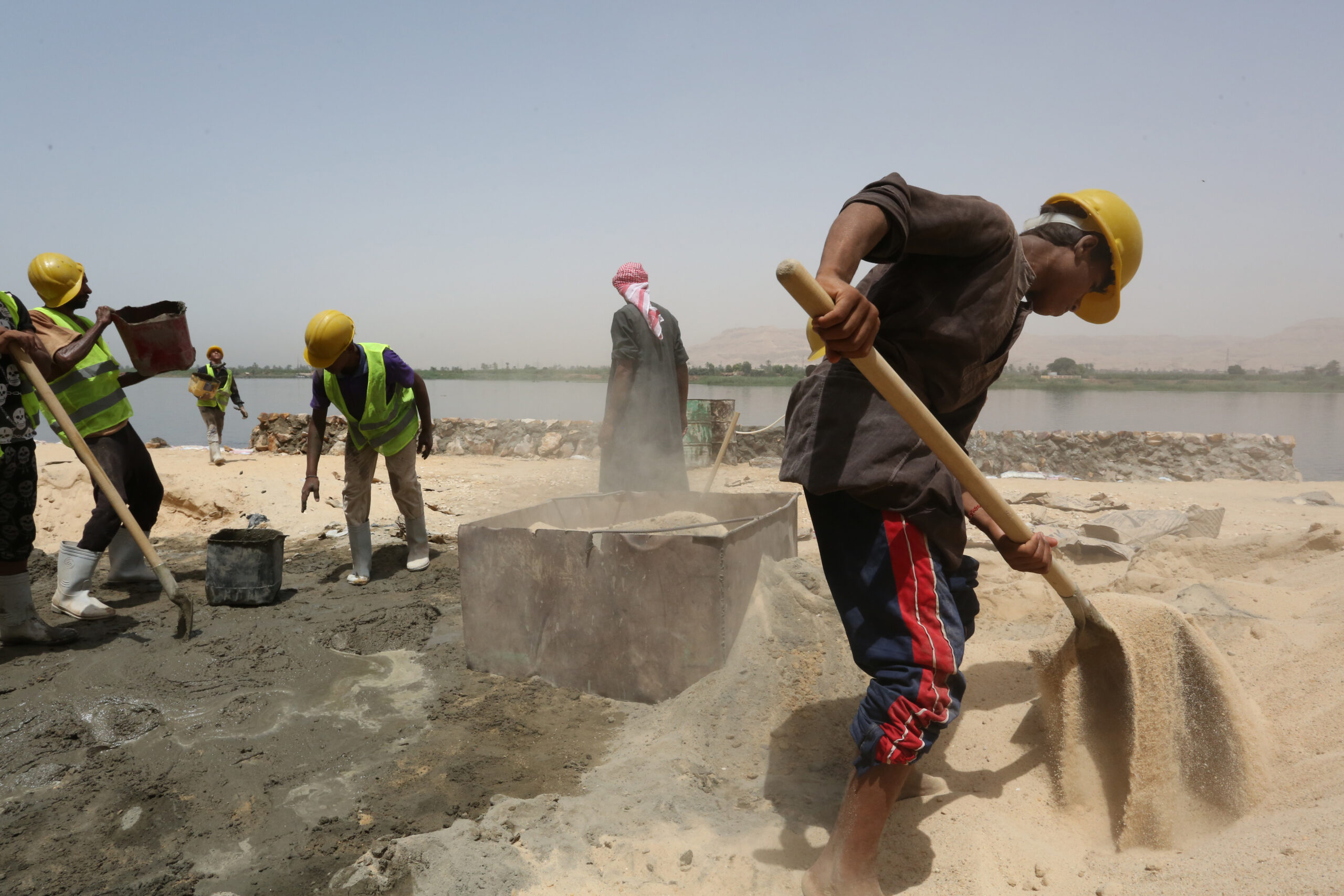
Four construction workers, including three minors, were killed and another one was injured when a roof collapsed on them during the construction of a plastic factory in Obour city, Qalyubiya on Sunday.
The five workers came from the village of Dahmasha Mashtool al-Souq, Sharqiya, and were all daily laborers on the factory construction project, one of the village residents confirmed to Mada Masr.
Sobhy Ibrahim, 16, Mohamed al-Shahat, 15, Mohamed Sayed Ibrahim, 15 and Hassan Salama, 33, were killed in the incident while Ibrahim Sobhy Aly, 32, was hospitalized after suffering asphyxiation when the roof caved in.
Labor organizer Amal Abdel Hameed told Mada Masr that workplace incidents of this kind are common, pointing to a lack of Labor Ministry oversight to ensure safety standards and the fact that workers on industrial sites, many of whom are minors, are not provided with contracts or insurance.
Media reports said that the Public Prosecution was investigating the incident while Qalyubiya Governor Ayman Attia ordered the governorate’s Labor Directorate to review all safety and security procedures at the construction site.
Abdel Hameed noted that the site should already have been inspected regularly according to the law. The current labor law contains a whole chapter on industrial safety, including periodic inspections and penalties for business owners who do not comply with safety regulations. “The Labor Ministry is supposed to inspect legally authorized locations every six months,” she said.
The ministry, however, does not maintain these regular inspections on registered workplaces to ensure that safety regulations are upheld, she said.
Head of the former independent irregular labor union, Mohamed Abdel Qader, noted to Mada Masr that the ministry does not have enough safety inspectors as none have been hired in years. A former head of the ministry’s National Center for Occupational Safety and Health and Work Environment Insurance said in 2020 that the ministry only has 600 inspectors, of whom only 420 to 450 do fieldwork.
Many worksites also fall completely out of the ministry’s scope given that around 50 to 60 percent of Egypt’s economy is informal.
Attia also reportedly ordered the directorate to disburse aid to the families of the workers who were killed in the incident at Obour City.
But Abdel Hameed said this could prove complex. With most irregular laborers, including the daily laborers who were employed at the plastic factory without contracts or insurance, the work relation has to be proven first in order to request compensation for a worker injured or killed in a workplace incident.
“We have to bring witnesses proving that the workers were working at the site and were exposed to a work-related accident, and that the accident was the result of the employer's negligence of industrial safety and health equipment at the construction site. This requires an investigation into their legal status and whether the site is regularly inspected by the Labor Ministry for industrial safety,” she explained.
And while acquiring compensation for a workplace injury or death can be done easily enough for any worker who has a contract and social insurance, according to Abdel Hameed, the real issue is that the majority of irregular laborers in Egypt, including most construction workers, do not have contracts and are not insured in any way.
Irregular workers are set to be included more clearly in the new draft labor law, Hameed said, but she added that the law is still missing stipulations for business owners to register irregular workers they employ at the ministry database and with social insurance.
“We have a market of mostly irregular laborers that we know little about, even their numbers,” she said.
There are no accurate official statistics on the number of irregular workers in Egypt yet. Official estimates previously ranged between 8 and 12 million, while Kamal Abbas, director of the Center for Trade Union and Workers' Services, previously told Mada Masr that the most conservative statistics, excluding many categories, indicate 13 million workers.
The numbers can far exceed these figures considering the size of the informal market. However, only 1,164,012 irregular workers were registered in the Labor Ministry databases in September.
Abdel Hameed noted that work-related accidents affecting irregular workers are common. She pointed to the almost-monthly recurrence of road accidents by vehicles carrying irregular agricultural laborers, mostly women and minors working with no legal protection, carried on the backs of trucks — which is also illegal — for long periods on their way to farmland in the desert.
She referred to an accident earlier this month in Minya, where a small truck carrying child laborers aged between 10 and 16 overturned on its way to a farm, killing eight of the children and injuring 27 more.
She also noted that such incidents are usually investigated as road accidents, in which the only questions are what happened and who is to blame, with compensation the only thing offered to the victims. Instead, they should also be investigated as violations of labor laws and child rights.
أخبار ذات صلة
Egypt’s 1st hourly minimum wage: An ‘announcement to global markets that our labor is cheap’
Sources express fear that the decision will formalize and entrench an already precarious situation
Helwan University administration seeks to downgrade contracts of over 300 employees
The new contracts offered to them would reclassify them as daily wage laborers, stripping them of
State water bill collectors in Qalyubiya suspend protest after company promises to meet demands
On Wednesday morning, workers’ representatives met with company chair

New labor law, same pro-business bias
A decade after initiating the process to draft a new labor law, the government announced on November 6 that the bill had finally been completed after incorporating several amendments. The…
Your support is the only way to ensure independent, progressive journalism survives.
You have a right to access accurate information, be stimulated by innovative and nuanced reporting, and be moved by compelling storytelling. Subscribe now to become part of the growing community of members who help us maintain our editorial independence.
Join us