
UPDATE: Ramy Shaath released from prison, forced to renounce citizenship
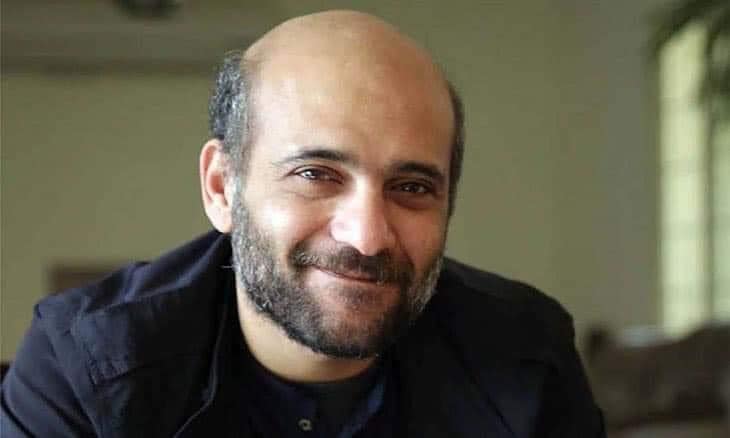
Egyptian-Palestinian activist Ramy Shaath was released from prison on Thursday night after being held for over 900 days in remand detention, according to a statement released by his family. Shaath, whose release was conditioned on the renunciation of his Egyptian citizenship, was flown directly to Amman upon his release, and he arrived in Paris on Saturday.
“If we are glad that the Egyptian authorities heard our call for freedom, we regret that they forced Ramy to renounce his Egyptian citizenship as a precondition for his release that should have been unconditional after two and a half years of unjust detention under inhumane conditions,” the family said in their statement.
Over the last six months, the National Security Agency had been communicating with Shaath's family to begin the process of Ramy’s citizenship renunciation, and to arrange for his deportation, according to a source informed of discussions around his release, who spoke to Mada Masr on condition of anonymity. Those procedures came to a head on January 1, when Shaath’s lawyer submitted an official document to the Supreme Administrative Court saying that he would drop his Egyptian citizenship, the source added.
French authorities had also announced they were informed that Shaath would be released.
Former MP Mohamed Anwar al-Sadat, who heads the International Dialogue Group, a lobby group that has negotiated with Egyptian authorities to secure the release of high profile detainees, announced on January 2 that Shaath was preparing to leave prison and the country soon, sparking wide media coverage.
Sadat thanked the Public Prosecution, the Interior Ministry and the Foreign Ministry in his statement, as well as the head of the France-Egypt Friendship Group in the French Parliament, and the French Embassy.
Shaath, a long-time activist for the Palestinian cause and the son of a senior political figure in the Palestinian Authority, had been detained since July 2019, when security forces surrounded his Garden City home and arrested him, according to his lawyer, Khaled Ali. Despite being held in remand detention for over two years, the publicly given reasons for Shaath’s detention never added up.
Following his arrest, Shaath was added to an investigation alongside a number of politically active figures who had been arrested a month before him, all of whom were participants in the formation of what was dubbed the Coalition for Hope in the media, a group that sought to engage in the 2020 parliamentary elections.
However, active investigations into the Coalition for Hope did not implicate Shaath and had been concluded a month prior to his arrest, according to his lawyer, Khaled Ali.
Nine months into Shaath’s detention, the Cairo Criminal Court ruled that Shaath, along with 12 others, be added to the national list of suspected terrorists. As with any citizen added to terrorism lists in Egypt, Shaath’s assets were frozen and he was banned from travel. Shaath only learned of the matter when the decision was published in the Egyptian Gazette two days after the ruling.
This meant that Shaath had been identified for investigation by the Public Prosecution, and a case was built against him and referred to the criminal court, which then made its decision, all without Shaath being informed or having the chance to submit a defense, said Ali. A lawsuit Ali submitted to appeal the ruling reached Egypt’s highest appellate court, with a final decision due in June of this year.
Shaath — who has been politically active in several progressive movements in Egypt since 2010 — co-founded in 2015 the Egyptian chapter of the Boycott Divestment and Sanctions movement, which seeks to exert public pressure on Israel to comply with international law.
Speaking of the true motives for Shaath’s arrest, a French official and an Egyptian official told Mada Masr that the activist was arrested after an official from an Arab country shared with Egyptian officials a recording of a meeting about the BDS movement that took place in Lebanon and in which Shaath and an official in the Egyptian government participated.
Throughout the two and a half years of Shaath’s imprisonment, his wife Celine Lebrun-Shaath, a French national who was deported from Egypt upon his arrest, led a longstanding public campaign for his release, while several diplomatic sources told Mada Masr that Palestinian officials, including Palestinian Authority President Mahmoud Abbas, undertook diplomatic efforts to mediate for Shaath’s release.
French President Emmanuel Macron also made a direct demand for Shaath to be released during a December 2020 press conference alongside President Abdel Fattah al-Sisi, held after bilateral talks at the Elysee Palace in Paris.
In January 2021, Lebrun-Shaath received permission to visit her husband in prison for the first time, over a year and a half after he was first arrested.
The Shaath family obtained Egyptian citizenship when Shaath’s father Nabil Shaath — a senior official under former Palestinian President Yasser Arafat and current President Mahmoud Abbas — was granted Egyptian citizenship by the late Egyptian President Gamal Abdel Nasser, for whom Shaath had worked.
Ramy Shaath’s family statement concluded, “we still remember and stand in solidarity with all of those who remain unjustly detained and we pray for the day when they too will be reunited with their loved ones.”

أخبار ذات صلة

Douma in new remand detention cycle as court rejects appeal
Prominent Egyptian activist and writer Ahmed Douma has entered a new cycle of remand detention, with a court rejecting an appeal against…

Politicians, students, 130 former prisoners call for Sisi to release Alaa Abd El Fattah immediately
Urgent appeals have mounted in the last hours for the immediate release of detained activist and wri
New terrorism charges leveled against Abouel Fotouh as he serves current prison sentence
Former presidential candidate and head of the Strong Egypt Party Abdel Moneim Abouel Fotouh was summoned on Wednesday by the Supreme State…

The weeks of dispute around reforms to the Criminal Procedures Code
Amid an ongoing political conversation around the use and abuse of remand detention to hold political detainees, legislators have dusted off a…
Your support is the only way to ensure independent, progressive journalism survives.
You have a right to access accurate information, be stimulated by innovative and nuanced reporting, and be moved by compelling storytelling. Subscribe now to become part of the growing community of members who help us maintain our editorial independence.
Join us