
Protests against Health Ministry escalate
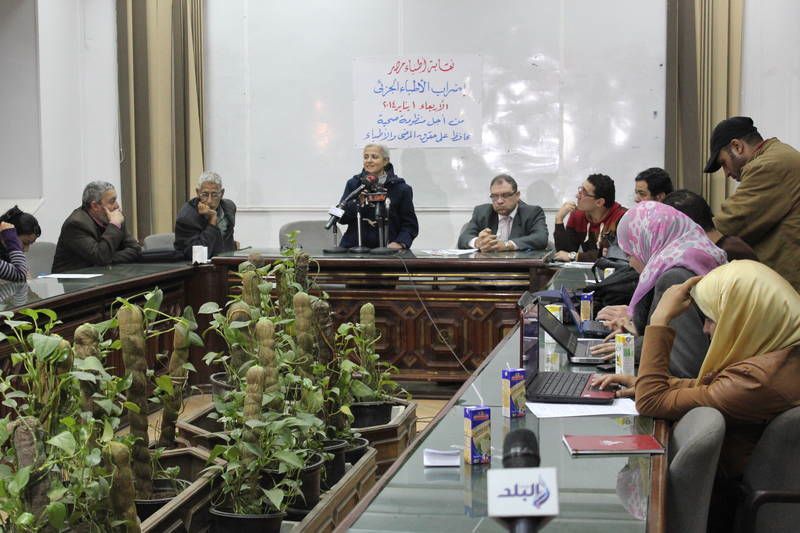
Egypt’s Health Ministry is facing a barrage of protest action from the Federation of Medical Professions - including the Doctors’, Pharmacists’ and Veterinarians’ Syndicates – who are calling for increased salaries and an improved national health care system, amongst other demands.
While unified strike actions initiated by the Federation of Medical Professions appear to have fallen apart for the month of January, each of the aforementioned syndicates is adopting its own escalatory measures in attempts to pressure the Health Ministry into meeting their demands. Strikes, protests, marches, lawsuits and collective resignation campaigns have all been proposed.
The Doctors’ and Pharmacists’ Syndicates moved to suspend their planned weekly Wednesday strikes for the rest of the month, while the Veterinarians’ Syndicate pushed ahead with a one-hour strike today.
Despite calling-off their partial strikes on Wednesday, some members of the Doctors’ Syndicate did stage a small protest outside the Health Ministry today, where they demanded improved salaries, safer hospitals and working conditions, along with an increased allocation for healthcare in the national budget.
The Doctors’ Syndicate had also filed a lawsuit against the health minister on Saturday, demanding suitable compensations for medical hazards and infectious illness associated with working at public hospitals. Monthly compensations for such hospital hazards amount to a meager LE19 to LE30 (around US$3 to $5.)
The state-owned MENA news agency reported that this lawsuit is associated with the death of Dr. Ahmed Abdel Latif, who recently died after contracting a serious respiratory illness while working at Banha Hospital’s intensive care unit.
Following deliberations at the Doctors’ Syndicate over the weekend, members moved to reschedule their partial strikes to February and March, with plans to escalate to two strike days per week in February, and three strike days per week in March.
Partial strikes by the Doctors’ and Pharmacists’ Syndicates, initially scheduled to take place each Wednesday throughout the month, were suspended in light of the relatively weak strikes that had taken place on January 1 and 8.
The Pharmacists’ Syndicate is still considering whether or not it will partake in these strikes planned for the next two months. The Nurse’s Syndicate, on the other hand, has openly denounced all calls for strikes.
The Doctors’ Syndicate issued a statement on January 18 clarifying that it “rejects complete work stoppages” on the basis that they “threaten the lives and health of patients.”
Dr. Mona Mina, Secretary General of the Doctors’ Syndicate, reiterated that partial strikes “would not affect hospitals’ emergency rooms, intensive care units, or urgent surgeries.”
Article 18 of Egypt’s new constitution states that “the denial of treatment in its various forms to any person in a case of emergency or serious threat to life is a criminal offense.”
Dr. Amr al-Shora, Board Member of the Doctors’ Syndicate, stated that this newly introduced provision “will not affect or criminalize our partial strikes, as we still provide emergency health care to all those who need it. This is part of our professional oath as doctors.”
Al-Shora went on to point out that this new constitutional article also stipulates that “the state shall commit to allocating a proportion of its budget to health care, of at least three percent of gross national product, to be increased gradually until it is consistent with global averages.”
He commented that this is a positive step forward, as the current health budget amounts to around 1.6 percent of GNP. “This means that state is responsible for doubling the health care expenditures from their current level.”
“However, we expect that the state will only start to implement these budgetary changes by the years 2016 or 2017,” al-Shora added.
Other members of the Doctors’ Syndicate have proposed further escalatory actions in hopes of pressuring the Health Ministry into improving their incomes and working conditions – such as collective resignations.
However, the Doctors’ Syndicate has not yet taken an official stance regarding this proposal for mass resignations.
Doctors employed at public hospitals have staged three nationwide strikes since 2011. Yet beyond receiving modest bonuses, their demands have largely been unmet.
The syndicate has reported that newly-employed doctors working for the Health Ministry earn a monthly salary of around LE1,000 (around $166.) The salaries of senior doctors rarely exceed double their starting salary.

أخبار ذات صلة
‘It doesn’t even cover transport,’ Medical interns demand higher stipends
Medical interns are calling for an increase in the monthly training stipends they receive during the obligatory two-year internships they undertake at…
Doctors say new law would criminalize reasonable medical error, call on politicians to intervene
A new bill that would alter the legal approach to medical malpractice is causing a stir among doctors. If passed, the bill…
Deterred from official healthcare, 26-yr-old dies after sex reassignment surgery
The committee that approves gender reassignment surgeries has not met in years
Lawmakers, their families receive privileged vaccine access ahead of priority groups
The prime minister ordered the Health Ministry to begin vaccinating MPs on April 11
Your support is the only way to ensure independent, progressive journalism survives.
You have a right to access accurate information, be stimulated by innovative and nuanced reporting, and be moved by compelling storytelling. Subscribe now to become part of the growing community of members who help us maintain our editorial independence.
Join us