
Press freedoms: More of the same

In the lead up to the June 30 protests that eventually led to the ouster of former President Mohamed Morsi, the government issued warnings it would shut down private satellite channels and restart investigations into journalists, the Committee to Protect Journalists said in a report released last week. |
“Within a week, those same sorts of measures would be turned against Morsi and the media that supported him,” the report said.
The 20-page report “On the Divide: Press freedom at risk in Egypt,” published by the New York-based CPJ, said that the playbook used by Morsi was adopted from his military predecessors, and has since been used by the military-backed government that replaced him.
Under Morsi, the report said, nearly 70 articles in eight different laws restricted freedom of expression and the freedom of the press, in addition to other tactics, used to intimidate journalists. Those included charged rhetoric, what could have been coordinated violence against journalists while in the field, the threat of lawsuits, and allowing protestors aligned with Morsi to threaten journalists.
The report has a special focus on the killing of Al-Hosseiny Abou Deif, who investigators said was shot at from a close range after being singled out by a laser pointer. Abou Deif was allegedly showing protestors outside the presidential palace a video of Muslim Brotherhood supporters on the rampage when he was shot in the head in December 2011.
Since Morsi was ousted, the report said, press freedoms have further been reduced. Five pro-Morsi stations were shut down in an order that cited “exceptional measures” and a military spokesperson said it was due to incitement to violence. The administrative court has not replied to the complaints of three of the channels that challenged the order’s legality.
The report, which was published before this past weekend’s high-profile attacks on journalists, noted a trend in which local media and political parties have made it harder for the press to perform its job.
“It is almost impossible for the media to operate freely and present professional journalism as both religious and nationalist forces produce polarizing narratives that reject the other side and escalate divisions and potential for armed confrontations,” the editor in chief of Al-Shorouk, Emad Eddin Hussein, told the researchers.
The government’s response has been to appoint a High Council for Journalism, but the report's authors assert that any state body would lack the appropriate independence to efficiently regulate the press while preserving freedoms.
Instead, the CPJ report gives 12 recommendations to Egyptian authorities, political parties, and news media, as well as the international community, which include legal reform and changing the discussion of the role of the press.

أخبار ذات صلة
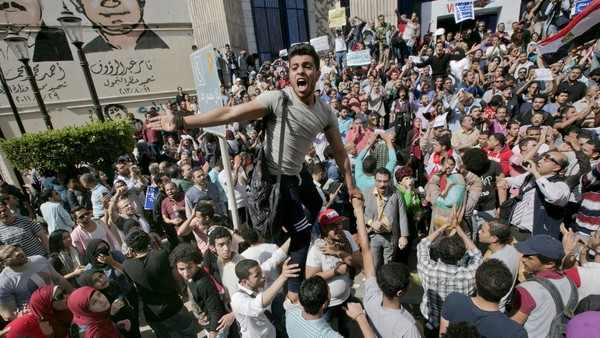
Presidency denies report claiming no tolerance for April 25 protests
Egypt’s presidency denied a report in Al-Shorouk newspaper claiming President Abdel Fattah al-Sisi said he has no tolerance for April 25 protests.…

Journalists turn to syndicate to protest courtroom bans
A group of journalists are preparing a petition requesting that the Journalists Syndicate refer to the Supreme Judicial Council after two judges decided to…
Journalist claims illegal detention, files complaint with prosecutor general
Al-Shorouk journalist Haitham Radwan filed a complaint at the prosecutor general’s office on Tuesday against Talbiya police station for his illegal detention.…
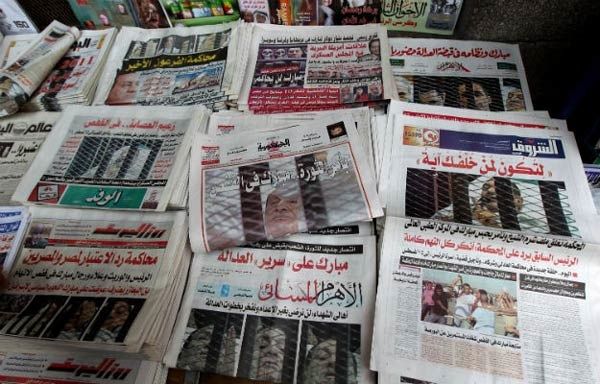
Egyptian media isn’t taking prisoners, state’s line is only line
The country’s media apparatus is displaying an iron-willed determination to uphold the state narrative. Within a week, two major television talk show hosts have been muzzled by their stations, and…
Your support is the only way to ensure independent, progressive journalism survives.
You have a right to access accurate information, be stimulated by innovative and nuanced reporting, and be moved by compelling storytelling. Subscribe now to become part of the growing community of members who help us maintain our editorial independence.
Join us