
‘No less dire than the hunger crisis’: Thirst imposed on Gaza deepens amid Israel’s ongoing blockade
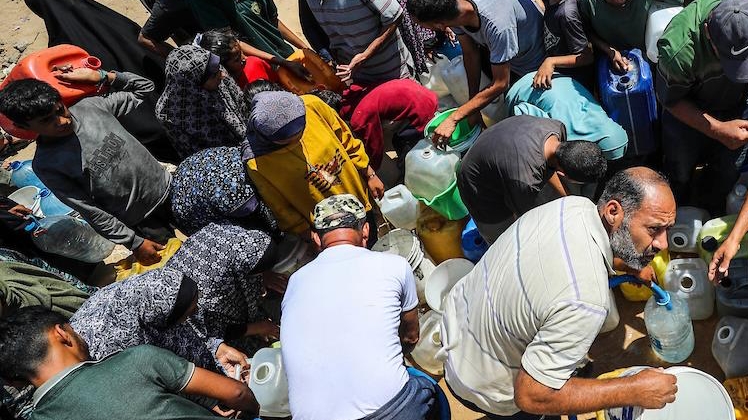
Tolin Hamada has taken on the responsibility of providing water to her family after her father suffered an injury.
She and her relatives are from northern Gaza, but they have been displaced to a tent to the west of Gaza City. To fetch water, Hamada takes a gallon container and walks until she finds a water truck where she can fill it, and haul it back through the streets in the summer heat to her tent.
She usually goes to the water trucks provided by the Saqya al-Maa initiative, but recently they’ve stopped sending a truck to her neighborhood.
“The water crisis is no less dire than the hunger crisis,” Mohamed al-Arabid, a coordinator with Saqya al-Maa in western Gaza City, told Mada Masr.
Five months into Israel’s siege on the Gaza Strip, water insecurity is worsening. Damage to infrastructure and a lack of fuel have rendered official services intermittent or absent, and while relief services are tiding a few families through the crisis, their reach is far from comprehensive and many are left trying to procure supplies at their own expense.
People staying in temporary accommodation across north and west Gaza told Mada Masr that they are limiting how much they drink daily to ration supplies, as severe thirst joins worsening starvation as a symptom of the Israeli blockade.
The municipality of Gaza City, once the strip’s most populous city and now crowded due to widespread displacement, is barely able to provide any services, municipality spokesperson Assem al-Nabih told Mada Masr.
Israeli forces have destroyed much of the city’s infrastructure. Around 75 percent of Gaza’s water wells have been destroyed, he said, and those that remain have sustained severe damage, dramatically slashing daily per capita water share.
Municipalities used to pipe or deliver water by truck to residents from one of three main sources: some supplies imported from Israeli state-owned company Mekorot; freshwater wells in which water quality has declined over the years due to resource limitations imposed by Occupation; and diesel-fuelled desalination stations.
The infrastructural challenge is compounded by the siege, Nabih said, as Gaza City municipality is facing a dire shortage of equipment and fuel.
Residents of Deir al-Balah have complained of all but absent supplies from the municipality, while other municipal networks are supplying water no more than once a week.
The lack of centralized supply has left many to fend for themselves in increasingly chaotic markets where prices are inflating exponentially — an example of conditions a researcher previously described to Mada Masr as part of a collapse of social order that Israel has brought about by prolonging its blockade.
Private vendors, the only option for many, have quadrupled their prices over the past three months. One private route to water supplies is unregulated wells — a resource that was already used somewhat before the current war. But now, some well owners are selling water within their neighborhoods, piping it over rooftops to avoid the energy required to pump it from ground level to upper floors. One thousand liters of this non-potable water now costs around 60 shekels, around US$18.
Even before Israel’s current genocidal war, 97 percent of Gaza’s water was impotable, according to World Health Organization standards, due to Israel’s 17-year-long blockade.
Akram Salam, who is taking shelter in Deir al-Balah with 14 relatives after their displacement from Rafah, is staying in an area of central Gaza that is not serviced by the municipality nor by trucks sent by relief initiatives.
Salman is forced to buy water for 160 shekels — around US$48 — per 1,000 liters, which is delivered by animal-drawn carts from filling stations. He then hauls the water in containers to a storage tank near their temporary home, which runs dry every five days.
To stretch the supply, the Salman family reuses water from washing food, dishes or hands to flush waste, amid the complete absence of safe water sources, Salman told Mada Masr.
The conditions worsen an already severe deterioration in hygiene reported by the United Nations, whose surveying in early July showed 97 percent of respondents reporting barriers to accessing hygiene products due to high costs and insufficient distribution.
For some neighborhoods, access to water is provided by citizen-run water truck initiatives that pass by periodically. Saqya al-Maa is one such initiative that relies on donations from activists outside the strip to cover the costs of purchasing and delivering water to displaced families, who depend on it for drinking, washing dishes, laundry and showering — though what they receive often barely meets their drinking needs.
But activists collecting funds and organizing such initiatives have noted that the process is becoming increasingly expensive.
The Saqya al-Maa water truck station that Hamada’s family once relied on has stopped operating, leaving Hamada to queue for hours in the heat to refill the container elsewhere.
Likewise, Suheir Abu Setta, also displaced from northern Gaza, leaves her tent every morning with a bucket in search of a passing water truck in the western neighborhoods, a long distance away from her tent.
Some water trucks have also been directly targeted by Israeli aerial fire in bombings that killed dozens of people as they queued for water.
Deliveries have become increasingly sporadic, and when trucks do arrive, they distribute tightly rationed amounts — barely enough to drink or meet the most basic needs — in an effort to conserve the dwindling supply.
Ibrahim Abu Afsh, displaced from the north to a camp in western Gaza, told Mada Masr at the end of July that the frequency of free water deliveries to the camp has dropped from once a day to once every four days. Each household now receives just two buckets of water per delivery, far from sufficient for the dozens of families sheltering in the camp.
Surveying by the UN water and sanitation agency reflects the residents’ experiences, showing at the end of July that 96 percent of households in the strip experienced moderate to high levels of water insecurity in early July, up from 93 per cent in June.
The agency reported that conditions were worst in the Gaza and North Gaza governorates, where 85 percent and 100 percent of respondents, respectively, said water access had deteriorated for most people in their communities during the first two weeks of July.
As prices soar and aid supplies dwindle, people have been forced to drastically reduce their water consumption.
Abu Afsh said he and his children can sometimes go a full day without a single sip of water.
أخبار ذات صلة

Hundreds of Gaza students demonstrate for right to study abroad
Hundreds of university students trapped in the besieged Gaza Strip gathered on Monday outside the Journalists Syndicate’s headquarters in western Gaza City…

In meeting with Board of Peace director-general, Hamas refuses UN disarmament plans until Israel commits to withdrawal
Hamas has refused to commit to the plans proposed by the United Nations for its disarmament, citing lack of advancement in Israel’s…

Israel agrees to limited reopening of Rafah border crossing — details pending
Israeli Prime Minister Benjamin Netanyahu’s office announced on Monday that it has agreed to a “limited reopening” of the Rafah border crossing…

Sisi touts ‘stabilization’ agenda at first Davos appearance in over 10 years
President Abdel Fattah al-Sisi advertised Egypt’s “stabilization” agenda in Davos on Wednesday, saying the country’s focus on steering away from regional conflicts…
Your support is the only way to ensure independent, progressive journalism survives.
You have a right to access accurate information, be stimulated by innovative and nuanced reporting, and be moved by compelling storytelling. Subscribe now to become part of the growing community of members who help us maintain our editorial independence.
Join us