
‘No choices’: Gaza City residents at a loss as Israel expands invasion, closing in on crowded western areas
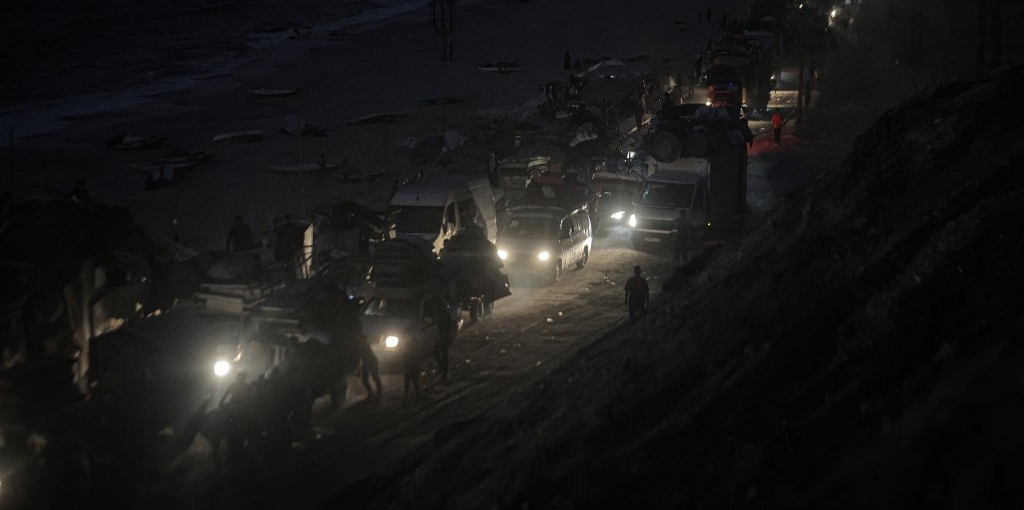
“Last night was the hardest of all nights,” Alaa al-Gaabary, a resident of western Gaza City’s Shati refugee camp, told Mada Masr on Tuesday morning.
The Israeli military announced that it had struck over 800 Hamas targets and hundreds of people across Gaza City on Monday night, as officials in Tel Aviv declared a new operational level of Gideon’s Chariots II — the plan in which they aim to seize control of the strip’s most populous metropole.
They are also seeking to displace a majority of the 1 million people living in the city.
Yet with only around 150,000 displacement movements recorded by monitoring agencies since mid-August, the invading military has staged gradual increases in its attack over recent days: first declaring the city’s entirety a military zone, and later ordering the whole population to evacuate before targeting high rise tower blocks.
Reacting to the steady progress of Israel’s oncoming violence toward crowded central and western areas of the coastal city, many of the residents Mada Masr spoke to on Tuesday expressed confusion and despair, as they contemplated the expense and pain of another relocation journey toward an uncertain future in the crowded areas of southern Gaza that are not equipped to host so many.
How the escalation played out for residents of the city
At least 53 individuals had been killed by Israeli gunfire and airstrikes on the city since dawn on Tuesday, the Palestinian News and Information Agency (Wafa) reported at midday.
Gaabary, whose Shati home is in the city’s westernmost coastal reaches, said she could hear the sounds of Israeli shelling, gunfire and explosions echoing throughout Gaza City on Monday night, “as if it were the very first days of the war.”
Expanded attacks on Monday evening saw Israeli forces advance steadily from three main directions, moving toward the city’s west, Palestinian journalist Mohanad Qeshta reported.
From the northeast and northern central directions, where large numbers of troops are stationed in Saftawy, and at the Jabalia al-Nazla neighborhood, forces advanced onto Sheikh Radwan.
They also advanced via Sudaniya in the northwest, closing off the crowded neighborhood — which connects central and western Gaza City to the Zikim crossing, where aid convoys are sometimes accessible.
A third advance took place into the Tal al-Hawa neighborhood in southeastern Gaza City, according to Qeshta, a front that builds on troop positions in Sabra and Zeitoun — they were among Israel’s first deployments when it began its ground invasion in August.
Qeshta said that Israeli forces targeted all three of these areas using remotely detonated explosives, violent airstrikes and artillery shelling, adding that Apache helicopters could be seen hovering overhead amid the constant gunfire.
Two Israeli military battalions are currently participating in the offensive, with a third due to join in the coming days, Israeli military correspondent Doron Kadosh tweeted on Tuesday.
The onslaught pushed many to evacuate frontier areas toward the less impacted western areas of the city. A resident of Abu Hasira Street, located in the city’s west, told Mada Masr that amid a surge in heavy raids and shelling by the Israeli military, many in Gaza City had evacuated to their neighborhood.
“[Abu Hasira Street and its surrounding area] have become crowded with displaced families who don’t know where to go,” they said.
The neighborhood was overcrowded despite the intense, unabated Israeli strikes intended to force people out.
What is the military aiming to achieve?
“Gaza is burning,” Israeli Defense Minister Israel Katz announced on Tuesday morning. “We will not back down until the mission is completed,” saying the goal was eliminating Hamas and releasing the Israeli hostages held by Hamas.
The elimination of Hamas, according to the Israeli military, entails the destruction of Gaza City’s tunnel infrastructure as well as that of “thousands of terrorists,” Kadosh reported on X.
The correspondent said that among the “terrorists,” the Israeli military has identified children aged 14-16, who “have recently been trained to carry out guerrilla operations against our forces.” The Israeli military said Tuesday that “hundreds of terrorists” have already been eliminated since the expansion of the assault on Gaza City.
As part of the operation, the Israeli military is also aiming to displace a vast majority of the city’s residents. Israeli military spokesperson Avichay Ardaee issued evacuation orders on Tuesday morning, instructing residents to flee through Rasheed street “as quickly as possible.” Evacuation leaflets were also dropped across the city.
Adraee directed people to go to Wadi Gaza, while the Israeli military stated that more tent accommodations have been installed in the designated “humanitarian zone” in Mawasi, Khan Younis.
But facilities are already overstretched in the area, which is already hosting 600,000 displaced people from across the strip.
Israel invaded the entirety of the Rafah Governorate and significant portions of Khan Younis earlier this year. Only around 13 percent of the strip is considered liveable, the rest is either designated as an active Israeli military zone or under evacuation orders, according to the Global Camp Coordination and Camp Management Cluster (CCCM).
‘No choices to be made in this matter:’ Gaza City residents feel they’re out of options
Despite the immense pressure of oncoming violence, many in Gaza City expressed confusion and dismay about the coming hours and days in the city under siege.
“People want to leave, they want to survive,” Gaabary said. “But they can’t find a place to go, they don’t have money and they don’t have anyone to get them there,” adding that she has considered evacuating with her family.
Gaza City residents attempting to move south out over the past weeks faced limited options: either stay in a tent in Mawasi, or an apartment in one of the last remaining residential buildings in central Gaza or Khan Younis. Both options would cost at least US$1,000 per family. Some people attempting to flee have even been forced to double back to their homes in frontier areas of the city under assault.
“There really are no choices: this is coercion and oppression,” Gaabary stressed. “Even if you leave, you don’t know whether you’ll live or die, whether you’ll be able to move on or be turned back — you have no idea what will happen to you.”
Of Gaza City’s population of around 1 million only around 142,387 people are estimated to have been displaced south since mid-August.
CCCM’s latest estimations, which cover the period from August 14 until September 14, contradict claims by the Israeli military that 300,000 Palestinians had already fled Gaza City before the ground offensive.
“Even the places they tell us to go to — who can actually go there?” Gaabary concluded. “Rafah is destroyed, Khan Younis is destroyed, and everywhere is overflowing with displaced people. Families are on the roads, scattered in the streets, with nowhere to set up their tents.”
أخبار ذات صلة

Hundreds of Gaza students demonstrate for right to study abroad
Hundreds of university students trapped in the besieged Gaza Strip gathered on Monday outside the Journalists Syndicate’s headquarters in western Gaza City…

In meeting with Board of Peace director-general, Hamas refuses UN disarmament plans until Israel commits to withdrawal
Hamas has refused to commit to the plans proposed by the United Nations for its disarmament, citing lack of advancement in Israel’s…

Israel agrees to limited reopening of Rafah border crossing — details pending
Israeli Prime Minister Benjamin Netanyahu’s office announced on Monday that it has agreed to a “limited reopening” of the Rafah border crossing…

Sisi touts ‘stabilization’ agenda at first Davos appearance in over 10 years
President Abdel Fattah al-Sisi advertised Egypt’s “stabilization” agenda in Davos on Wednesday, saying the country’s focus on steering away from regional conflicts…
Your support is the only way to ensure independent, progressive journalism survives.
You have a right to access accurate information, be stimulated by innovative and nuanced reporting, and be moved by compelling storytelling. Subscribe now to become part of the growing community of members who help us maintain our editorial independence.
Join us