
Military Academy excludes 179 imams from state employment for physical fitness criteria
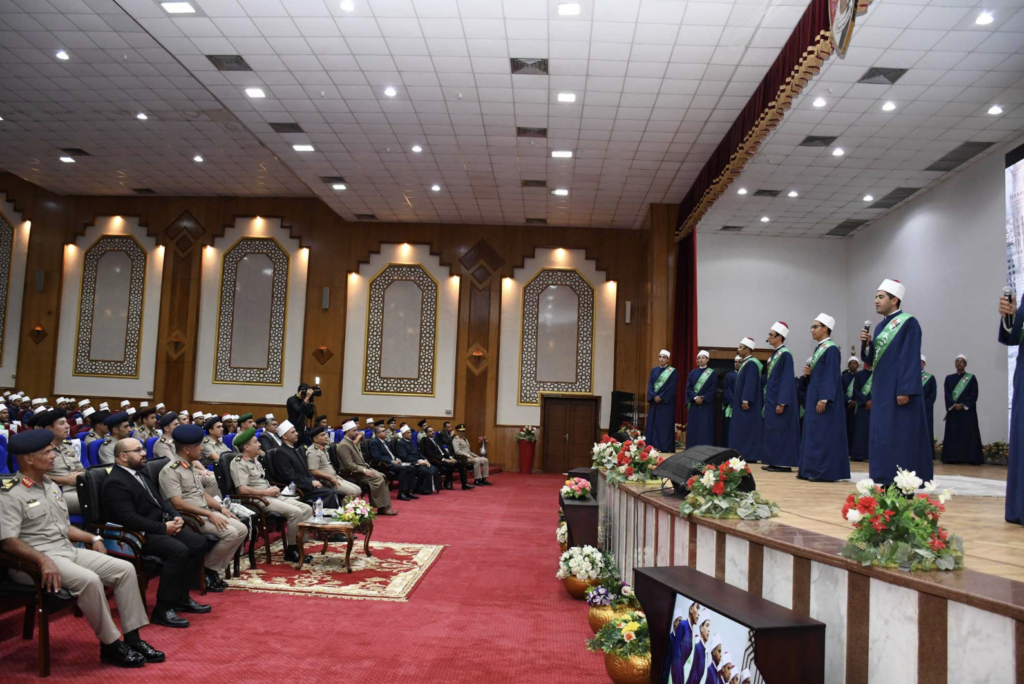
On the grounds of physical fitness criteria that were not announced as application requirements, the Military Academy barred 179 imams and khatibs from its mandatory training program for appointees to the Religious Endowments Ministry, according to ten excluded candidates who spoke to Mada Masr.
All of them had passed the hiring exams before being barred at the final stage of the process on the basis of their body weight, or their medical exemption from conducting mandatory national military service.
None of these conditions were listed in the ministry’s hiring announcement or regulations, nor were they applied to earlier cohorts who completed the Military Academy training sessions required before joining the ministry, the imams said.
The excluded imams sent telegrams to the presidency and filed complaints with the Religious Endowment Ministry.
When contacted by Mada Masr, Ahmed al-Nabawy, general secretary of the Supreme Council for Islamic Affairs at the Religious Endowments Ministry, said that admission or exclusion from the training course is “solely a matter for the Military Academy,” and that the ministry has no role in defining the academy’s selection criteria.
Nabawy represented the ministry on the personal qualification assessment panel — the last stage before admission to the academy’s program — but insisted that any questions about why candidates were accepted or rejected “must be directed to the academy,” citing “internal organizational matters and work confidentialities” between the two sides.
In February 2024, the ministry announced a competition process through which it would appoint 1,000 imams and khatibs. According to Ali*, an imam at a ministry-affiliated mosque in Qalyubia, more than 22,000 people applied, including hundreds qualified to doctoral level in theology and Islamic daawa.
Candidates, Ali said, sat two rounds of exams: the first was an online test in August 2024 via the website of the Central Agency for Organization and Administration, followed by an oral exam held in June 2025 at one of the agency’s premises in the Agouza neighborhood.
According to Ali, 22,500 imams across the governorates — currently working on temporary contracts or under a fixed fee arrangement — took the online exam, of whom 1,500 passed and moved on to the oral exam, conducted by a seven-member panel of senior ministry officials, followed by an interview with a psychologist.
According to the ten imams who spoke to Mada Masr, 580 candidates passed the oral exams. They were then told by the ministry that the appointment of their cohort, which was dubbed the Imam Hassan al-Attar cohort after the 18th-century sheikh of Al-Azhar, would depend on completing a six-month training program at the Military Academy.
The Military Academy training programs were first introduced as a mandatory hiring requirement for public sector employees through a circular sent out to ministries by the Cabinet’s secretary general at the time.
Ali said the process for the Imam Hassan al-Attar cohort began when Ramadan Afifi, the ministry representative overseeing the Military Academy training process, created a WhatsApp group that included all 580 imams and khatibs qualified for the course. “[He then] told us to report to the academy in September 2025 to register our details on its digital system and submit a set of documents relating to our families,” he recalled.
Two weeks after registering, the candidates were given appointments for medical testing, Ali said. All of them were screened across 11 clinics — including ophthalmology, dentistry and surgery — and underwent blood work and x-rays. One clinic specialized in height-weight measurements to determine physical condition.
Ali passed the medical stage and was called for a physical fitness test two weeks later. “The fitness exam was tough, just like what Military Technical College officers do,” he said. “A 1.5-kilometer run in six minutes, 40 push-ups, 40 sit-ups, 10 pull-ups and a 100-meter sprint in 12 seconds.”
After clearing the fitness test, he also passed a psychological evaluation, qualifying — along with 543 other candidates — for the personal qualification assessment stage, the final step before enrollment.
According to Ali, the interview panel was made up of Military Academy generals and a representative from the Religious Endowments Ministry, who asked questions about each candidate’s name, weight, height and military service status.
Ali and the nine other imams who spoke to Mada Masr, said they completed the personal assessment convinced that they had met every requirement for appointment. Yet they, together with 169 other candidates, did not find their names on the final list of 266 imams announced by Afifi as qualified to join the training program that began on January 3.
The ten imams said that although they had passed the medical examination — including the height-and-weight check — the academy cited excess weight of between three and five kilograms, and, in some cases, medical exemptions from military service as grounds for excluding them at the personal assessment stage. They argued that neither condition appears in any law or regulation, and that neither was applied to imams appointed over the past two years after completing the same training course.
Ali, who is 177 cm tall and weighs 80 kilograms — just three kilos above the academy’s ideal weight threshold — said that previous cohorts of ministry imams, along with other government hires who passed through the academy’s qualification program, were allowed a margin of 10-20 kg.
Mada Masr attempted to reach Afifi to ask about the fate of the appeals filed by those excluded, the rationale for introducing new admission criteria and whether these requirements were approved by the Religious Endowments Ministry. Afify did not respond by the time of publication.
Lawyer Khaled Ali said expanding the grounds for disqualifying citizens from public-sector employment to include criteria not rooted in legislation violates international labor standards. “There’s no such thing as barring someone from work because they’re diabetic or because they’re taller or shorter — that is discrimination,” he told Mada Masr.
Many are already working in government institutions without contracts — such as mosque imams who receive minimal stipends with no social or insurance protections — while the state imposes strict hiring barriers without legal justification, according to Ali.
Likewise, Saber Barakat, an International Labor Organization expert on labor relations and trade union freedoms, said the imams should now have recourse to the courts, stressing that excluding candidates from government posts based on their weight or height constitutes a form of discrimination prohibited by the Constitution.
But legal action might not yield the hoped-for outcomes. Hoda Nasrallah, a lawyer with the Egyptian Initiative for Personal Rights (EIPR), said that the Administrative Court has so far rejected appeals filed by the EIPR on behalf of dozens of teachers excluded from appointments at the Education Ministry on similar grounds in July 2023.
Those candidates were excluded for being overweight, pregnant or having recently given birth near the date of Military Academy testing, despite the fact that none of these conditions appeared in the competition announcement. The rulings, she said, now form a judicial precedent that weakens the likelihood of courts overturning similar decisions in future cases.
Mada Masr previously published, in April 2023, the circular issued by Cabinet General Secretary Major General Osama Saad and sent to ministries to convey presidential instructions obliging state bodies to put prospective public-sector employees through a six-month-long course at the Military College before employment.
An initial cohort of imams qualified to work for the Religious Endowments Ministry after completing a course at the Reserve Officers Faculty, as per a Defense Ministry announcement in 2023.
The Military Academy took over in 2024, with its next class graduating in April 2025 at a ceremony attended by President Abdel Fattah al-Sisi. According to a presidential statement at the time, the Military Academy for imams was introduced in line with Sisi’s directives to the Religious Endowments Ministry, “in coordination with relevant state institutions, including the academy, to develop a comprehensive training program aimed at strengthening the capabilities of imams at every level, improving religious discourse and communication tools, and particularly equipping them to counter extremist ideology.” The program, the statement said, was also designed to “deepen awareness and understanding of intellectual matters and contemporary challenges.”
During a visit to the academy on September 26, Sisi said that the goal of training judges, teachers, imams and other civil servants at the Military Academy is to “build, prepare and train radiant personalities.”
Sisi said he aims to train around 100,000 civil servants over the next decade, arguing that the benefits of the program will ripple outward to nearly half a million people through their families, and further through the wider influence of media and religious platforms in mosques and churches.
***
*Pseudonyms

أخبار ذات صلة
‘We inherited this land, we cannot leave it:’ Rent hikes over 170% threaten farmers on Endowments, Agricultural Reform land
The hikes come within a recent push to maximize state revenue and prioritize large-scale farming

Who controls Egypt’s religious institutions? How the top of the executive, security apparatus loom over the 3 institutional houses of Islam
Objection to the potential selling of endowments has primarily come from Al-Azhar.
Armed groups target Endowments Ministry imam in North Sinai
The killing of an imam under the purview of the Endowments Ministry by armed groups in Arish marks a new turn in…
Government continues attempts to extend control over mosques
The ministry claims a new decree will protect mosques from 'infiltration'
Your support is the only way to ensure independent, progressive journalism survives.
You have a right to access accurate information, be stimulated by innovative and nuanced reporting, and be moved by compelling storytelling. Subscribe now to become part of the growing community of members who help us maintain our editorial independence.
Join us