
Manufacturing popular pro-military protests: How Sudanese protesters are being brought out to call for a coup
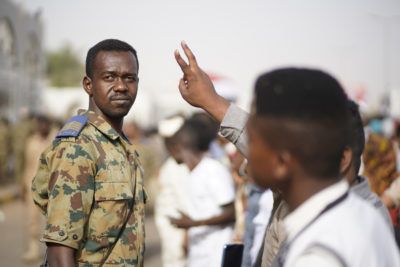
“We’re not leaving tonight until the statement comes out,” pro-military protester Toum Hajo chanted in front of a crowd that had gathered in front of the presidential palace in Khartoum on Saturday to call for the military to dissolve the transitional government.
Hajo, a member of the Charter of National Accord, a recently formed splinter faction of the civilian-rebel group coalition that had led the charge to oust former Sudanese President Omar al-Bashir from power in 2019, was one of hundreds of protesters that took to the streets over the weekend to demand the military take control of the country amid an increasingly public crisis in relations between the military and civilian wings of a post-revolutionary transitional government.
In the three days since crowds began amassing, the sit-in outside the palace has now grown into the thousands.
Demonstrators were transported to the capital from several states on Saturday aboard buses and trucks and, upon arrival, were not met by the usual heavy security presence in Khartoum’s government quarter.
Once they reached the center of Khartoum, demonstrators quickly set up a platform, from which protest leaders alternated between Islamist chants and calls for power over the country to be entrusted exclusively to the army.
“One army, one people. Down with the hunger government. Down with Hamdok,” protesters chanted, leveling criticism at Prime Minister Abdalla Hamdok, whom they blamed for the heightened economic distress caused by a blockade on Port Sudan, a vital gateway for the entry of strategic goods into the country.
However, not all of the “pro-military” protesters had the same degree of conviction as Hajo.
Hesham Khairallah, 15, a participant in Saturday’s demonstration, told Mada Masr that he did not know why he had been brought to the courtyard of the presidential palace by organizers in his neighborhood on the outskirts of the city of Omdurman to Khartoum’s west.
“I saw them pay 50,000 Sudanese pounds (about US$113) to the car driver, who gathered over 30 men, women and children for them to participate in a celebration, with most of them not knowing who organized it or what its aim was,” says Khairallah.
As demonstrators began arriving near the presidential palace, Mada Masr observed a number of cars surrounding the area and distributing food and water to participants, who ran toward them, while a number of people carrying bags were roaming around to disburse payments to some of the vehicles.
The protests this week come after Sovereign Council Chairman General Abdel Fattah al-Burhan and Vice Chairman Mohamed Hamdan Dagalo, known as “Hemedti,” threatened in recent months to mobilize members of the public in their support and from there, to dissolve the government.
Per the 2019 constitutional declaration, the military wing of the Sovereign Council was meant to hand over leadership of the transitional government to the civilian wing in May 2021, but a peace agreement reached with rebel groups last October pushed back the transfer of power indefinitely.
However, there is wide speculation that the military is unlikely to hand over the reins to the civilian wing. An Egyptian official briefed on the international consultations around the management of the crisis in Sudan told Mada Masr on condition of anonymity last week that some further “postponement” in the handover is expected, but that the exact length of time is still a subject of disagreement within Sudan’s ruling quarters and among international actors.
Several high profile security events have also laid bare the divide between military and civilian components of the government in recent weeks. After a putative “coup attempt” on September 21, civilian government members said they had warned military figures of apparent mobilization toward a coup after several leaks and speculation that a power grab was imminent appeared in Sudanese newspapers, but they said they were met with no answer and later found a security response being coordinated without them.
The fractures may also be within the military itself, according to a Sudanese military source.
“What happened on September 21 was a protest by senior army officers as a result of a general dissatisfaction with their financial situation compared to the Rapid Support Forces, whose members enjoy great financial privileges,” the source says.
Alongside the talk of a coup and a deteriorating security situation, Sudan’s economy, which had started out on a shaky path toward recovery after years of rampant inflation and scarcity due to the Bashir regime’s isolation from the world economy, was derailed once again last month as the main valve for trade entering the country, Port Sudan, was shut down on September 17 by Beja tribal leader Sayed Mohamed al-Amin Tirik. Amid an ongoing blockade, Tirik has raised the same demands as the military side: the dissolution of the current government, the appointment of a more competent one and a retraction of terms established in the Juba Peace Agreement, in which he and other groups in east, south and west Sudan were brought into a tentative consensus to cooperate toward the democratic transition.
On October 3, cracks also began to show within the civilian side of the government, predominantly made up of members of the Freedom and Change Coalition. Forming the “Freedom and Change Coalition 2” alliance, which later became the “Charter of National Accord,” a cast of figures from within the current government and the broader Freedom and Change Coalition splintered off, escalating against the civilian wing of the Sovereignity Council.
Among them are two major rebel groups, the Justice and Equality Movement, led by Finance Minister Jebril Ibrahim, and the Sudan Liberation Movement, led by Minni Arko Minnawi, the governor of the Darfur region.
The new alliance also includes a party established months ago, whose secretary general is director of the Sudanese Mineral Resources Company Mubarak Ardol; the Sudanese Baath Party led by Yahya al-Hussein; the head of the center track in the Juba Peace Agreement, Toum Hajo; and head of the northern track, Mohamed Sayed Ahmed Sir al-Khatim.
These moves were met with silence from the leaders of the civilian government — as well as the original Freedom and Change Coalition — who said that the only fair demand put forward by the splinter group was an expansion of the ruling coalition, which they said should be sorted out through dialogue instead of an alliance with the military.
In a statement on Friday, Hamdok told the public that tensions in the country were the result of an impasse over how to deliver a national project that achieves the goals of the revolution, attributing this to “deep divisions among civilians and among the military, as well as between civilians and the military.”
Hamdok held an emergency Cabinet meeting on Monday, where he proposed a committee be formed to find a solution to the crisis.
Meanwhile, the Freedom and Change Coalition is betting on the Sudanese public who mobilized to overthrow the Bashir regime, calling for demonstrations on October 21.

أخبار ذات صلة

Sudan Nashra: RSF launches drone campaign in Kordofan, Blue Nile, forces mass displacement | Clashes return to South Kordofan’s Dalang | Armed by RSF for Sudan battles, militias kill at least 169 in South Sudan, sources say | Rizeigat head leaves for Juba after Hemedti requests meeting amid tensions with RSF leadership
Subscribe to our Lens on Sudan newsletter here. The Rapid Support Forces launched drone campaigns in Kordofan and Blue Nile State this…
Sudan Nashra: Idris promotes govt roadmap as Quad prepares humanitarian truce proposal | WFP convoy, displaced civilians targeted in North Kordofan, dozens killed | Military launches operation to retake Bara
Subscribe to our Lens on Sudan newsletter here. As the US-led Quad on Sudan prepares to unveil a new proposal for a…

Sudan Nashra: Somalia enters Sudan-Egypt-Saudi Arabia-Turkey axis | Sudanese, Ethiopian sources: Trump’s GERD initiative could pave way for further talks with Addis Ababa | Western North Darfur operations cross into Chad again | RSF, military press toward major cities in Kordofan
Ambassadors of Sudan, Egypt, Saudi Arabia and Turkey arrived in Somalia’s newly created Northeast State this week to attend the inauguration of…
Sudan Nashra: Burhan’s Ankara talks cap December high-level diplomacy | Informal trade routes to Kordofan cut, driving shortages, price hikes | RSF campaign leaves hundreds of civilians killed, thousands displaced in North Darfur, fighting flares in North Kordofan
Transitional Sovereignty Council Chair Abdel Fattah al-Burhan’s visit to Ankara this week caps a tightly sequenced diplomatic push in December, following earlier…
Your support is the only way to ensure independent, progressive journalism survives.
You have a right to access accurate information, be stimulated by innovative and nuanced reporting, and be moved by compelling storytelling. Subscribe now to become part of the growing community of members who help us maintain our editorial independence.
Join us