
Hundreds of thousands turn out to affirm revolutionary demand of civilian rule in Sudan

In a round rejection of demonstrations earlier this week calling for a military-led government in Sudan, hundreds of thousands of protesters filled streets in the capital and major cities across the country to reaffirm the demands of the 2018 revolution for civilian rule.
“Surrender [power], Burhan. No to military rule. Civilian [government] is the choice of the people,” demonstrators chanted in Khartoum, referring to the Sovereignty Council Chairman Abdel Fattah al-Burhan, who has led a transitional government in the wake of the ouster of former President Omar al-Bashir in 2019.
The prospect of a civilian-led government in Sudan, one of the chief aims of the 2018 revolution, has come under increasing threat in recent months as the military wing of the transitional government has made overt statements about continuing to rule and has threatened delays in the constitutionally mandated handover of power to the civilian wing.
Thursday’s protests were organized after rival demonstrators took to the streets earlier this week in what were presented as populist calls for military rule. Beyond the facade of an organic protest movement, however, rebel groups newly aligned with the military worked to bus people into the capital in exchange for cash and goods.
Nonetheless, turnout for Thursday’s pro-civilian protests — which were organized by neighborhood resistance committees on the anniversary of the October 1964 revolution against the military rule of General Ibrahim Abboud — significantly eclipsed the pro-military protests from earlier in the week.
The Central Committee for Sudan Doctors said 37 people, including four gunshot victims, were injured in the protests, which the committee attributed to government forces.
Police stationed near the Parliament building in Omdurman on Thursday fired tear gas and rubber bullets toward pro-civilian protesters trying to cross a bridge linking Omdurman and Khartoum. Several protesters were injured, including one who was hit in the chest by a rubber bullet, according to a statement released by the doctors’ committee.
Pro-military protesters have staged a days-long sit-in outside the presidential palace in central Khartoum since earlier this week without facing any pushback from security forces.
Thursday’s pro-civilian protests did not play out in the capital alone. The resistance committees shared meeting points for protesters to convene in the south and east of Khartoum city, in Omdurman and Ombada to Khartoum’s northwest, Kosti and Rabak in the south of Sudan, Port Sudan in the east, Nuhud and Sennar in central Sudan, and in several states in Darfur.
Youssef Osman, 37, who joined the demonstrations in Central Darfur capital Zalingei, told Mada Masr he considered the crowds coming out in support of the civilian government and against military rule to be a “clear message” in rebuke of a pro-military sit-in that assumed position in front of the Khartoum presidential palace last week.
Per the 2019 constitutional declaration, the military wing of the Sovereign Council was meant to hand over leadership of the transitional government to the civilian wing in May 2021, but a peace agreement reached with rebel groups last October pushed back the transfer of power indefinitely.
Simmering tensions between the civilian and military proponents of the military council have become increasingly evident over recent months. Alongside the talk of a coup and a deteriorating security situation, Sudan’s economy, which had started out on a shaky path toward recovery after years of rampant inflation and scarcity due to the Bashir regime’s isolation from the world economy, was derailed once again last month as the main valve for trade entering the country, Port Sudan, was shut down on September 17 by Beja tribal leader Sayed Mohamed al-Amin Tirik.
Amid an ongoing blockade, Tirik has raised the same demands as the military side: the dissolution of the current government, the appointment of a more competent one and a retraction of terms established in the Juba Peace Agreement, in which he and other groups in east, south and west Sudan were brought into a tentative consensus to cooperate toward the democratic transition.
On October 3, cracks also began to show within the civilian side of the government, when a contingent of the civilian-rebel group coalition broke off to form the “Freedom and Change Coalition 2” alliance, which later became the “Charter of National Accord.”
At the head of this new military-aligned coalition are two major rebel groups, the Justice and Equality Movement, led by Finance Minister Jebril Ibrahim, and the Sudan Liberation Movement, led by Minni Arko Minnawi, the governor of the Darfur region. The two groups fought against forces aligned with former President Omar al-Bashir in Darfur but were brought into the transitionary government after the signing of the Juba Peace Agreement in October 2020.
The new alliance also includes a party established months ago, whose secretary general is Director of the Sudanese Mineral Resources Company Mubarak Ardol; the Sudanese Baath Party, led by Yahya al-Hussein; the head of the center track in the Juba Peace Agreement, Toum Hajo; and head of the northern track, Mohamed Sayed Ahmed Sir al-Khatim.
In his first comment on Thursday’s protests, Prime Minister Abdalla Hamdok said that “the masses have proven their adherence to peaceful means to achieve the slogans of the revolution, which is that a civilian government is the people's choice.”
“The masses delivered their voice and conveyed their message that there is no retreat from the goals of the revolution and there is no room for turning back from it,” the prime minister added in a short video he posted on Thursday. “I will continue to work on completing the transition institutions and achieving the goals and slogans of the revolution.”
Neighborhood committees have rejected any further power-sharing agreement with the military in their statement urging protesters to take to the streets.

أخبار ذات صلة

Sudan Nashra: Prosecution declares war on Civil Front for Democracy leaders | RSF imposes steep fees on Gezira farmers | Tribal mobilization in North Darfur
As the one-year anniversary of the war in Sudan approaches, the nation’s political and social fabric continues to come apart under the…
Sudan Nashra: Military push to connect White Nile, North Kordofan capitals | Turkish-Libyan mediation | Hamdok heads to Cairo
After almost a year of fighting that has displaced more than 10 million people, changed the urban landscape of Sudan’s capital, and…
Sudan Nasrha: Military achieves breakthrough in Omdurman | Rift between Civil Front for Democracy, Democratic Bloc | SPLM-N expels RSF from Habila
Sudanese Armed Forces secured major breakthrough in reestablishing control over Khartoum.
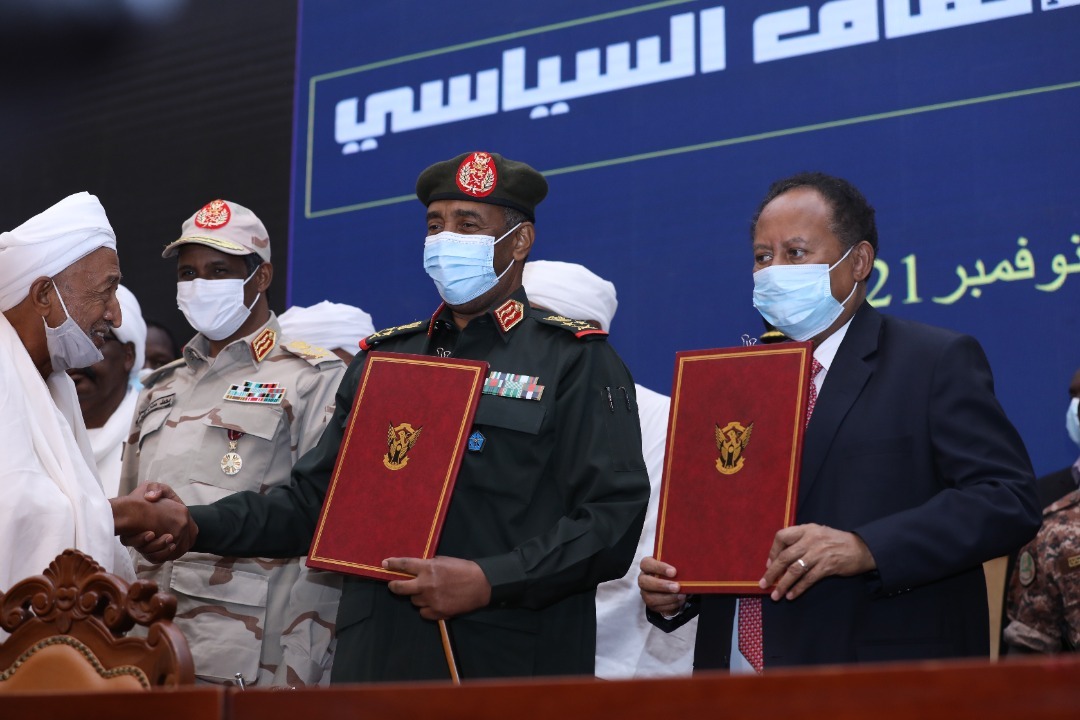
Hamdok reinstated as Sudanese prime minister in deal with Burhan, protest movement rejects deal
The deal also provides for the release of political prisoners arrested since the start of the coup
Your support is the only way to ensure independent, progressive journalism survives.
You have a right to access accurate information, be stimulated by innovative and nuanced reporting, and be moved by compelling storytelling. Subscribe now to become part of the growing community of members who help us maintain our editorial independence.
Join us